Freshly Printed - allow 10 days lead
Couldn't load pickup availability
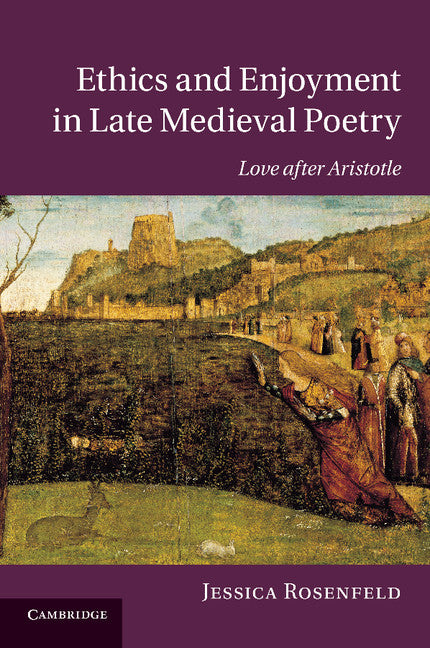
Ethics and Enjoyment in Late Medieval Poetry
Love after Aristotle
Provides an essential ethical history of courtly love poetry by tracing its engagement with the late medieval reception of Aristotelian ethics.
Jessica Rosenfeld (Author)
9781107696600, Cambridge University Press
Paperback / softback, published 21 November 2013
258 pages
22.9 x 15.2 x 1.4 cm, 0.35 kg
Jessica Rosenfeld provides a history of the ethics of medieval vernacular love poetry by tracing its engagement with the late medieval reception of Aristotle. Beginning with a history of the idea of enjoyment from Plato to Peter Abelard and the troubadours, the book then presents a literary and philosophical history of the medieval ethics of love, centered on the legacy of the Roman de la Rose. The chapters reveal that 'courtly love' was scarcely confined to what is often characterized as an ethic of sacrifice and deferral, but also engaged with Aristotelian ideas about pleasure and earthly happiness. Readings of Machaut, Froissart, Chaucer, Dante, Deguileville and Langland show that poets were often markedly aware of the overlapping ethical languages of philosophy and erotic poetry. The study's conclusion places medieval poetry and philosophy in the context of psychoanalytic ethics, and argues for a re-evaluation of Lacan's ideas about courtly love.
Introduction: love after Aristotle
1. Enjoyment: a medieval history
2. Narcissus after Aristotle: love and ethics in Le Roman de la Rose
3. Metamorphoses of pleasure in the fourteenth century Dit Amoureux
4. Love's knowledge: fabliau, allegory, and fourteenth-century anti-intellectualism
5. On human happiness: Dante, Chaucer, and the felicity of friendship
Coda: Chaucer's philosophical women.
Subject Areas: Literary studies: poetry & poets [DSC], Literary studies: classical, early & medieval [DSBB]