Freshly Printed - allow 7 days lead
Couldn't load pickup availability
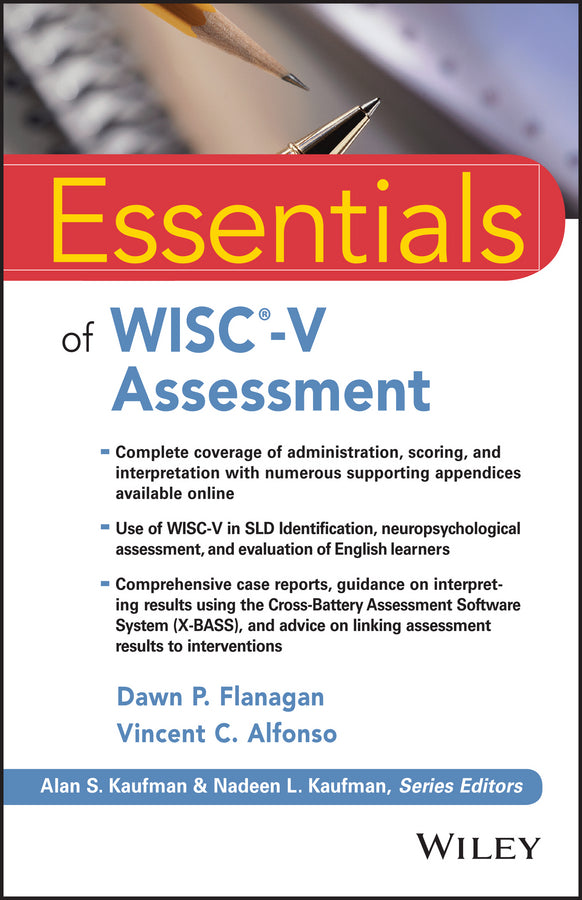
Essentials of WISC-V Assessment
Dawn P. Flanagan (Author), Vincent C. Alfonso (Author)
9781118980873, Wiley
Paperback / softback, published 7 April 2017
656 pages
21.1 x 14 x 4.6 cm, 0.68 kg
The comprehensive reference for informative WISC-V assessment Essentials of WISC-V Assessmentprovides step-by-step guidance for administering, scoring, and interpreting the Wechsler Intelligence Scale for Children (WISC-V). Packed with practical tips for more accurate assessment, this informative guide includes numerous case studies that illustrate a range of real-world issues. Special attention is devoted to the assessment of individuals who have significant learning difficulties, such as learning disabilities, and who speak English as a second language. The WISC-V is a valuable assessment tool, but it must be administered and scored appropriately to gain meaning from score interpretation. This book gives you an in-depth understanding of the WISC-V assessment and interpretive process to assist practitioners in: As the world's most widely-used intelligence test for children, the WISC-V is useful in diagnosing intellectual disabilities and specific learning disabilities, as well as in identifying giftedness. In this volume, sample reports demonstrate how WISC-V assessment results may be linked to interventions, accommodations, modifications, and compensatory strategies that facilitate positive outcomes for children. Essentials of WISC-V Assessment is the all-in-one practical resource for both students and practitioners. The book can be used on its own or with companion software (purchased separately) that provides a user-friendly tool for producing psychometrically and theoretically defensible interpretations of WISC-V performance, and may be used to develop interventions based on each child's strengths and weaknesses.
Acknowledgments xi Series Preface xiii Foreword xv One Overview of the WISC-V 1 Two How to Administer the WISC-V 53 Three How to Score the WISC-V 133 Four How to Interpret the WISC-V 167 Five Strengths and Weaknesses of the WISC-V 279 Six A Neuropsychological Approach to Interpretation of the WISC-V 287 Seven Use of the WISC-V in the Identification of Specific Learning Disabilities 405 Eight Illustrative Case Report 511 Nine Assessment of English Learners With the WISC-V 539 Ten WISC-V and Q-interactive 591 Epilogue Dorothea McCarthy Remembered 617 Appendices A–F can be accessed and downloaded from https://www.wiley.com/Essentials+of+WISC-V+Assessment-p- 9781118980996 Appendix A A Brief Overview of the Cattell-Horn-Carroll (CHC) Theory Appendix B Norms Tables for New WISC-V Clinical Composites Appendix C Case Reports Appendix D Form for Manifestations of Cognitive Weaknesses Appendix E Definition of Terms and Clarification of Concepts Used in the Dual Discrepancy/ Consistency Model of SLD and the Cross-Battery Assessment Software System (X-BASS) Appendix F Task Characteristics of WISC-V Subtests About the Authors 621 Contributors 622 Index 623
Susie Engi Raiford
W. Joel Schneider, Dawn P. Flanagan, and Vincent C. Alfonso
George McCloskey, Jamie Slonim, Robert Whitaker, Samantha Kaufman, and Naoko Nagoshi
Erin M. McDonough
Samuel O. Ortiz, Kristan E. Melo, and Meghan A. Terzulli
Carlea Dries, Ron Dumont, and Kathleen D. Viezel
Alan S. Kaufman
Gail Cheramie, Jamie Chaffin, and Robert Lichtenstein
Marlene Sotelo-Dynega
Subject Areas: Psychology [JM]