Freshly Printed - allow 5 days lead
Couldn't load pickup availability
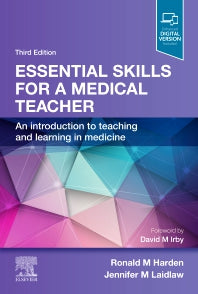
Essential Skills for a Medical Teacher
An Introduction to Teaching and Learning in Medicine
An ideal foundational resource for new and experienced medical educators
Ronald M. Harden (Author), Jennifer M Laidlaw (Author)
9780702078545
Paperback, published 25 June 2020
334 pages
23.4 x 15.6 x 2.2 cm, 0.54 kg
"In this book, the authors serve as readers' personal faculty development coaches. They provide a concise summary of the most important points a teacher must consider when engaging with learners and provide practical examples from their own personal and professional lives that add interest. The topics are relevant for all medical educators and are wonderfully integrated throughout the various sections and chapters of this faculty development resource. Although appropriate for any medical educator, this book is perhaps particularly valuable for those who are new to medical education or are working to improve their curricula and approaches to learning and assessment." Amy L. Wilson-Delfosse, PhD (Case Western Reserve University School of Medicine) – Doody’s Notes –Weighted Numerical Score: 95 - 4 Stars "Essential Skills for a Medical Teacher provides a concise introduction to the field of medical education and is a practical guide underpinned by educational models and theory which are introduced alongside each section. The book covers what constitutes a ‘good’ medical teacher, outcome-based education, organizing a learning programme, and methods of teaching and assessment in medical education. The overarching feel of the book is that it offers a sensible hands-on manual supported with an evidence base. It is not packed full of jargon and educational concepts are described simply. It is clear and concise throughout and it is easy to see how the authors’ tips, which ooze experience, could be translated into practice. A whistle-stop tour of each topic is provided, giving adequate information in most places for the novice. At some points there is a feeling of a need for slightly more information but instead of clogging this introductory book, at all points the authors direct the reader to other resources. Each chapter ends with a reflection section which encourages the reader to actively reflect on his/her own practice as a teacher and this can be used as a powerful self-evaluation resource. The book is perfectly suited to those just getting involved in medical education at more than just a basic level and would complement those beginning to undertake study in this field, such as a postgraduate certificate in medical education. I will certainly be using it when I begin mine." British Journal of Hospital Medicine, October 2012, Vol 73, No 10 "I am pleased to be able to review the book, Essential Skills for a Medical Teacher: An Introduction to Teaching and Learning in Medicine. It was a very enjoyable and informative reading adventure. The book is introduced with the basic premise that teaching is ‘‘a craft and a science,’’ and that through gaining a deeper understanding of their ‘‘work’’ all teachers can improve ‘‘from poor to good’’ or from ‘‘good to excellent’’ (page xix). With this in mind, I read the book with three sets of eyes: those of the novice or new instructor; of the clinician with some teaching experience, but little formal training in teaching; and, finally, with the eyes of an experienced instructor with training in medical education, the proficient or expert educator. In summary I felt that, Essential Skills for a Medical Teacher: An Introduction to Teaching and Learning in Medicine fulfills its mission to provide an excellent introduction as a well as a resource for advanced study. Harden and Laidlaw provide a common language and set of principles that should be as useful within chiropractic education as it is for education in other health professions. Read it to expand your own skills or, even better, read it with your colleagues to magnify the positive impact on chiropractic education." Extract from review in J Chiropr Educ 2013 Vol. 27 No. 1 "I would definitely recommend this book, especially to any people just setting out in medical education. The book's strengths are that it is an excellent first book for medical education. It is easy-to-read and to find the right areas within it, in fact it is easier to look in this book and find a subject area and then look up the listed 'further reading' suggestions than it is to look in more comprehensive texts. This book covers all the basic requirements of an educator setting out and has lots of ideas and tips to ensure the educator will succeed. The book is small and illustrated and therefore not daunting to dip into. It does not cover all the principles and theories of education, but it is so well-written that I wished that it did cover these as well, rather than having to read about these in more complex books! I found it really helped with my understanding of the subject and certainly clarified some areas that had been nebulous for years." BMA Book Awards Highly Commended citation: 2013
Perfect for new teachers in undergraduate, postgraduate, or continuing education, as well as more experienced educators who want to assess, improve, and gain new perspectives on teaching and learning, Essential Skills for a Medical Teacher is a useful, easy-to-read professional resource. This book offers a concise introduction to the field of medical education, with key coverage of educational models and theory that can help inform teaching practice. Clear illustrations and practical tips throughout make it an excellent starting point for those new to the field of medical education or who want to facilitate more effective learning for their students or trainees. Significant developments will be highlighted throughout this revised edition including the case for ‘just-in-time’ learning, the concept of learning and technology not learning technology, the implementation in practice of competency based education, a fundamental rethink of assessment with programmatic assessment and the development of the role of the student and the patient as partners in the education process.
Section 1 – Challenges you face as a teacher (Teaching responsibilities) Section 2 – Specifying what students should learn (Outcome-based education) Section 3 – Planning the curriculum (The Curriculum) Section 4 – Helping the student to learn (The teacher’s toolkit) Section 5 – Checking that the student has learned (Assessment) Section 6 – Planning for the future
Subject Areas: Medicine: general issues [MB]