Freshly Printed - allow 7 days lead
Couldn't load pickup availability
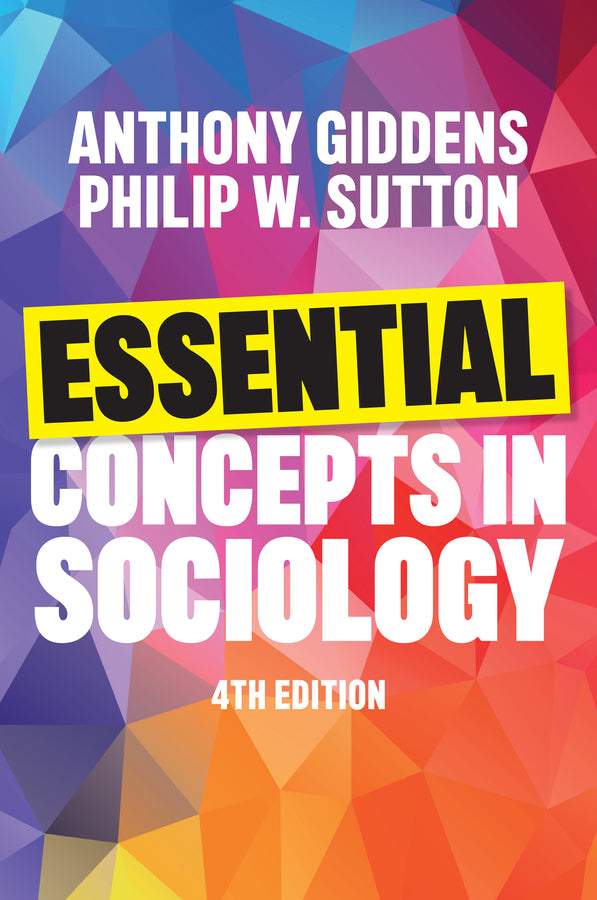
Essential Concepts in Sociology
Anthony Giddens (Author), Philip W. Sutton (Author)
9781509574179, Polity Press
Paperback / softback, published 27 March 2026
264 pages
22.6 x 15.2 x 2 cm, 0.386 kg
Social life is in a constant process of change, and sociology can never stand still. As a result, contemporary sociology is a theoretically diverse enterprise, covering a huge range of subjects and drawing on a broad array of research methods. Central to this endeavour is the use of core concepts and ideas which allow sociologists to make sense of societies, though our understanding of these concepts necessarily evolves and changes.
This clear and jargon-free book introduces a careful selection of essential concepts that have helped to shape sociology and continue to do so. Going beyond brief, dictionary-style definitions, Anthony Giddens and Philip W. Sutton provide an extended discussion of each concept which sets it in historical and theoretical context, explores its main meanings in use, introduces relevant criticisms, and points readers to its ongoing development in contemporary research and theorizing.
Organized in ten thematic sections, the book offers a portrait of sociology through its essential concepts, ranging from capitalism, identity and deviance to the digital revolution, environment, postcolonialism and intersectionality. Revised and updated for this new Fourth Edition, this book will be essential reading for those approaching sociology for the first time as well as anyone seeking a reliable guide for understanding a rapidly changing world.
Introduction Theme 2 Doing Sociology Theme 3 Environment and Urbanism Theme 4 Structure of Society Theme 5 Unequal Life Chances Theme 6 Relationships and the Life Course Theme 8 Health, Illness and the Body Theme 9 Crime and Social Control Theme 10 Political Sociology
Theme 1 Thinking Sociologically
Digital Revolution
Globalization
Modernity
Postcolonialism
Postmodernity
Rationalization
Society
Ideal Type
Qualitative/Quantitative Methods
Realism
Reflexivity
Science
Social Constructionism
Structure/Agency
Alienation
Environment
Industrialization
Migration
Risk
Sustainable Development
Urbanism
Bureaucracy
Capitalism
Consumerism
Division of Labor
Education
Organization
Religion
Class
Gender
Intersectionality
Patriarchy
Poverty
Race and Ethnicity
Social Mobility
Status
Community
Family
Life Course
Network
Sexuality
Socialization
Theme 7 Interaction and Communication
Culture
Discourse
Identity
Ideology
Interaction
Media
Public Sphere
Biomedicine
Medicalization
Sick Role
Social Model of Disability
Social Self
Anomie
Deviance
Labelling
Moral Panic
Social Control
Stigma
Authority
Citizenship
Conflict
Democracy
Nation State
Power
Social Movement
Subject Areas: Sociology & anthropology [JH]