Freshly Printed - allow 10 days lead
Couldn't load pickup availability
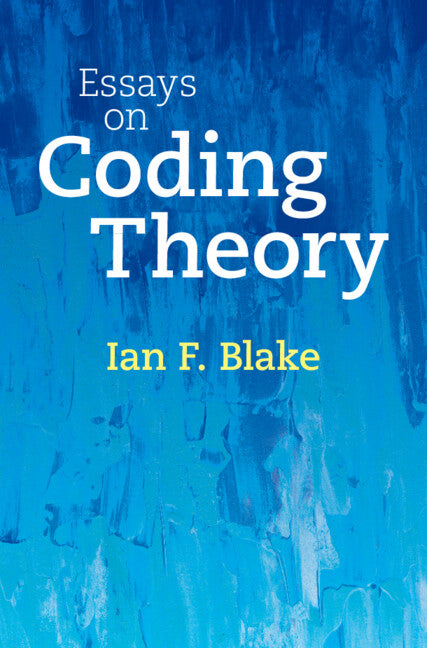
Essays on Coding Theory
Brief informal introductions to coding techniques developed for the storage, retrieval, and transmission of large amounts of data.
Ian F. Blake (Author)
9781009283373, Cambridge University Press
Hardback, published 14 March 2024
474 pages
23.4 x 15.8 x 3 cm, 0.84 kg
'Blake's book is truly commendable and deserves high praise. We highly recommend it to anyone interested in modern coding theory, as it covers a broad range of current topics with reasonable depth and clarity. This book would be particularly valuable for professors teaching graduate or specialized courses on coding theory, providing a solid foundation and extensive resources for both teaching and further study. The book remains an excellent resource and a highly engaging read. Its comprehensive coverage and clear explanations make it a significant contribution to the field, and it will undoubtedly be a valuable asset for both students and educators alike. In summary, Blake's work stands out as a pivotal text that not only enhances understanding but also fosters a deeper appreciation for the complexities and innovations in coding theory.' SIGACT News
Critical coding techniques have developed over the past few decades for data storage, retrieval and transmission systems, significantly mitigating costs for governments and corporations that maintain server systems containing large amounts of data. This book surveys the basic ideas of these coding techniques, which tend not to be covered in the graduate curricula, including pointers to further reading. Written in an informal style, it avoids detailed coverage of proofs, making it an ideal refresher or brief introduction for students and researchers in academia and industry who may not have the time to commit to understanding them deeply. Topics covered include fountain codes designed for large file downloads; LDPC and polar codes for error correction; network, rank metric, and subspace codes for the transmission of data through networks; post-quantum computing; and quantum error correction. Readers are assumed to have taken basic courses on algebraic coding and information theory.
Preface
1. Introduction
2. Coding for erasures and fountain codes
3. Low density parity check codes
4. Polar codes
5. Network codes
6. Coding for distributed storage
7. Locally repairable codes
8. Locally decodable codes
9. Private information retrieval
10. Batch codes
11. Expander codes
12. Rank metric and subspace codes
13. List decoding
14. Sequences sets with low correlation
15. Post-quantum cryptography
16. Quantum error correcting codes
17. Other types of coding
Appendix A: Finite geometries, linearized polynomials and Gaussian coefficients
Appendix B: Hasse derivatives and zeros of multivariate polynomials
References
Index.
Subject Areas: Discrete mathematics [PBD]