Freshly Printed - allow 8 days lead
Couldn't load pickup availability
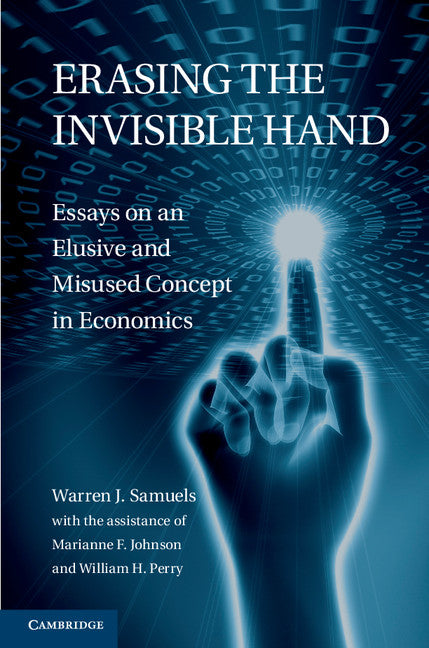
Erasing the Invisible Hand
Essays on an Elusive and Misused Concept in Economics
This book examines the use, principally in economics, of the concept of the invisible hand, centering on Adam Smith.
Warren J. Samuels (Author), Marianne F. Johnson (Assisted by), William H. Perry (Assisted by)
9781107613164, Cambridge University Press
Paperback / softback, published 14 April 2014
358 pages
22.9 x 15.2 x 2.5 cm, 0.53 kg
'Warren Samuels has written an authoritative, detailed and mainly original contribution to scholarship, ably assisted by his collaborators, Marianne Johnston and William Perry.' Gavin Kennedy, EH.net
This book examines the use, principally in economics, of the concept of the invisible hand, centering on Adam Smith. It interprets the concept as ideology, knowledge, and a linguistic phenomenon. It shows how the principal Chicago School interpretation misperceives and distorts what Smith believed on the economic role of government. The essays further show how Smith was silent as to his intended meaning, using the term to set minds at rest; how the claim that the invisible hand is the foundational concept of economics is repudiated by numerous leading economic theorists; that several dozen identities given the invisible hand renders the term ambiguous and inconclusive; that no such thing as an invisible hand exists; and that calling something an invisible hand adds nothing to knowledge. Finally, the essays show that the leading doctrines purporting to claim an invisible hand for the case for capitalism cannot invoke the term but that other nonnormative invisible hand processes are still useful tools.
Preface
1. Adam Smith's invisible hand and the Nobel prize in economic sciences
2. The political economy of Adam Smith
3. On the identities and functions attributed to the invisible hand
4. Adam Smith's History of Astronomy argument: how broadly does it apply? And where do propositions which 'sooth the imagination' come from?
5. Conceptual and substantive issues and problems
6. The invisible hand in an uncertain world with an uncertain language
7. The invisible hand as knowledge
8. The invisible hand and the economic role of government
9. The survival requirement of Pareto optimality
10. Conclusions and further insights.
Subject Areas: Philosophy of science [PDA], Economic history [KCZ], Political economy [KCP], History of ideas [JFCX], History of Western philosophy [HPC]