Freshly Printed - allow 4 days lead
Couldn't load pickup availability
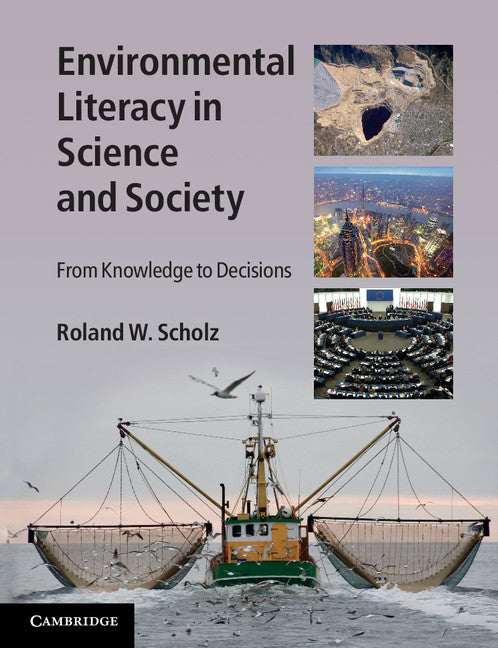
Environmental Literacy in Science and Society
From Knowledge to Decisions
Comprehensive review and transdisciplinary analysis of environmental literacy within the context of environmental science and sustainable development.
Roland W. Scholz (Author)
9780521183338, Cambridge University Press
Paperback, published 21 July 2011
656 pages, 216 b/w illus. 31 tables
24.5 x 18.9 x 2.9 cm, 1.3 kg
'Collective environmental and social problems constitute the dark side of increasing wealth for growing human populations. Roland Scholz strongly pleads for broad, multi- and interdisciplinary thinking about human-environment interactions. In [his] view, human and environmental systems cannot be separated. Rather, their interaction should be the central topic of our visions, methodologies and strategies. For natural scientists and technologists this requires a basic familiarity with how human individuals and societies function. For behavioral and social scientists it demands a solid appreciation of specific environmental problem domains. By consequence, actual policy-making should rest upon integrative teamwork. Scholz's book provides for an inspiring boost to our own environmental literacy, what it is and how it historically developed. It's a fruitful basis for extensive student courses.' Charles Vlek, Professor of Environmental Psychology and Decision Research, University of Groningen
In an era where humans affect virtually all of the earth's processes, questions arise about whether we have sufficient knowledge of human-environment interactions. How can we sustain the Earth's ecosystems to prevent collapses and what roles should practitioners and scientists play in this process? These are the issues central to the concept of environmental literacy. This unique book provides a comprehensive review and analysis of environmental literacy within the context of environmental science and sustainable development. Approaching the topic from multiple perspectives, it explores the development of human understanding of the environment and human-environment interactions in the fields of biology, psychology, sociology, economics and industrial ecology. The discussion emphasises the importance of knowledge integration and transdisciplinary processes as key strategies for understanding complex human-environment systems (HES). In addition, the author defines the HES framework as a template for investigating sustainably coupled human-environment systems in the 21st century.
List of boxes
Overview
Roadmap to environmental literacy
Part I. Invention of the Environment: Origins, Transdisciplinarity, and Theory of Science Perspectives: 1. What knowledge about what environment?
2. From environmental literacy to transdisciplinarity
3. Basic epistemological assumptions
Part II. History of Biological Knowledge: 4. Emerging knowledge on morphology, ecology, and evolution
5. From molecular structures to ecosystems
Part III. Contributions of Psychology: 6. Psychological approaches to human-environment interactions
7. Drivers of individual behavior and action
Part IV. Contributions of Sociology: 8. Traditional sociological approaches to human-environment interactions
9. Modern sociological approaches to human-environment interactions
Part V. Contributions of Economics: 10. Origins of economic thinking and the environment
11. Contemporary economic theories dealing with the environment
Part VI. Contributions of Industrial Ecology: 12. The emergence of industrial ecology
13. Industrial agents and global biogeochemical dynamics
Part VII. Beyond Disciplines and Sciences: 14. Integrated systems modeling of complex human-environment systems Roland W. Scholz, Justus Gallati, Quang Bao Le and Roman Seidl
15. Transdisciplinarity – a tool for environmental literacy
Part VIII. A Framework for Investigating Human-Environment Systems (HES): 16. The HES postulates
17. The HES framework Roland W. Scholz, Claudia R. Binder and Daniel J. Lang
18. Applying the HES framework Roland W. Scholz, Claudia R. Binder, Daniel J. Lang, Timo Smieszek and Michael Stauffacher
19. Comparing the HES framework with alternative approaches Roland W. Scholz and Fridolin Brand
Part IX. Perspectives for Environmental Literacy: 20. New horizons: environmental and sustainability sciences
Glossary
References
Index.
Subject Areas: Life sciences: general issues [PSA], Biology, life sciences [PS]