Freshly Printed - allow 7 days lead
Couldn't load pickup availability
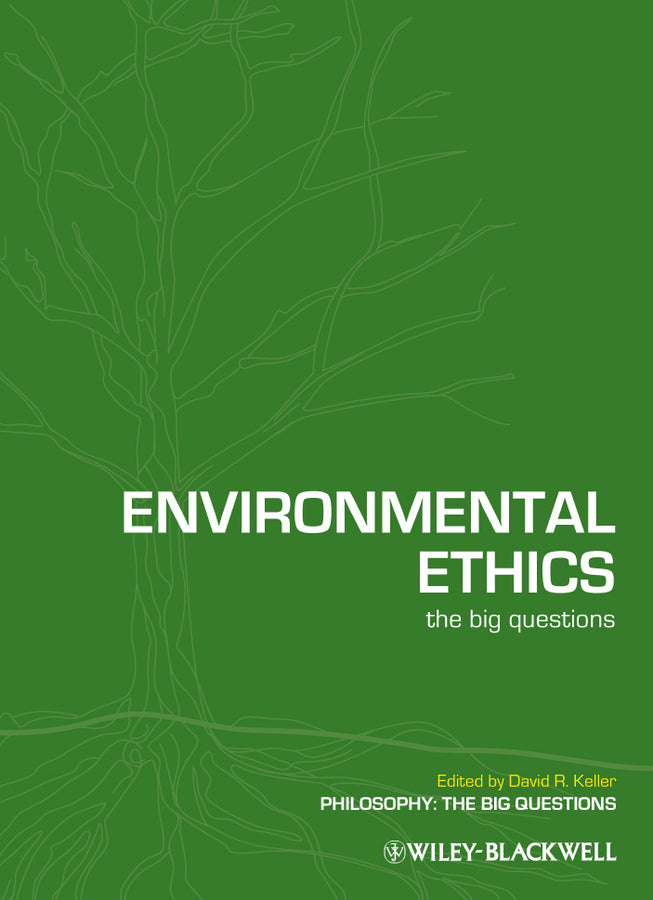
Environmental Ethics
The Big Questions
"Environmental ethics emerged in the mid-1970s and has been exponentially growing in volume and scope ever since. As a new century and a new millennium dawn, environmental ethics is the philosophy of the future, looking outward to partner with social and life sciences, history, law, business, and literature to provide synthesis instead of the finer and finer analysis of arcane "puzzles" that characterized the inward-looking philosophy of the previous century. In the new spirit of the new philosophy of the new century, this new textbook provides a synoptic overview of the field. The pioneers, living and dead, are all represented along with the emerging voices of the present. Unique to this volume is commentary by the leading lights in the field about why environmental ethics is a worthwhile study. That section, along with Keller's historical and thematic overview of the field, the best yet in any textbook, is worth the price of admission to the book."
—J Baird Callicott, Regents Professor of Philosophy, Chair, Department of Philosophy and Religion Studies, University of North of Texas
David R. Keller (Edited by)
9781405176392, Wiley
Hardback, published 26 February 2010
608 pages
25.3 x 19.7 x 3.6 cm, 1.315 kg
"Overall, Environmental Ethics: the big questions is an essential text for anyone looking to get to grips with key thinkers and their contributions to this new and burgeoning domain of ethics. Whilst challenging at times, the variety of papers in terms of both inter-disciplinary and difficulty is wide, allowing readers to effectively engage irrespective of background. Further, the layout is clear and general binding and page quality high to ensure this can remain an indispensable reference text for the future." (The Guardian, 26 November 2013) "Overall, Environmental Ethics: the big questions is an essential text for anyone looking to get to grips with key thinkers and their contributions to this new and burgeoning domain of ethics. Whilst challenging at times, the variety of papers in terms of both inter-disciplinary and difficulty is wide, allowing readers to effectively engage irrespective of background. Further, the layout is clear and general binding and page quality high to ensure this can remain an indispensable reference text for many years to come." (Economics & Philosophy, 1 November 2013) "The major strength of the book is the fact that it evolved from a classroom course on environmental ethics. The different texts are selected, put together and introduced by an experienced teacher. As such, the selection of text has already proven successful and instructive. The editor has put an enormous amount of effort into selecting the right texts, which took him, according to the preface, over four years." (Ethical Perspectives, 2011)
Through a series of multidisciplinary readings, Environmental Ethics: The Big Questions contextualizes environmental ethics within the history of Western intellectual tradition and traces the development of theory since the 1970s. Designed to be used with a web-site which contains a continuously updated archive of case studies:
environmentalethics.info
Preface xi List of Sources xiii Introduction: What is Environmental Ethics? 1 Part I Why Study Environmental Ethics? 25 George Sessions Emily Brady John Granrose Frederick Ferré J Baird Callicott Warwick Fox Eugene C Hargrove Ian Smith Isis Brook Holmes Rolston III Clare Palmer Kristin Shrader-Frechette Victoria Davion Greta Gaard Peter Singer James P Sterba Michael E Zimmerman Bryan G Norton Anthony Weston David Rothenberg Contributors to Part I 53 Part II What Is Anthropocentrism? 57 Introduction 59 1 Humans as Moral Ends 63 2 The Mastery of Nature 65 3 Nonhumans as Machines 69 4 Mechanistic Metaphysics 72 5 The Amoral Status of Nature 73 6 Nature as Economic Resource 77 7 Indirect Duties to Nonhumans 82 8 In Defense of Anthropocentrism 83 Part III What Is Nonanthropocentrism? 89 Introduction 91 9 Walking 93 10 The Wild Parks and Forest Reservations of the West and Hetch Hetchy Valley 96 11 Is There a Need for a New, an Environmental, Ethic? 98 12 Attitudes to Nature 103 13 Should Trees Have Standing? Toward Legal Rights for Natural Objects 110 14 The Varieties of Intrinsic Value 120 15 Value in Nature and the Nature of Value 130 16 The End of Anthropocentrism? 137 17 Is the Crown of Creation a Dunce Cap? 143 Part IV What Is the Scope of Moral Considerability? 147 Introduction 149 A Individualism (Polycentrism) 154 Hierarchical Biocentrism 154 18 Persons in Nature: Toward an Applicable and Unified Environmental Ethics 154 Psychocentrism 161 19 Animals as Subjects-of-a-Life 161 20 All Animals are Equal 169 Egalitarian Biocentrism 175 21 The Ethics of Respect for Nature 175 22 Kantians and Utilitarians and the Moral Status of Nonhuman Life 182 B Holism (Ecocentrism) 193 23 The Land Ethic 193 24 The Conceptual Foundations of the Land Ethic 201 25 Gaia As Seen Through the Atmosphere 211 C General Ethics 213 26 Developing a General Ethics (with Particular Reference to the Built, or Human-Constructed,Environment) 213 Part V What Are the Prominent Alternatives to Grounding Environmental Ethics in Axiology? 221 Introduction 223 A Environmental Psychologism 230 27 The Shallow and the Deep Ecology Movement 230 28 The Heart of Deep Ecology 235 29 The Deep Ecological Movement: Some Philosophical Aspects 240 30 Transpersonal Ecology 245 B Environmental Virtue Ethics 252 31 Environmental Virtue Ethics 252 C continental Environmental Ethics 257 32 On Environmental Philosophy and Continental Thought 257 D Political Environmental Ethics 268 Social Ecology 268 33 What Is Social Ecology? 268 34 Socialism and Ecology 275 Ecological Feminism 281 35 The Power and the Promise of Ecological Feminism 281 36 Feminism and the Philosophy of Nature 291 37 Nature, Self, and Gender: Feminism, Environmental Philosophy, and the Critique of Rationalism300 E Environmental Pragmatism 311 38 Beyond Intrinsic Value: Pragmatism in Environmental Ethics 311 39 Methodological Pragmatism, Pluralism, and Environmental Ethics 318 F Direct Action 327 40 Earth First! 327 The Ethics of Ecological Sabotage: An Exchange 333 41 Ecological Sabotage: Pranks or Terrorism? 333 42 Earth First! and The Monkey Wrench Gang 334 43 More on Earth First! and The Monkey Wrench Gang 335 44 Editor’s Response 336 Part VI What Are the Connections Between Realism, Relativism, Technology, And Environmental Ethics? 337 Introduction 339 A Subjectivist Environmental Ethics 342 45 Meta-Ethics and Environmental Ethics 342 B The Social Construction of Nature 352 46 How To Construe Nature: Environmental Ethics and the Interpretation of Nature 352 47 The Trouble With Wilderness 359 C Ecological Realism 362 48 Virtually Hunting Reality in the Forests of Simulacra 362 D Environmental Ethics and the Philosophy of Technology 368 49 Technology and the Limits of Nature 368 Part VII What Are the Connections Between Ecological Science and Environmental Ethics? 377 Introduction 379 50 Ecology – A Subversive Subject 380 51 What is Conservation Biology? 384 52 Environmental Ethics and Ecological Science 392 53 The Metaphysical Implications of Ecology 400 54 The Ends of the World as We Know Them 409 Part VIII What Are Some Ethical Dimensions Of Environmental Public Policy? 413 Introduction 415 A The Population/Poverty Debate 422 55 An Essay on the Principle of Population 422 56 Impact of Population Growth 426 57 The Ecological Necessity of Confronting the Problem of Human Overpopulation 434 58 How Poverty Breeds Overpopulation 443 59 More People, Greater Wealth, More Resources, Healthier Environment 447 60 Population: Delusion and Reality 454 61 A Special Moment in History 469 B Industrial Agriculture 476 62 Nature as the Measure for a Sustainable Agriculture 476 63 Putting Food Production in Context: Toward a Postmechanistic Agricultural Ethic 481 C Socioeconomic Environmental Justice 491 64 Environmental Justice for All 491 65 Just Garbage 501 D Environmental Ethics and Economic Policy 509 66 A Declaration of Sustainability 509 67 The Steady-State Economy 516 68 Making Capitalism Sustainable 525 69 The Ignorance Argument: What Must We Know to be Fair to the Future? 534 70 Environmental Justice and Intergenerational Debt 545 E Globalization 551 71 The Environmental Limits to Globalization 551 Part IX What Is the Future of Environmental Ethics? 559 72 The Future of Environmental Ethics 561 Bibliography 575
Thomas Aquinas
Francis Bacon
René Descartes
Isaac Newton
John Stuart Mill
John Locke
Immanuel Kant
Wilfred Beckerman and Joanna Pasek
Henry David Thoreau
John Muir
Richard (Routley) Sylvan
John Passmore
Christopher D. Stone
John O’Neill
Holmes Rolston iii
Mary Midgley
Chip Ward
Frederick Ferré
Tom Regan
Peter Singer
Paul W. Taylor
James P. Sterba
Aldo Leopold
J. Baird Callicott
James E. Lovelock
Warwick Fox
Arne Naess
Andrew McLaughlin
Arne Naess
Warwick Fox
Ronald Sandler
Steven Vogel
Murray Bookchin
James O’Connor
Karen J. Warren
Carolyn Merchant
Val Plumwood
Anthony Weston
Andrew Light
Dave Foreman
Eugene Hargrove
Edward Abbey
Dave Foreman
Eugene Hargrove
Robert Elliot
Roger J. H. King
William Cronon
Paul Shepard
David Rothenberg
Paul B. Sears
Michael E. Soulé
Mark Sagoff
J. Baird Callicott
Jared Diamond
Thomas Robert Malthus
Paul R. Ehrlich and John P. Holdren
Garrett Hardin
Barry Commoner
Julian L. Simon
Amartya Sen
Bill McKibben
Wes Jackson
David R. Keller and E. Charles Brummer
Robert D. Bullard
Peter S. Wenz
Paul Hawken
Herman E. Daly
John Elkington
Bryan Norton
Clark Wolf
David Ehrenfeld
Holmes Rolston III
Subject Areas: Philosophy [HP]