Freshly Printed - allow 7 days lead
Couldn't load pickup availability
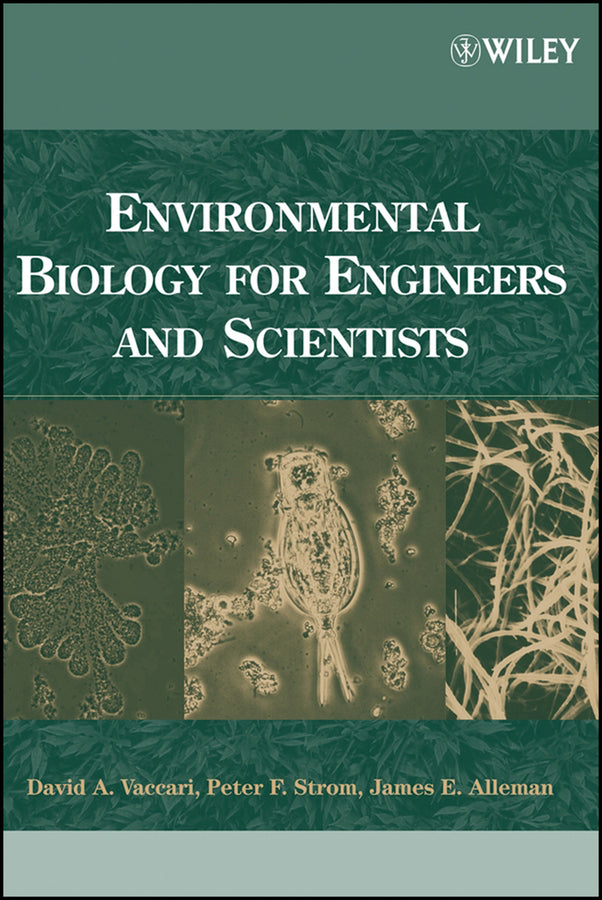
Environmental Biology for Engineers and Scientists
David A. Vaccari (Author), Peter F. Strom (Author), James E. Alleman (Author)
9780471722397, Wiley
Hardback, published 8 November 2005
960 pages
26.2 x 18.4 x 4.7 cm, 1.774 kg
"…this is a great text that covers a multitude of topics well, and is well written and comprehensive. I predict it will be popular as a text for environmental engineering students." (Journal of Hazardous Materials, August 2006) "…a resource for a two-semester course but can be used as an outline…for a single-semester course…highly recommended." (CHOICE, May 2006) "...attempts to cover a wide range of biology without making it tedious to those working outside the area...an important reference for practicing environmental professionals…" (Journal of American Water Works Association, April 2006) "Based on a graduate level course designed to teach engineers to be literate in biological concepts and terminology, the text covers a wide range of biology without making it tedious for nonbiology majors." (Journal of the American Water Resources Association, February 2006)
The growth of the environmental sciences has greatly expanded the scope of biological disciplines today's engineers have to deal with. Yet, despite its fundamental importance, the full breadth of biology has been given short shrift in most environmental engineering and science courses.
Filling this gap in the professional literature, Environmental Biology for Engineers and Scientists introduces students of chemistry, physics, geology, and environmental engineering to a broad range of biological concepts they may not otherwise be exposed to in their training. Based on a graduate-level course designed to teach engineers to be literate in biological concepts and terminology, the text covers a wide range of biology without making it tedious for non-biology majors.
Teaching aids include:
* Notes, problems, and solutions
* Problem sets at the end of each chapter
* PowerPoints(r) of many figures
A valuable addition to any civil engineering and environmental studies curriculum, this book also serves as an important professional reference for practicing environmental professionals who need to understand the biological impacts of pollution.
Preface. 1. Perspectives on Biology. 2. Biology as a Whole. 3. The Substances of Life. 4. The Cell: the Common denominator of Living Things. 5. Energy and Metabolism. 6. Genetics. 7. The Plants. 8. The Animals. 9. The Human Animal. 10. Microbial Groups. 11. Quantifying Microorganisms and Their Activity. 12. Effect of Microbes on Human Health. 13. Microbial Transformations. 14. Ecology: the Global View of Life. 15. Ecosystems and Applications. 16. Biological Applications for Environmental Control. 17. The Science of Poisons. 18. Fate and Transport of Toxins. 19. Dose-Response Relationships. 20. Field and Laboratory Toxicology. 21. Toxicity of Specific Substances. 22. Applications of Toxicology. Appendixes. A: Physiochemical Properties of Common Pollutants. B: Biodegradability of Common Pollutants. C: Toxicological Properties of Common Pollutants. D: Standards for Exposure to Common Toxic Pollutants. E: Ambient Air Quality Standards. F: Unit Conversions and Physical Constants. G: The Elements. H: Periodic Table of the Elements. Index.
Subject Areas: Chemistry [PN]