Freshly Printed - allow 7 days lead
Couldn't load pickup availability
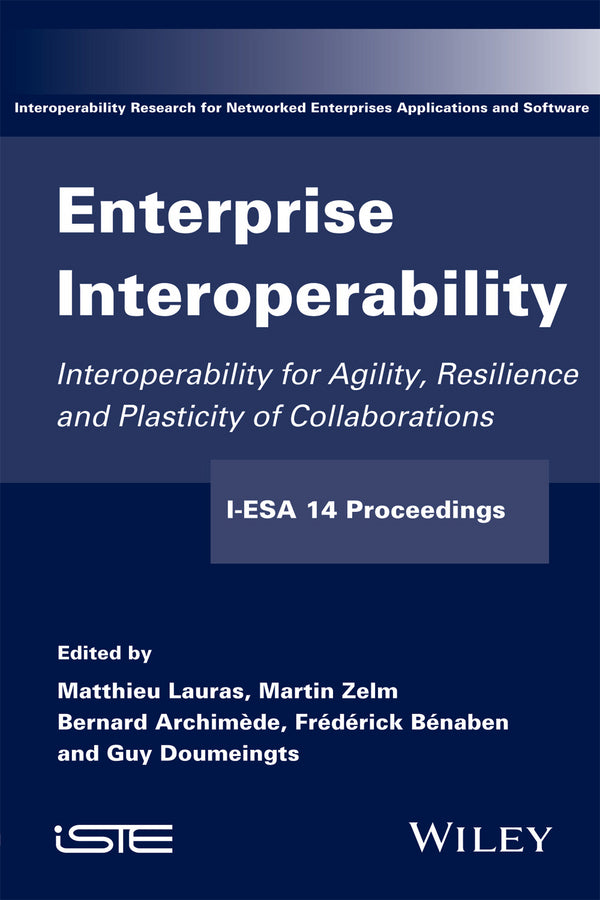
Enterprise Interoperability
Interoperability for Agility, Resilience and Plasticity of Collaborations (I-ESA 14 Proceedings)
Matthieu Lauras (Edited by), Martin Zelm (Edited by), Bernard Archimède (Edited by), Frédérick Benaben (Edited by), Guy Doumeignts (Edited by)
9781848217997, Wiley
Hardback, published 30 December 2014
368 pages
24.3 x 16.4 x 2.5 cm, 0.658 kg
Enterprises and organizations of any kind embedded in today's economic environment are deeply dependent on their ability to take part in collaborations. Consequently, it is strongly required for them to get actively involved for their own benefit in emerging, potentially opportunistic collaborative enterprise networks. The concept of “interoperability” has been defined by INTEROP-VLab as “The ability of an enterprise system or application to interact with others at a low cost in a flexible approach”. Consequently, interoperability of organizations appears as a major issue to succeed in building on the fly emerging enterprise networks. The International Conference on Interoperability for Enterprise Systems and Applications (I-ESA 2014) was held under the motto “interoperability for agility, resilience and plasticity of collaborations” on March 26-28, 2014 and organized by the Ecole des Mines d’Albi-Carmaux, France on behalf of the European Laboratory for Enterprise Interoperability (INTEROP-VLab). On March 24-25, co-located with the conference eight workshops and one doctoral symposium were held in four tracks complementing the program of the I-ESA’14 conference. The workshops and the doctoral symposium address areas of greatest current activity focusing on active discussions among the leading researchers in the area of Enterprise Interoperability. This part of the conference helps the community to operate effectively, building co-operative and supportive international links as well as providing new knowledge of on-going research to practitioners. The workshops and doctoral symposium aimed at exploiting new issues, challenges and solutions for Enterprise Interoperability (EI) and associated domains of innovation such as Smart Industry, Internet-Of-Things, Factories of the Future, EI Applications and Standardisation. These proceedings include the short papers from the I-ESA’14 workshops and the doctoral symposium. The book is split up into 9 sections, one for each workshop and one for the doctoral symposium. All sections were organized following four tracks: (1) EI and Future Internet / Factory of the Future; (2) EI Application Domains and IT; (3) EI Standards; (4) EI Doctoral Symposium. For each section, a workshop report is provided summarizing the content and the issues discussed during the sessions. The goal of the first track was to offer a discussion opportunity on interoperability issues regarding the use of Internet of Things on manufacturing environment (Workshops 1 and 3) on one hand, and regarding the potential of innovation derived from the use of digital methods, architectures and services such as Smart Networks (Workshops 2 and 4) on the other hand. The second track focused on particular application domains that are looking for innovative solutions to support their strong collaborative needs. Thus, the track developed one workshop on the use of EI solution for Future City-Logistics (Workshop 5) and one on the use of EI solutions for Crisis / Disaster Management (Workshop 6). The third track studied the recent developments in EI standardization. Two workshops were dedicated to this issue. The first one has proposed to focus on the management of standardization (Workshop 8) and the second one has chosen to work on the new knowledge on standardization developments in the manufacturing service domain (Workshop 9). The last track, the doctoral symposium presented research results from selected dissertations. The session discussed EI knowledge issues, notably in terms of gathering through social networks or Internet of Things and of exploitation through innovative decision support systems.
Preface xi Workshop 1. IoT Interoperability for Manufacturing: Challenges and Experiences 1 Report 2 Smart Industry Services in Times of Internet of Things and Cloud Computing 5 Designing and Executing Interoperable IoT Manufacturing Systems 15 Internet of Things Research on Semantic Interoperability to Address Manufacturing Challenges 21 Manufacturing Integration Challenges: Top-Down Interoperability and Bottom-Up Comprehensiveness Towards a Global Information Backbone for Smart Factory 31 An Improved Decision Support System in Factory Shop-Floor through an IoT Approach 37 Leveraging IoT Interoperability for Enhanced Business Process in Smart, Digital and Virtual Factories 43 Workshop 2. Future Internet Methods, Architectures and Services for Digital Business Innovation in Manufacturing, Health and Logistics Enterprises 49 Report 50 Future Internet Technologies and Platforms to Support Smart, Digital and Virtual and Business Processes for Manufacturing 53 Delivering Care in a Future Internet59 FITMAN Verification and Validation Method: Business Performance Indicators and Technical Indicators 64 Validation and Quality in FI-PPP e-Health Use Case, FI-STAR Project 71 Workshop 3. ICT Services and Interoperability for Manufacturing 81 Report82 Intelligent Systems Configuration Services for Flexible Dynamic Global Production Networks 85 Binding Together Heterogeneous Future Internet Services in Manufacturing Workplaces 91 Holistic, Scalable and Semantic Approach at Interoperable Virtual Factories 95 Predictive Industrial Maintenance: A Collaborative Approach 101 On Optimizing Collaborative Manufacturing Processes in Virtual Factories 108 Modelling Interoperability-Related, Economic and Efficiency Benefits in Dynamic Manufacturing Networks through Cognitive Mapping 115 Cloud-Based Interoperability for Dynamic Manufacturing Networks 122 A smart Mediator to Integrate Dynamic Networked Enterprises 128 Workshop 4. SmartNets – Collaborative Development and Production of Knowledge-Intensive Products and Services 135 Report 136 The Industrial Model of Smart Networks for SME Collaboration: Implementation and Success Stories 139 Towards a Conceptual Model of the Resource Base for Hyperlinking in Innovation Networks 146 Enhanced Incubators: Fostering Collaboration, Growth and Innovation 152 Application of the SmartNets Methodology in Manufacturing Service Ecosystems 158 Application of a Domain-Specific Language to Support the User-Oriented Definition of Visualizations in the Context of Collaborative Product Development 164 Workshop 5. Collaboration Issues for City-Logistics 171 Report – G. MACE-RAMETE, J. GONZALEZ-FELIU 172 Simulation-Based Analysis of Urban Freight Transport with Stochastic Features 175 Impacts of Urban Logistics on Traffic Flow Dynamics 181 A Basic Collaborative City Logistics’ Solution: The Urban Consolidation Centre 188 VRP Algorithms for Decision Support Systems to Evaluate Collaborative Urban Freight Transport Systems 196 The Last Food Mile Concept as a City Logistics Solution for Perishable Products: The Case of Parma's Food Urban Distribution Center 202 Supporting Decision for Road Crisis Management through an Agile and Collaborative Information System 208 Workshop 6. Applications of Advanced Technologies in the Context of Disaster Relief and Crisis Management 213 Report – A. CHARLES 214 Enhancing the Emergency Response Using an Event-Driven System 216 Designing Decision Support Systems for Humanitarian Organisations: Requirements and Issues 222 From Global to Local Disaster Resilience: The Case of Typhoon Haiyan 228 Workshop 8. Corporate Standardisation Management 235 Report – K. JAKOBS 236 Lack of Openness as a Potential Failure in Standardisation Management: Lessons Learnt from Setbacks in European Learning Technology Standardisation 238 The Individual in Standard Setting: Selection, Training, Motivation in the Public Sector 244 A Framework for the Management of Intra-Organizational Security Process Standardization 250 Standards Roles in Hacklin's Strategic Model: Cases in the Space Sector 256 Standardization Management and Decision-Making: The Case of a Large Swedish Automotive Manufacturer 261 Some Factors Influencing Corporate ICT Standardisation Management 267 Workshop 9. Standardisation Developments for Enterprise Interoperability and the Manufacturing Service Domain 273 Report – M. ZELM, D. CHEN 274 Towards Standardisation in Manufacturing Service Engineering of Ecosystem 277 Framework for Manufacturing Servitization: Potentials for standardization 283 How Can Existing Standards Support Service Life Cycle Management 290 An Approach to Interoperability Testing to Speed up the Adoption of Standards 295 A Common Vocabulary to Express Standardization Features: Towards the Interoperability of Industrial Data Standards 301 An Info*Engine-Based Architecture to Support Interoperability with Windchill System 308 Doctoral Symposium 315 Report – B. ARCHIMÈDE, J. LAMOTHE 316 Build Enterprise Relationship Network to Support Collaborative Business 318 Analysing Internet of Things to Feed Internet of Knowledge: Support Decision-Making in Crisis Context 325 On the Interoperability in Marine Pollution Disaster Management 331 A Framework for Characterizing Collaborative Networks of Organizations 337 Index of Authors 343
M. LAURAS, M. ZELM, B. ARCHIMÈDE, F. BÉNABEN, G. DOUMEINGTS
D. ROTONDI
M. SERRANO, P. DIMITROPOULOS
U. KANNENGIESSER, G. WEICHHART
P. COUSIN, M. SERRANO, J. SOLDATOS
V.K. NGUYEN
P. PETRALI
J. SOLA, A. GONZALEZ, O. LAZARO
S. GUSMEROLI, G. DOUMEINGTS
J. SOLA, A. GONZALEZ, O. LAZARO
C. THUEMMLER, T. JELL
G. DOUMEINGTS, B. CARSALADE, M. RAVELOMANANTSOA, F. LAMPATHAKI, P. KOKKINAKOS, D. PANOPOULOS
P. COUSIN, S. FRICKER, D. FEHLMY, F. LE GALL, M. FIEDLER
K. POPPLEWELL
R.I.M. YOUNG, K. POPPLEWELL, F.-W. JAEKEL, B. OTTO, G. BHULLAR
M. SESANA, S. GUSMEROLI, R. SANGUINI
G. PAVLOV, V. MANAFOV, I. PAVLOVA, A. MANAFOV
F. FERREIRA, A. SHAMSUZZOHA, A. AZEVEDO, P. HELO
D. SCHULLER, R. HANS, S. ZÖLLER, R. STEINMETZ
O.I. MARKAKI, S. KOUSSOURIS, P. KOKKINAKOS, D. PANOPOULOS, D. ASKOUNIS
D. STOCK, A. BILDSTEIN
C. DIOP, A. KAMOUN, E. MEZGHANI, M. ZOUARI, E. EXPOSITO
A. LAU
A. LAU, M. TILEBEIN, T. FISCHER
S.-V. REHM, S. GROSS
T.J. MARLOWE, V. KIROVA, M. MOHTASHAMI
M. HIRSCH, D. OPRESNIK, H. MATHEIS
T. RESCHENHOFER, I. MONAHOV, F. MATTHES
N. HERAZO-PADILLA, J.R. MONTOYA-TORRES, S. NIETO-ISAZA, L. RAMIREZ POLO, L. CASTRO, D. RAMÍREZ, C.L. QUINTERO-ARAÚJO
N. CHIABAUT, J.-M. SIGAUD, G. MARQUES, J. GONZALEZ-FELIU
L. FAURE, B. MONTREUIL, G. MARQUÈS, P. BURLAT
J. GONZALEZ-FELIU, J.-M. SALANOVA GRAU
E. MORGANTI, J. GONZALEZ-FELIU
G. MACÉ-RAMÈTE, F. BÉNABEN, M. LAURAS, J. LAMOTHE
A.-M. BARTHE-DELANOË, F. BÉNABEN, M. LAURAS, S. TRUPTIL
K. SAKSRISATHAPORN, A. CHARLES, A. BOURAS
T. COMES, B. VAN DE WALLE
T. HOEL
G. CANARSLAN
C. SILLABER, M. BRUNNER, R. BREU
K. BENMEZIANE, A. MIONE
A. FOUKAKI
K. JAKOBS
M. ZELM, G. DOUMEINGTS
D. CHEN, S. GUSMEROLI
M. FREITAG, M. HIRSCH, J. NEUHÜTTLER
A. BRUTTI, P. DE SABBATA, N. GESSA
A.-F. CUTTING-DECELLE, G.-I. MAGNAN, C. MOUTON, R.I.M. YOUNG
M. ANIS DHUIEB, F. BELKADI, F. LAROCHE, A. BERNARD
L. WANG, S. LIU, L. WU, L. PAN, X. MENG
A. SIRKO, S. TRUPTIL, A.-M. BARTHE- DELANOË, F. BÉNABEN
V. NICOLESCU, M. CARAIVAN, G. SOLOMON, V. CIUPINA
A. MONTARNAL, X. FERNANDEZ, J. LAMOTHE, F. GALASSO, C. THIERRY, F. BÉNABEN, M. LAURAS
Subject Areas: Electronics & communications engineering [TJ]