Freshly Printed - allow 7 days lead
Couldn't load pickup availability
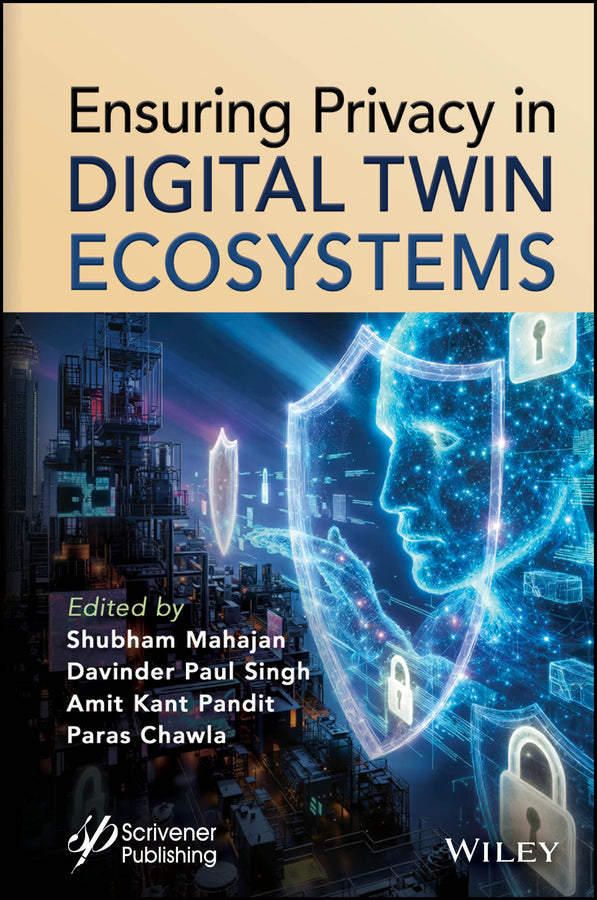
Ensuring Privacy in Digital Twin Ecosystems
Shubham Mahajan (Edited by), Davinder Paul Singh (Edited by), Amit Kant Pandit (Edited by), Paras Chawla (Edited by)
9781394383719, Wiley
Hardback, published 14 July 2026
576 pages
22.9 x 15.2 x 3.4 cm, 0.919 kg
Protect your organization’s virtual replicas from escalating cyber threats with this definitive guide to embedding privacy-by-design strategies and advanced encryption techniques into the core of your digital twin ecosystems. Digital twins, which create virtual replicas of physical entities, enable real-time monitoring, predictive analytics, and optimized operations, revolutionizing the way organizations approach efficiency, decision-making, and innovation. However, with the growing reliance on digital twins comes an escalating concern about privacy and data security. These ecosystems collect vast amounts of sensitive data, making them prime targets for cyber threats and privacy breaches. This book focuses on the intricate challenges and solutions related to maintaining privacy and data security in digital twin environments. It provides comprehensive insights into the security frameworks, technologies, and best practices that ensure the protection of digital twin environments, safeguarding them from breaches, misuse, and unauthorized access. The content will delve into a variety of topics, including privacy-by-design strategies, encryption techniques, data anonymization methods, and AI-driven privacy solutions specifically tailored for digital twin ecosystems. Case studies will be explored to highlight real-world examples of privacy vulnerabilities and how organizations overcame these challenges. By integrating technical discussions with legal and ethical frameworks, the book offers a holistic approach that caters to both practitioners and researchers at an intermediate-to-advanced level.
Preface xix 1 Balancing Innovation and Privacy: Navigating the Landscape of Digital Twin Ecosystems 1 1.1 Overview of Digital Twin Ecosystems (DTEs) 2 2 Digital Twins and Privacy: Navigating the Nexus of Innovation and Data Protection 23 2.1 Introduction 24 3 Privacy in Smart City Digital Twin 57 3.1 Introduction 58 4 Future Trends and Emerging Challenges in Digital Twins 101 5 The Future of Privacy in Digital Twin Ecosystems 137 5.1 Introduction 138 6 The Future of Privacy in Digital Twin Ecosystems: Risks, Technologies, and Regulations 175 6.1 Introduction 176 7 Privacy in the Age of Digital Twins 215 7.1 Introduction 216 8 AI and ML for Privacy-Preserving Digital Twins: Challenges and Opportunities 245 8.1 Introduction 246 9 Federated Explainable Hybrid Learning Framework (FEHLF) for Real-Time, Resource-Constrained Big Data Applications 273 10 Revolutionizing Healthcare: Digital Twins and the Role of Cyber Physical Systems in Modern Medicine 311 10.1 Introduction 312 11 Safeguarding Privacy and Security in AI-Powered Healthcare Systems 333 11.1 Introduction 334 12 Neuro-Symbolic AI for Cardiovascular Pharmacovigilance: A Holistic Approach to Drug-Induced Cardiotoxicity 367 12.1 Introduction 368 13 Cloud Computing in Education: Challenges, Limitations and Future Prospect 397 13.1 Introduction 398 14 Cloud Computing Security: Challenges and Solutions with Emerging Trends and Future Directions 413 14.1 Introduction 414 15 Author Royalty Distribution System Using Blockchain Technology 429 15.1 Introduction 430 16 LCR Circuit Analysis of Incident Angle Metamaterial Absorber for Double-Band Wi-Fi Applications in IoT-Based Sensors: A Mathematical Insight 471 16.1 Introduction 472 17 Digital Twin Technology in Education: Applications, Benefits, Challenges, Ethical Issues and Security Concerns 499 17.1 Introduction 500 18 Navigating the Future: Cloud Computing's Progress and Challenges in Healthcare 521 18.1 What is Cloud Computing? 522 Conclusion 531
Acknowledgement xxi
Manish Kumar Panday, Manish Baboo Agarwal, Manu Mehrotra and Seema Agarwal
1.2 Developing Digital Twins Further 3
1.3 Privacy Concerns Related to Digital Twins Ecosystem 7
1.4 Benefits of Decentralization 9
1.5 Encryption Techniques and Data Security 9
1.6 Compliance with Governance and Other Policies 10
1.7 Approaches to Shifting to Proactively Protective Measures for Digital Privacy 12
1.8 Conclusion 15
Ashima Kalra, Bhawna Tandon and Panchal Sandeep Govindrao
2.2 Digital Twins: Foundations and Use Cases 27
2.3 Privacy Threats in Digital Twin Environments 32
2.4 Legal and Regulatory Landscape 34
2.5 Privacy-Preserving Techniques for Digital Twins 37
2.6 Ethical and Societal Considerations 41
2.7 Case Studies and Real-World Challenges 44
2.8 Future Directions and Open Research Problems in Privacy-Preserving Digital Twin Systems 48
2.9 Conclusion 51
Lingaraj K., S. Supreeth, Rashmi Laxmikant M., Karthik Rao M. C., Lalit Garg and D. Viswanath Reddy
3.2 Understanding Smart City Digital Twins 61
3.3 Privacy Challenges in Smart City Digital Twins 68
3.4 Privacy by Design in SCDT Architectures 72
3.5 Legal and Ethical Frameworks 80
3.6 Case Studies 89
3.7 Future Directions 93
Kavita Arora, Neha Gupta and Wanqing Tu
Anandkumar Pardeshi and Sujata Deshmukh
5.2 Privacy Threats in Digital Twin Ecosystems 141
5.3 Adaptive Privacy-Preserving Mechanisms in Digital Twin Ecosystems 145
5.4 Decentralized Identity and User-Controlled Privacy in Digital Twin Ecosystems 149
5.5 Next-Generation Technologies and Privacy Implications in Digital Twin Ecosystems 153
5.6 Regulatory and Ethical Considerations in Digital Twin Ecosystems 156
5.7 Case Studies and Industry Applications of Privacy-Preserving Digital Twins 161
5.8 Future Research Directions in Digital Twin Privacy 165
5.9 Conclusion 167
Sandhya Soman, Suresh K., Gnanasankaran Natarajan and Sundaravadivazhagan Balasubramaniam
6.2 Digital Twin Ecosystem: An Overview 177
6.3 Privacy Challenges in the Digital Twin Ecosystems 185
6.4 The Future of Privacy in Digital Twin Ecosystems 195
6.5 Future Trends and Predictions 202
6.6 Conclusion and Research Directions 207
Shobha Chawla, Neha Gupta, Vijayalaxmi Rajendran and Akhilesh Tiwari
7.2 Security Threats to Digital Twins 220
7.3 Design of Data Privacy Law 229
7.4 Strategies for Securing Digital Twins 233
7.5 Privacy by Design 237
Raj Kishor Verma, Gaurav Agarwal and Nitin Pandey
8.2 Literature Review 257
8.3 Proposed Worked 260
8.4 Conclusion 268
8.5 Future and Scope 268
8.6 Opportunities and Challenges 269
Tamanna Sharma, Neha Arya, Chirag Sharma and Sonam Nagpal
Krishna Pandey, Suman Kumari, Rhythma Badola and Rahul Joshi
10.2 Cyber-Physical System 313
10.3 Evolution of Cloud Security Enabled DT 314
10.4 Effective Competence in Hospital Using DT 316
10.5 DT in Device Development 317
10.6 Medical Devices, Medical Testing and Treatments, and Medical Wearables 319
10.7 Regulatory Services 320
10.8 DT Frameworks in Healthcare 320
10.9 Cyber Flexibility in Healthcare and DT 321
10.10 CPS and DT 323
10.11 Advantages and Limitations of DT 325
10.12 Conclusion and Future Scope 327
Arpita Maheriya and Sailesh Suryanarayan Iyer
11.2 Background Study 337
11.3 Challenges in Building Secure AI-Based Healthcare Data System 339
11.4 Frameworks, Acts, and Policies for Data Privacy Protection 341
11.5 Attacks on AI Healthcare Model 345
11.6 Privacy-Preserving Techniques 346
11.7 Quantum Healthcare Data 358
11.8 Future Research Directions 359
11.9 Conclusion 362
Jossy P. George, Kamal Upreti and Bosco Paul Alapatt
12.2 Overview of Cardiovascular Drug Safety Concerns 368
12.3 The Clinical Burden of Drug-Induced Cardiotoxicity 369
12.4 Challenges with Traditional PV Systems 371
12.5 Motivation for AI Integration—Need for Explainability and Clinical Trust 372
12.6 Background and Theoretical Foundations 375
12.7 Future Directions 390
12.8 Conclusion 390
Arun Kumar Rana, Mandeep Kaur, Sumit Kumar Rana, Deepak Kumar and Maksud Alam
13.2 What is Cloud Computing? 399\
13.3 The Role of Cloud Computing in Education 399
13.4 Benefits of Cloud Computing in Education 402
13.5 Challenges and Limitations 406
13.6 Future Prospects of Cloud Computing in Education 408
13.7 Conclusion 408
Arun Kumar Rana, Nada Ratkovic, Kamalakanta Muduli, Sumit Kumar Rana, Deepak Kumar and Mohit Mittal
14.2 Cloud Computing Models and Architectures 414
14.3 Security Challenges in Cloud Computing 415
14.4 Security Solutions and Best Practices 419
14.5 Emerging Trends and Future Directions 423
14.6 Conclusion 425
Konki Mohit and R. Kanniga Devi
15.2 Literature Review 433
15.3 Proposed System 448
15.4 Methodology 453
15.5 Models 459
15.6 Results and Discussion 462
15.7 Conclusion and Future Work 467
Ram Krishna, Harendra Singh, Arun Kumar Rana, Anurag Singh and Avinash Kumar
16.2 Generalized Model of Transmission Line for the Nonseparated Absorber 475
16.3 Suggested Double-Band Absorber Circuit Model 477
16.4 Estimated Value of Resistance of Each LCR by Equivalent Circuit Analysis 481
16.5 Computation of the Absorber's Size 486
16.6 Discussion 487
16.7 Conclusion 491
Ankur Nandi, Milan Barman, Sourav Sen, Tapash Das and Tarini Halder
17.2 Objectives 501
17.3 Methodology 501
17.4 Discussion 502
17.5 Conclusion 513
Bibliography 514
Arun Kumar Rana, Sumit Kumar Rana, Deepak Kumar, Ram Krishna, Anurag Singh and Harendra Singh
18.2 Advantages of Cloud Computing in Healthcare 523
18.3 Challenges of Cloud Computing in Healthcare 525
18.4 Cloud Computing Models in Healthcare 526
18.5 Use Cases of Cloud Computing in Healthcare 527
18.6 Future Trends and Opportunities 529
References 532
Index 535
Subject Areas: Computer networking & communications [UT]