Freshly Printed - allow 10 days lead
Couldn't load pickup availability
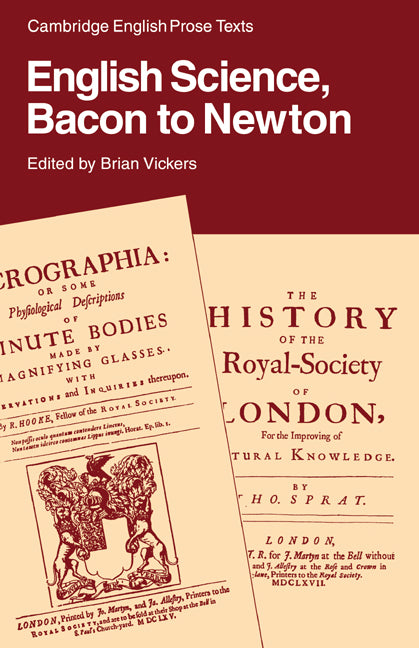
English Science: Bacon to Newton
This book will be of consuming interest to thoughtful readers who care about the history of their own language.
Brian Vickers (Edited by)
9780521316835, Cambridge University Press
Paperback / softback, published 21 May 1987
260 pages
21.6 x 13.8 x 2 cm, 0.42 kg
'Brian Vickers's collection brings together extracts from the writings of English experimental philosophers of the seventeenth century. Its appearance … is a welcome sign of attempts to build bridges between literary studies and the history of science. The focus is well chosen: the experimentalists of the early Royal Society are an identifiable group, with a distinctive style of doing and writing natural philosophy, producing what Vickers calls 'the prose of experiment'. This is well represented here by extracts from a number of well-known works: Robert Boyle's Sceptical Chymist, Henry Power's Experimental Philosophy, Robert Hooke's Micrographia and Thomas Sprat's History of the Royal Society. Francis Bacon, whose writing inspired this group, is rightly given first place in the anthology, with his works Preparative Towards a Natural and Experimental History and New Atlantis. At the end of the period covered, the inclusion of Isaac Newton's New Theory about Light and Colours (1672) enables the reader to see the Baconian style of experimental writing being transformed into a more theoretical and axiomatic one. The presentation of the texts is of a high standard, and will unquestionably be useful for students. Helpful notes, a glossary and a select bibliography are provided.' British Journal for the History of Science, 21 (1988): 362-3
Seventeenth-century England witnessed an unprecedented flourishing of natural philosophy, inspired by Francis Bacon's call for a new science based on observation and experiment, to be carried out in collective research projects,whose findings would be communicated in clear language. This anthology documents the effect of Bacon's ideas in the remarkably fruitful period following 1660. It includes his sketch of a scientific research institute in the New Atlantis (1627), which inspired the founding of the Royal Society in 1662, as acknowledged by Thomas Sprat in its History, excerpted here. Bacon's plea for an appropriate language for science also affected the Royal Society, as Sprat records, and gave birth to a number of schemes for man-made artificial languages, represented here by John Wilkins's Essay Towards a Real Character and a Philosophical Language (1668). The selections are accompanied by a general introduction, extensive notes, contemporary illustrations, a glossary of obsolete and technical terms and an updated bibliography.
List of plates
Acknowledgements
Preface
Introduction
Part I. Francis Bacon (1561–1626): 1. Preparative towards a Natural and Experimental History, 1620
2. New Atlantis, c.1624
Part II. Robert Boyle (1627–1691): 3. Experiments with the air-pump, 1660
4. The Sceptical Chymist, 1661
Part III. Henry Power (1623–1668): 5. Experimental Philosophy, 1664
Part IV. Robert Hooke (1635–1702): 6. Micrographia, 1665
7. On Earthquakes and Fossils, 1668
Part V. Thomas Sprat (1635–1713) 8. History of the Royal Society, 1667
Part VI. John Wilkins (1614–1672): 9. An Essay Towards a Real Character and a Philosophical Language, 1668
Part VII. Isaac Newton (1642–1727): 10. A New Theory about Light and Colours, 1672
Appendix: Joseph Glanvill's stylistic revisions, 1661 and 1676
Glossary
Notes
Select bibliography.
Subject Areas: History of science [PDX], Literary studies: general [DSB]