Freshly Printed - allow 10 days lead
Couldn't load pickup availability
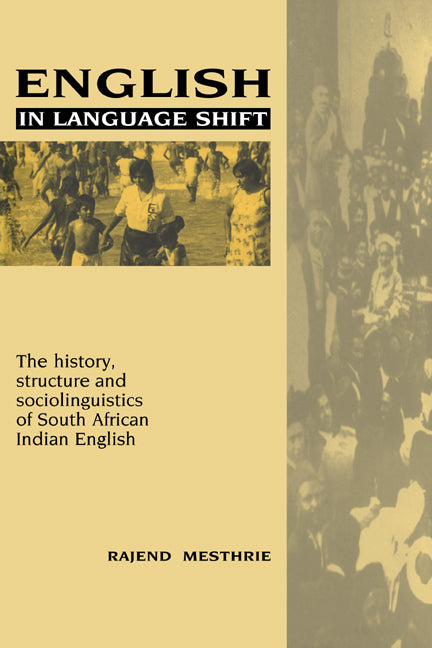
English in Language Shift
The History, Structure and Sociolinguistics of South African Indian English
Rajend Mesthrie examines the rise of a new variety of English among Indian migrant workers indentured on the plantations of Natal in South Africa.
Rajend Mesthrie (Author)
9780521026499, Cambridge University Press
Paperback / softback, published 1 June 2006
276 pages, 3 b/w illus. 3 maps
22.9 x 15.4 x 1.6 cm, 0.396 kg
'A most impressive piece of work.' J. M. Coetzee
Rajend Mesthrie examines the rise of a new variety of English among Indian migrant workers indentured on the plantations of Natal in South Africa. Considering the historical background to, and linguistic consequences of, language shift in an immigrant context, he draws significant parallels between second language acquisition and the processes of pidginization and creolization. In particular, he analyses universals of second language acquisition and the role of transfer from the Indic and Dravidian substrate languages. English in Language Shift observes the acquisition of language in its social setting, often outside the classroom. Its linguistic focus is on the distinctive syntax of South African Indian English, with respect to word order and clause structures; and it contains descriptions of lexis, phonetics and morphology, in terms of social variation. South African Indian English is compared with other dialects within South Africa, with English in India, and with Englishes generally.
Preface
Acknowledgements
1. Historical background: the shaping of a New English
2. Variation in SAIE: a first glimpse
3. Syntactic variation: the relative clause
4. Word-order principles
5. Non-syntactic variation
6. Perspectives from second-language acquisition
7. Perspectives from pidgin and creole studies
Appendices
Notes
Sources and references
Index.
Subject Areas: Language acquisition [CFDC]