Special Order - allow 2+ weeks lead
Couldn't load pickup availability
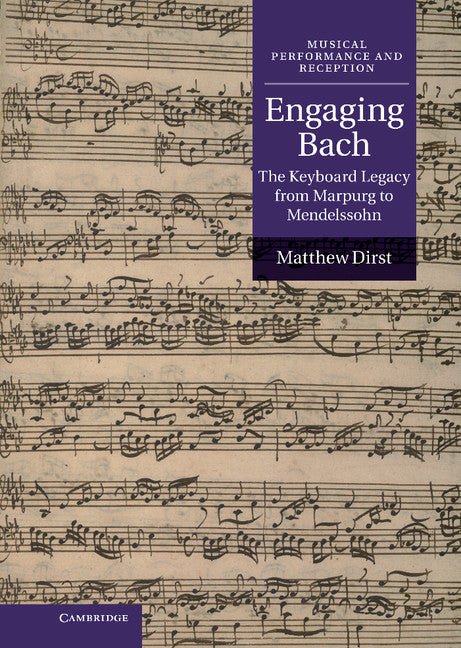
Engaging Bach
The Keyboard Legacy from Marpurg to Mendelssohn
Matthew Dirst examines the leading role of Bach's keyboard works in the creation of his historical legacy.
Matthew Dirst (Author)
9780521651608, Cambridge University Press
Hardback, published 29 March 2012
202 pages, 9 b/w illus. 7 tables 38 music examples
25.3 x 18 x 1.4 cm, 0.56 kg
'This concise volume is a welcome and valuable addition to the burgeoning genre of Bach reception literature.' Early Music America
More than any other part of Bach's output, his keyboard works conveyed the essence of his inimitable art to generations of admirers. The varied responses to this repertory - in scholarly and popular writing, public lectures, musical composition and transcription, performances and editions - ensured its place in the canon and broadened its creator's appeal. The early reception of Bach's keyboard music also continues to affect how we understand and value it, though we rarely recognize that historical continuity. Here, Matthew Dirst investigates how Bach's music intersects with cultural, social and music history, focusing on a repertory which is often overshadowed in scholarly and popular literature on Bach reception. Organized around the most productive ideas generated by Bach's keyboard works from his own day to the middle of the nineteenth century, this study shows how Bach's remarkable and long-lasting legacy took shape amid critical changes in European musical thought and practice.
1. Why the keyboard works?
2. Inventing the Bach chorale
3. What Mozart learned from Bach
4. A bürgerlicher Bach: turn-of-the-century German advocacy
5. The virtuous fugue: English reception to 1840
6. Bach for whom? Modes of interpretation and performance, 1820–50.
Subject Areas: Keyboard instruments [AVRG], Romantic music [c 1830 to c 1900 AVGC5], Classical music [c 1750 to c 1830 AVGC4], Baroque music [c 1600 to c 1750 AVGC3]