Special Order - allow 2+ weeks lead
Couldn't load pickup availability
Empirical Implications of Theoretical Models in Political Science
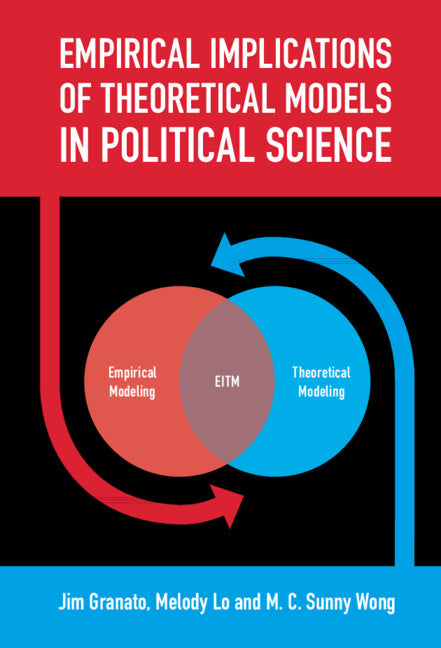
Provides a framework to demonstrate how to unify formal, theoretical and empirical analysis through various interdisciplinary examples.
Jim Granato (Author), Melody Lo (Author), M. C. Sunny Wong (Author)
9780521193863, Cambridge University Press
Hardback, published 13 May 2021
398 pages
15 x 23 x 3 cm, 0.74 kg
'Too often in the social sciences, formal theories and empirical studies have occupied separate worlds. This book is a masterful overview of a more modern approach, demonstrating how empirical implications can be rigorously derived from theoretical models. The new framework not only lets researchers test models more reliably, but more importantly, it directs them to previously unsuspected empirical findings that conventional empirical analysis will not uncover. This is a volume that every empirical researcher will want to read.' Christopher H. Achen, Princeton University
Tension has long existed in the social sciences between quantitative and qualitative approaches on one hand, and theory-minded and empirical techniques on the other. The latter divide has grown sharper in the wake of new behavioural and experimental perspectives which draw on both sides of these modelling schemes. This book works to address this disconnect by establishing a framework for methodological unification: empirical implications of theoretical models (EITM). This framework connects behavioural and applied statistical concepts, develops analogues of these concepts, and links and evaluates these analogues. The authors offer detailed explanations of how these concepts may be framed, to assist researchers interested in incorporating EITM into their own research. They go on to demonstrate how EITM may be put into practice for a range of disciplines within the social sciences, including voting, party identification, social interaction, learning, conflict and cooperation to macro-policy formulation.
Part I. EITM: Background and Framework: 1. Modeling Insights and Pathbreaking Institutions A Sketch
2. Contemporary Methodological Practices
3. The EITM Framework
Part II. EITM in Practice: 4. Economic Voting
5. Strategists and Macropartisanship
6. Macro Policy
7. Information Diffusion
8. Political Parties and Representation
9. Voter Turnout
10. International Political Economy
11. Macro Political Economy
12. Social Behavior and Evolutionary Dynamics
13 Competition and Reward Valuation
14. An Alternative Unification Framework
15. Conclusion.
Subject Areas: Politics & government [JP], Research methods: general [GPS]