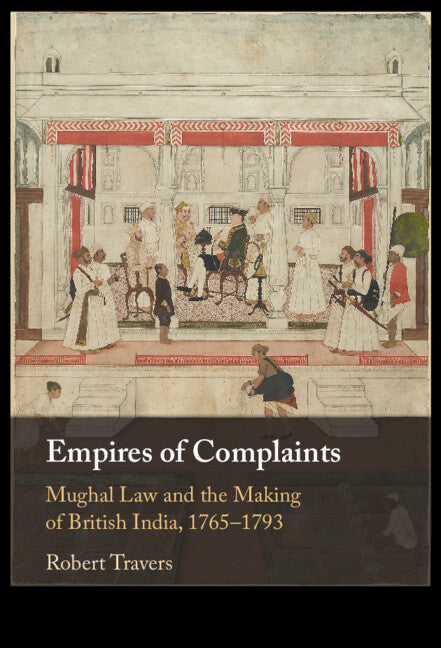
Freshly Printed - allow 10 days lead
Couldn't load pickup availability
Empires of Complaints
Mughal Law and the Making of British India, 1765–1793
Travers explores how Mughal political and legal culture shaped and was reshaped by the British colonial state in Bengal.
Robert Travers (Author)
9781009123389, Cambridge University Press
Hardback, published 15 September 2022
298 pages
23.5 x 15.8 x 2.1 cm, 0.58 kg
'… an enriching and essential read for all scholars interested in South Asian legal history but also more broadly in the history of modern South Asia.' Priyasha Saksena, Rechtsgeschichte - Legal History
In this deeply researched and revealing account, Robert Travers offers a new view of the transition from Mughal to British rule in India. By focusing on processes of petitioning and judicial inquiry, Travers argues that the East India Company consolidated its territorial power in the conquered province of Bengal by co-opting and transforming late Mughal, Persianate practices of administering justice to petitioning subjects. Recasting the origins of the pivotal 'Permanent Settlement' of the Bengal revenues in 1793, Travers explores the gradual production of a new system of colonial taxation and civil law through the selective adaptation and reworking of Mughal norms and precedents. Drawing on English and Persian sources, Empires of Complaints reimagines the origins of British India by foregrounding the late Mughal context for colonial state-formation, and the ways that British rulers reinterpreted and reconstituted Persianate forms of statecraft to suit their new empire.
Introduction
1. Petitioning, taxation and law in eighteenth century Bengal: the context for empire
2. Recasting Mughal law: company justice after 1772
3. Zamindari succession disputes and Persianate Hindu law
4. 'At the Durbar' in Calcutta: Banians, revenue farming, and the politics of landed debt
5. A jagirdar's lament: an Indo-Persian historian's appeal to the British empire
6. Conclusion: the making and remaking of a colonial judicial state (c.1780–1793)
Select bibliography.
Subject Areas: Legal history [LAZ], Modern history to 20th century: c 1700 to c 1900 [HBLL], Asian history [HBJF]