Freshly Printed - allow 7 days lead
Couldn't load pickup availability
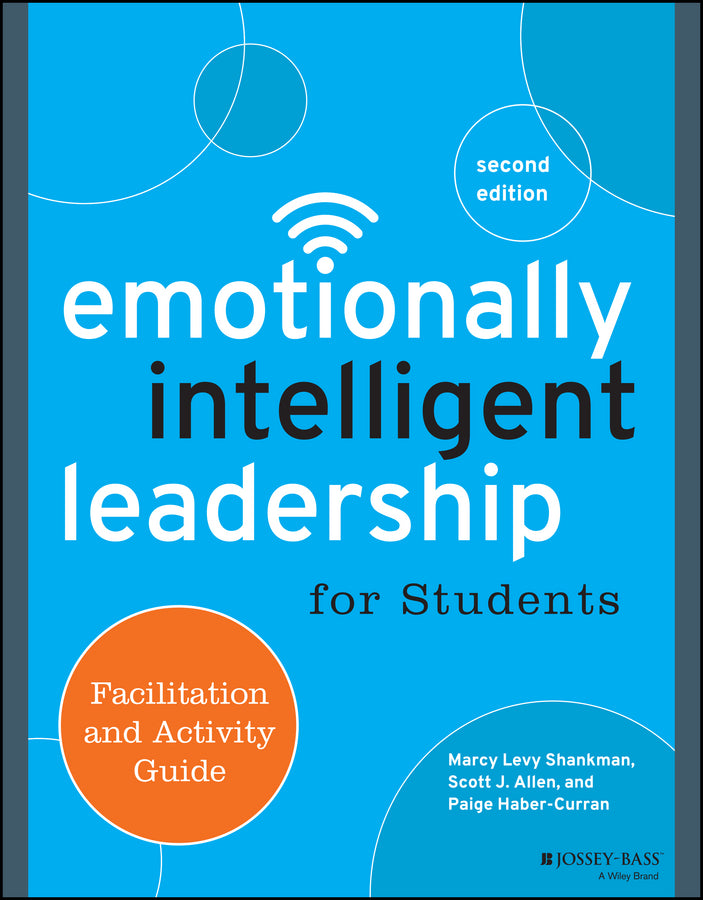
Emotionally Intelligent Leadership for Students
Facilitation and Activity Guide
Marcy Levy Shankman (Author), Scott J. Allen (Author), Paige Haber-Curran (Author)
9781118821770, Wiley
Paperback / softback, published 27 February 2015
408 pages
27.9 x 21.6 x 2.5 cm, 0.953 kg
A how-to guide to help for facilitators and instructors develop emotionally intelligent leadership capacities in their students The Emotionally Intelligent Leadership for Students: Facilitation and Activity Guide delivers a comprehensive curriculum for those who want to help students foster the 19 emotionally intelligent leadership (EIL) capacities presented in the book Emotionally Intelligent Leadership: A Guide for Students. Research from around the world has demonstrated that there is a relationship between emotional intelligence and leadership. For the all-new second edition, the authors have completely rewritten all the modules according to their revised, data-based EIL model. These activities bring theory into practice, targeting specific learning outcomes that will help students become better leaders. This guide will allow you to lead students through the Emotionally Intelligent Leadership for Students: Student Workbook and can be used with or without the Emotionally Intelligent Leadership for Students: Inventory, which helps students to assess their EIL capacities. The Emotionally Intelligent Leadership for Students suite of resources offers an immersive and transformative educational experience, fostering growth and promoting intense self-reflection. Students will be empowered to develop into the effective leaders of the future.
Preface ix Acknowledgments xv About the Authors xvii Facilitation Notes xxi 1 Introduction to Emotionally Intelligent Leadership 1 Module 1.1: Emotionally Intelligent Leadership: An Overview 1 2 Consciousness of Self 11 Module 2.1: Personal SWOT Analysis 12 Module 2.2: Famous Faces 14 Module 2.3: A Ranking Debate 17 3 Emotional Self-Perception 37 Module 3.1: Emotional Inventory 38 Module 3.2: Organizational Analysis 40 Module 3.3: The Personal Case Study 43 Module 3.4: Emotional Scavenger Hunt 46 4 Emotional Self-Control 53 Module 4.1: Navigating Stress 54 Module 4.2: Managing Your Hot Buttons 57 Module 4.3: Regulating Your Response 61 5 Authenticity 74 Module 5.1: Values Collage 74 Module 5.2: Building Your Personal Mission Statement 78 6 Healthy Self-Esteem 86 Module 6.1: Exploring Resilience 87 Module 6.2: This I Believe 90 Module 6.3: Remember a Time 93 7 Flexibility 99 Module 7.1: Where Do You Stand on Change? 100 Module 7.2: Innovation Station 102 Module 7.3: A “Tricky” Game 107 8 Optimism 120 Module 8.1: Social Media Assessment 121 Module 8.2: The Look of Optimistic Leadership 123 Module 8.3: Optimism Improv 125 9 Initiative 134 Module 9.1: Local Heroes 135 Module 9.2: Busting the Barriers 137 Module 9.3: Conceptual Blocks 140 10 Achievement 150 Module 10.1: Flow 150 Module 10.2: Deliberate Practice 154 11 Consciousness of Others 162 Module 11.1: Discovering Individuals within a Group 162 Module 11.2: All Hands In 164 12 Displaying Empathy 173 Module 12.1: The Heart of Empathy: Listening 174 Module 12.2: Perspective Taking 177 Module 12.3: A Radical Experiment in Empathy 181 13 Inspiring Others 185 Module 13.1: Inspirational Items 186 Module 13.2: How Great Leaders Inspire Action 188 Module 13.3: Mission, Vision, and Values 191 14 Coaching Others 202 Module 14.1: Listening Closely 203 Module 14.2: Coaching for Goals 206 Module 14.3: Hands-On Coaching 212 15 Capitalizing on Difference 217 Module 15.1: What’s on Your Wheel 218 Module 15.2: Finding Common Ground 221 Module 15.3: Same and Different: Contribution and/or Challenge? 224 16 Developing Relationships 231 Module 16.1: Rock-Paper-Scissors Tournament 232 Module 16.2: Concentric Circles: Building Relationships 234 Module 16.3: Personal NetworkingWeb 238 17 Building Teams 246 Module 17.1: What Makes an Effective Team? 247 Module 17.2: Egg Drop Challenge 249 Module 17.3: Teamwork within Remember the Titans 252 18 Demonstrating Citizenship 260 Module 18.1: A Focus on Followership 260 Module 18.2: Citizenship on Our Campus 263 Module 18.3: Enabling Group Citizenship 265 19 Managing Conflict 274 Module 19.1: Facing Challenges 275 Module 19.2: What’s the Problem? 278 Module 19.3: Sort It Out 281 20 Facilitating Change 293 Module 20.1: Perspectives on Change 294 Module 20.2: Roles of Change Agents 297 Module 20.3:Worst-Case Scenario 300 21 Consciousness of Context 309 Module 21.2: Is It a Party? 309 Module 21.2: Different or Same? 313 22 Analyzing the Group 319 Module 22.1: Peeling the Onion 319 Module 22.2: Elements of Culture 323 Module 22.3: Get On the Balcony 326 23 Assessing the Environment 335 Module 23.1: Zoom 336 Module 23.2: Mapping Contexts 339 Module 23.3: Visualizing Opportunities and Threats 342 Appendix A EIL Overview 345 Appendix B Co-Curricular Outlines 349 Appendix C Curricular Syllabi 352 Appendix D Emotionally Intelligent Leadership for Students: Inventory Administration Instructions 356
Subject Areas: Education [JN]