Freshly Printed - allow 7 days lead
Couldn't load pickup availability
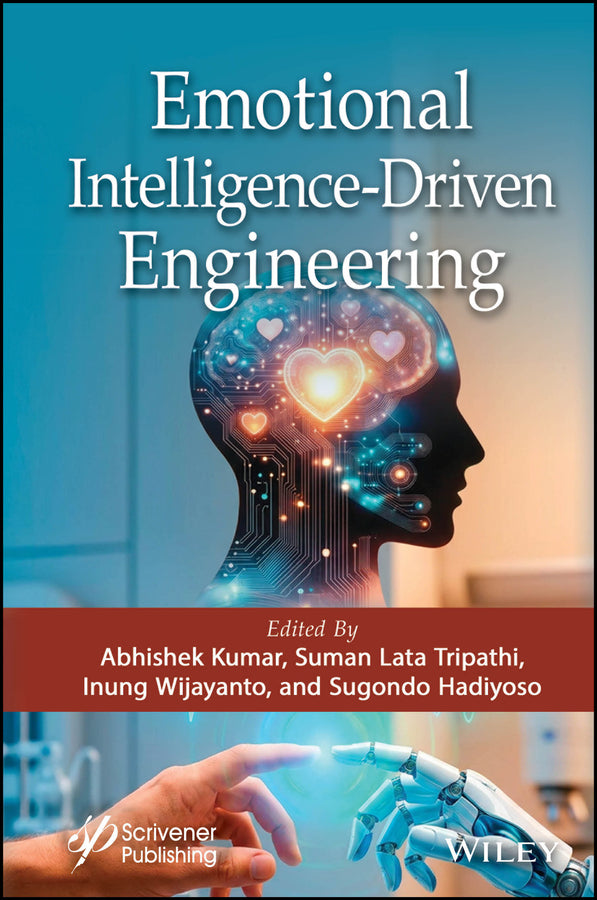
Emotional Intelligence-Driven Engineering
Abhishek Kumar (Edited by), Suman Lata Tripathi (Edited by), Inung Wijayanto (Edited by), Sugondo Hadiyoso (Edited by)
9781394389865, Wiley
Hardback, published 23 June 2026
592 pages
25 x 15 x 1.5 cm, 0.666 kg
In a digital age where technical expertise is no longer enough, this book provides the essential tools to integrate empathy, psychology, and neuroscience into your design process for a deeper human-technology connection. Engineering has traditionally prioritized functional and technical factors, enhancing equipment for reliability, effectiveness, and efficiency. However, a dramatic perspective shift is changing the way technologies are created, developed, and implemented, as well as how we interact with them. This book provides an innovative perspective on the design and development of systems, services, and products by investigating the significant confluence of engineering, technology, and emotional intelligence. In the growing digital age of today, technological expertise is no longer sufficient to satisfy the wide range of consumer demands. It is equally important to comprehend, predict, and account for human emotion. This book incorporates the interdisciplinary method known as emotion-driven engineering, which includes emotional intelligence in the design, development, and implementation of engineering solutions. Based on disciplines including human-computer interface, design thinking, psychology, and neuroscience. This book provides an efficient framework for developing products that connect with consumers. With both theoretical ideas and practical applications, the book is organized to help engineers, designers, and technologists integrate emotional awareness and empathy into their work.
Preface xxix 1 Exploring Emotional Intelligence in Design Thinking 1 1.1 Introduction 2 2 Exploring the Integration of Emotion and Engineering: An In-Depth Analysis of Emotional Intelligence in Design and Its Impact on Human-Centered Engineering Practices 23 2.1 Introduction 24 3 The Integration of Emotion and Engineering 49 3.1 Introduction 50 4 Emotional Intelligence in AI: Bridging the Gap between Humans and Machines 81 4.1 Introduction 82 5 Emotionally Intelligent AI Assistants: Machine Learning for Enhanced Human–AI Interaction 107 5.1 Introduction 108 6 Emotionally Intelligent Assistants with Machine Learning 143 6.1 Introduction 144 7 Emotion AI: Advancing Emotional Recognition with Machine Learning 179 7.1 Introduction 180 8 Emotion-Sensitive Deep Learning Models 197 8.1 Understanding Emotion Sensitivity 198 9 Deep Learning for Emotion Detection: Making Machines Feel 219 9.1 Introduction 220 10 Emotion-Aware AI for Facial Expression Analysis to Enhance Workforce Well-Being in Industry 4.0 241 10.1 Introduction 242 11 Emotion-Based Music Recommendation System 257 11.1 Introduction 257 12 Emotional Sensors: Emotion-Driven IoT 271 12.1 Introduction 272 13 Neuro-IoT: Merging Brain Signals with Smart Electronics 297 13.1 Introduction 298 14 Personalized Voice Assistant with Emotional Intelligence Using NLP and GCP 325 14.1 Introduction 326 15 Emotional Algorithms – Machines to Understand Human Feelings 341 15.1 Defining Emotional AI and Affective Computing 342 16 Emotional Indicators in Cybersecurity: Developing a Framework for Early Insider Threat Detection 373 16.1 Introduction 374 17 The Role of Cobots in Shifting from Automation to Collaboration 387 17.1 Introduction to Cobots 388 18 Enhancing Quality Control and Predictive Maintenance with Data Insights 399 18.1 Introduction 400 19 Emotion Detection Using Pre-Trained CNN Models: A Deep Learning Approach with Real-Time Implementation 411 19.1 Introduction 412 20 Emotionally Intelligent AI Assistant Powered by Machine Learning and NLP 445 20.1 Introduction 446 21 Neuro-IoT and Emotion Recognition: Merging Brain Signals with Smart Electronics for Emotionally Intelligent Systems 465 21.1 Introduction 466 22 EmoHeart: Human-Centered First-Emotion Smart IoT Devices for Cardiology 485 22.1 Introduction 486 23 Natural Bioactive Compounds as Cardioprotective Agents: A Promising Avenue for Heart Health 503 23.1 Introduction 504 References 532
Sancheti Dipak D., Chaudhari Rajendra S., Deore Harshal S. and Bora Pradyumna M.
1.2 Understanding Emotional Intelligence 3
1.3 Understanding Design Thinking 5
1.4 The Importance of Emotional Intelligence in Design Thinking for Engineering Solutions 7
1.5 Fundamentals of Emotional Intelligence in Design 8
1.6 Applications and Case Studies 12
1.7 Challenges and Future Perspectives 15
1.8 Conclusion 17
Sancheti Santosh D., Sanghavi Mahesh R., Sanghavi Kainjan M. and Sancheti Dipak D.
2.2 Understanding Emotions in Engineering 28
2.3 Emotional Intelligence in Design 31
2.4 Human-Centered Engineering Practices 33
2.5 The Interplay of Emotion and Engineering 36
2.6 Implications for Engineering Education and Practice 40
2.7 Conclusion and Future Directions 42
Abinaya Swathiswaramurthi
3.2 Understanding Emotions 51
3.3 Models and Frameworks for Emotion-Integrated Engineering 53
3.4 Case Studies and Applications 61Contents vii
3.5 Proposed Model 62
3.6 Experimental Analysis 67
3.7 Results and Discussion 68
3.8 Expanding Applications and Future Trends 71
3.9 Ethical and Societal Implications 78
Bindu S., Smitha Gayathri D., Prashant M. K. and Mohan Kishore D.
4.2 The Significance of Integrating Emotions into AI Systems 85
4.3 Understanding the Science of Human Emotions 89
4.4 Computational Models of Emotions and Emotion Recognition Techniques 92
4.5 Sentiment Analysis and Natural Language Processing (NLP) 95
4.6 Case Study 100
4.7 Risks of Emotionally Manipulative AI 100
4.8 Conclusions 102
Rahul Kumar Ghosh, Gourab Dutta, Sandip Chakraborty and Subhadip Nandi
5.2 Foundations of Emotionally Intelligent AI 113
5.3 Conversational AI and Emotion Recognition 117
5.4 Ethical Considerations and Challenges in Emotion AI 123
5.5 Case Studies: Real-World Implementations of Emotion AI 128
5.6 Future Trends and Research Directions 131
5.7 Conclusion 136
Piyal Roy, Shivnath Ghosh, Amitava Podder and Saptarshi Kumar Sarkar
6.2 Foundations of Emotional Intelligence 148
6.3 Machine Learning for Emotional Intelligence 152
6.4 Data Collection and Preprocessing 157
6.5 Building Emotionally Intelligent Assistants 162
6.6 Evaluation and Metrics 165
6.7 Ethical and Societal Implications 170x Contents
6.8 Conclusion and Future Scope 175
A. Prabhu Chakkaravarthy, J. Dhanalakshmi and D. Praveena Anjelin
7.2 Related Work 182
7.3 Methodology 186
7.4 Preprocessing and Feature Engineering 187
7.5 Results and Discussion 189
7.6 Challenges in Emotion Recognition 192
7.7 Applications of Emotion Detection 192
7.8 Future Directions 193
7.9 Conclusion 194
Reeaa Rana, Diveyam Mishra and Sandeep Kumar Jain
8.2 Understanding Emotion Data 200
8.3 Deep Learning Approach for Emotional Stability 203
8.4 Model Architectures and Framework 205
8.5 Evaluation Metrics for Emotion-Sensitive Models 208
8.6 Challenges and Future Directions 210
8.7 Successful Implementations: Context and Value 212
8.8 Conclusion 214
Manjushree Nayak and Amisha Sukla
9.2 The Heart of Emotion Detection: Key Algorithms 221
9.3 Multimodal Emotion Recognition: Unifying Seeing, Hearing, and Reading Emotions 222
9.4 Methodology 224
9.5 Dataset Overview 230
9.6 Result Analysis and Discussion 231
9.7 Conclusion 234
U. Sinthuja, K. Kabilan and R. Meenakshisundaram
10.2 Survey 246
10.3 Analyzing the Algorithms of AI for FEI 248
10.4 Enhancing the Industry 4.0 Work Environment with Facial Emotion Identification 252
10.5 Conclusion 254
Abhishek Kumar
11.2 Related Work 259
11.3 System Architecture 260
11.4 Emotion Detection Module 260
11.5 Emotion Classification 261
11.6 Music Metadata Tagging 261
11.7 Recommendation Engine 262
11.8 Implementation 262
11.9 Conclusion 267
Subhadip Nandi, Gaurab Dutta and Rahul Kumar Ghosh
12.2 Applications of Emotion-Driven IoT 273
12.3 Introduction to Emotion-Driven IoT (EIoT) 276
12.4 Technological Foundations 279
12.5 AI and ML Techniques in Emotion Classification 281
12.6 Proposed Solutions and Advancements 290
12.7 Future Research Directions 290
Amandeep Kaur, Ramandeep Sandhu, Indu Rani, Gaganpreet Kaur and Deepika Ghai
13.2 Understanding Neuro-IoT 301
13.3 Applications of Neuro-IoT 306
13.4 Related Work 309
13.5 Challenges and Ethical Considerations 314
13.6 Technological Advancements 316
13.7 Conclusion 320
Bavithra K., Nivetha G., D. Yashwanth Daran and Manasha K. G.
14.2 Literature Survey 327xviii Contents
14.3 Objective 328
14.4 Existing Methodology 328
14.5 Proposed Methodology 331
14.6 Research Methodology 333
14.7 Packages Used 335
14.8 Code Snippets 337
14.9 Natural Language Processing (NLP) 338
14.10 Result 338
14.11 Future Scope 339
Madhankumar C.
15.2 Importance of Emotion Recognition in AI-Driven Decision-Making 342
15.3 Traditional Rule-Based Sentiment Analysis vs. Deep Learning-Based Affect Recognition 343
15.4 Key Challenges in Emotional AI 344
15.5 Emerging Trends in Emotional AI 344
15.6 Deep Learning and Affective Neural Networks 346
15.7 Empathetic AI and Human-Centric Chatbots 349Contents xix
15.8 Ethics, Bias, and Privacy in Emotional AI 350
15.9 Future Innovations and Applications in Emotional AI 351
15.10 AI in Customer Engagement and Personalization 353
15.11 Challenges and Research Directions in Emotional AI 360
15.12 Final Thoughts 369
Soumya Roy, Kaushik Chanda, Subhadip Nandi and Anudeepa Gon
16.2 Methodology and Implementation 377
16.3 Results and Evaluation 379
16.4 Comparison with Existing Frameworks 382
16.5 Conclusion 383
Rajesh Singh, Aashna Sinha, Vivek Kumar Singh and Praveen Kumar Malik
17.2 Features of the Cobots 389
17.3 The Function of Cobots in Industries 390
17.4 Conclusion 395
Rajesh Singh, Anita Gehlot, Fraiz Parveen and Praveen Kumar Malik
18.2 Quality Control and Predictive Maintenance 402
18.3 Predictive Maintenance Using Machine Learning 405
18.4 Case Study 406
18.5 Discussion 407
18.6 Conclusion 408
Pratyush Rai, Naman Gupta, Aryan Singh, Nagendra Prabhu S. and Arun Kumar
19.2 Literature Assessment 417
19.3 Deep Getting to Know and CNN for Emotion Recognition 426
19.4 Proposed System Architecture 430
19.5 Data Preprocessing and Dataset 434
19.6 Applications on the Actual International Usage for Emotion-Based Recognition 440
19.7 Data Availability Statement 442
19.8 Conclusion 442
Kushagra Purohit, Gaurav Gupta, S. Nagendra Prabhu and Arun Kumar
20.2 Literature Investigation 447
20.3 System Analysis 451
20.4 Result Analysis 455
20.5 Convolutional Neural Network (CNN) 460
20.6 Conclusion 462
Vishal Jain, Archan Mitra and Sanchita Paul
21.2 Literature Review 469
21.3 Methodology 474
21.4 Findings 477
21.5 Discussion 479
21.6 Conclusion and Future Work 481
Abdul Razak Mohamed Sikkander, Suman Lata Tripathi, Joel J. P. C. Rodrigues and Radhakrishnan
22.2 Research Objectives 488
22.3 Methodologies 488
22.4 Challenges and Obstacles 493
22.5 Future Perspectives 496
22.6 Conclusions 498
Abdul Razak Mohamed Sikkander, Suman Lata Tripathi, Joel J. P. C. Rodrigues, Nitin Wahi, G. Theivanathan and Fatma Bassyouni
23.2 Research and Methodologies 507
23.3 Results 525
23.4 Conversations 525
23.5 Challenges and Obstacles 529
23.6 Future Perspectives 530
23.7 Conclusions 531
Index 539
Subject Areas: Computer science [UY]