Freshly Printed - allow 10 days lead
Couldn't load pickup availability
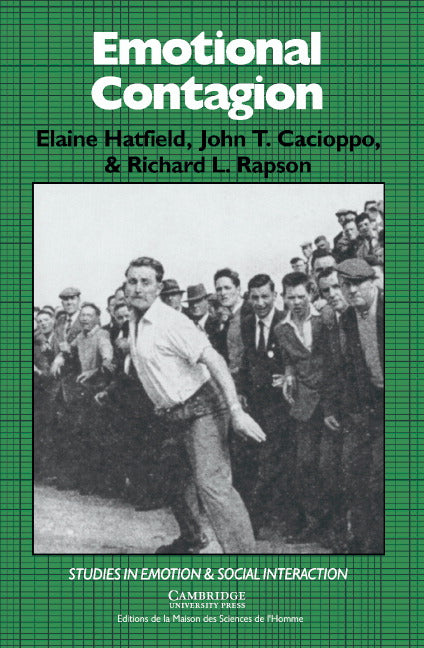
Emotional Contagion
A study of the phenomenon of emotion contagion, or the communication of mood to others.
Elaine Hatfield (Author), John T. Cacioppo (Author), Richard L. Rapson (Author)
9780521444989, Cambridge University Press
Hardback, published 24 September 1993
252 pages, 12 b/w illus. 4 tables
23.6 x 15.7 x 2.3 cm, 0.504 kg
"...this book clearly explores its topic and presents a compelling case for its thesis, all in readable prose that is laced with interesting examples." Cognition and Emotion
When people are in a certain mood, whether elation or depression, that mood is often communicated to others. When we are talking to someone who is depressed it may make us feel depressed, whereas if we talk to someone who is feeling self-confident and buoyant we are likely to feel good about ourselves. This phenomenon, known as emotional contagion, is identified here, and compelling evidence for its affect is offered from a variety of disciplines - social and developmental psychology, history, cross-cultural psychology, experimental psychology, and psychopathology.
1. Introduction
2. Animal research
3. Developmental research: A. Evidence that children catch their parents' emotions
B. Evidence that parents catch their childrens' emotions
4. Clinical research: A. Therapists' reaction to clients: i. Clinicians assessment of clients' emotional states: Conscious judgments versus emotional contagion
ii. Do therapists' expectations subtly effect emotional contagion?
B. Psychopathic clients
C. Peoples' reactions to the anxious, depressed, or angry
5. Social psychological research: A. Cross-cultural research: hysterical contagion
B. Experimental social psychological research
6. Historical research: A. The dancing manias of the Middle-Ages
B. The great fear of 1789
C. The New York City riots of 1863
D. Man's inhumanity to man
6. Summing up.
Subject Areas: Social, group or collective psychology [JMH]