Freshly Printed - allow 7 days lead
Couldn't load pickup availability
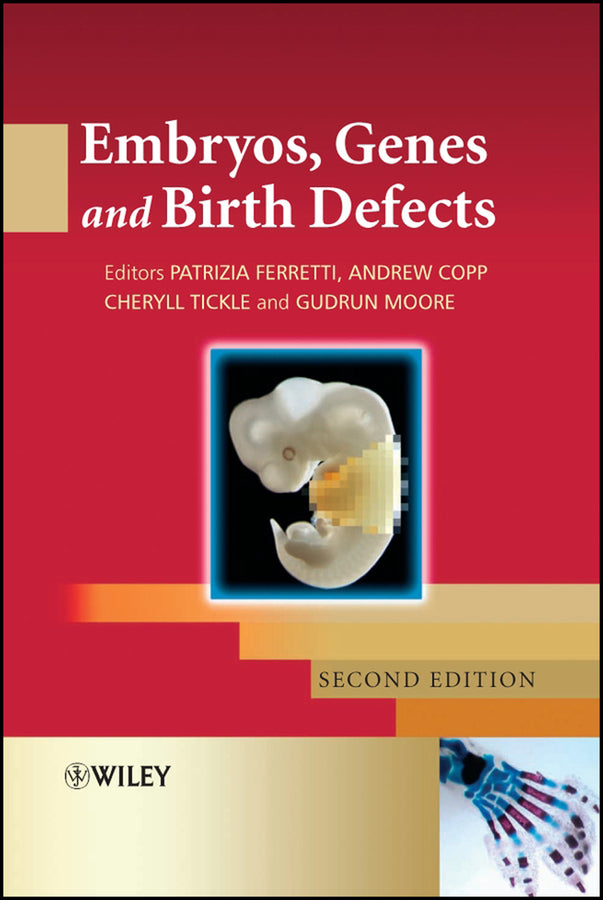
Embryos, Genes and Birth Defects
Patrizia Ferretti (Edited by), Andrew Copp (Edited by), Cheryll Tickle (Edited by), Gudrun Moore (Edited by)
9780470090107, Wiley
Hardback, published 21 April 2006
576 pages
25 x 17.6 x 3.7 cm, 1.162 kg
The first edition of Embryos, Genes and Birth Defects, edited by the late Peter Thorogood, was a radical new book aimed at bridging the gap between the medical disciplines of embryology and dysmorphology, and recent advances in cellular, molecular and developmental biology. This new edition remains unique in its breadth and brings up to date our understanding of birth defects and of the strategies utilized to gain such knowledge. It features new chapters on human cytogenetics, mutagenesis and the eyes and ears. The book presents key topics in developmental biology and explains how they provide the foundations for understanding clinical birth defects. The first six chapters introduce concepts and strategies adopted to elucidate developmental anomalies leading to birth defects. The book then focuses on specific organs and reviews the cellular and molecular mechanisms affecting their development and how disruption of these mechanisms by genetic or environmental factors may underlie certain birth defects. The chapters are concise and provide up-to-date coverage of topics in a format that is easily accessible and yet at the forefront of research. Written primarily for paediatricians, obstetricians, clinical geneticists and allied workers, this book guides the reader through the contribution of modern molecular biology to our understanding of human development. Developmental and cellular biologists will learn how errors in the cellular and genetic mechanism can lead to classical disorders, diseases and syndromes.
Preface to the First Edition ix 1. The Relationship between Genotype and Phenotype: Some Basic Concepts 1 Introduction 1 2. Uses of Databases in Dysmorphology 19 What is a syndrome? 19 3. Human Cytogenetics Introduction 33 4. Identification and Analysis of Genes Involved in Congenital Malformation Syndromes 51 Gene identification 51 5. Transgenic Technology and Its Role in Understanding Normal and Abnormal Mammalian Development 79 Introduction 79 6. Chemical Teratogens: Hazards, Tools and Clues 99 Introduction 99 7. The Limbs 123 Developmental anatomy of the human limb 123 8. Brain and Spinal Cord 167 Introduction 167 9. Birth Defects Affecting the Eye 199 The eye 199 10. The Ear 231 Introduction 231 11. Development of the Enteric Nervous System in Relation to Hirschsprung's Disease 263 Introduction 263 12. The Head 301 Introduction 301 13. The Heart 341 Developmental anatomy 341 14. The Skin 373 Introduction 373 15. The Vertebral Column 411 Introduction 411 16. The Kidney 463 Introduction 463 17. The Teeth 515 Developmental anatomy 515 Index 537
Preface to the Second Edition xi
Contributors xiii
Philip Stanier and Gudrun Moore
The relationship between genotype and phenotype 2
The role of 'model' systems 8
The changing concept of homology 9
Michael Baraitser
Some of these problems are addressed by dysmorphology databases 20
Where databases do not help 23
Dysmorphology databases 24
How databases work 26
J. D. A. Delhanty
Population cytogenetics 34
Structural anomalies 35
The genesis of chromosome abnormalities 36
Embryo survival 44
The cause of high levels of chromosome abnormality in human embryos 44
Relative parental risks – age, translocations, inversions, gonadal and germinal mosaics 45
Peter J. Scambler
Biological analysis of genes implicated in birth defect syndromes 59
Animal models 64
Why study rare human birth defect syndromes? 70
Valerie Vidal and Andreas Schedl
Transgenic mice 80
Genetic manipulation using gene targeting in ES cells 88
Outlook and future developments 95
Nigel A. Brown (with revisions by Cheryll Tickle
Teratogens and human malformations 100
General strategy in chemical teratogenesis 102
Valproic acid 102
Gene–teratogen interaction 106
Teratogens and phenocopies 106
Teratogens as manipulative tools 108
Teratogens as clues 110
Final comments 117
Patrizia Ferretti and Cheryll Tickle
Main classes of limb defects 125
Contemporary studies on mechanisms of limb development 127
Limb regeneration 140
How, when and where experimental studies elucidate abnormal development 145
Agenda for the future 151
Andrew J. Copp
Overview of nervous system development 169
Defects of CNS development: towards a genetic and developmental understanding 175
Agenda for the future 192
Jane C. Sowden
Development of the eye 200
Congenital eye defects and paediatric blindness 204
Gene mutations underlying congenital eye defects 206
Cellular and molecular mechanisms affecting eye development and how they elucidate the causes of abnormal development 213
Agenda for the future 220
Sarah Spiden and Karen P. Steel
Development of the outer and middle ear 233
Development of the inner ear 234
Main classes of ear defects 236
Mechanisms involved in development of the outer and middle ear 248
Mechanisms underlying inner ear development 249
Mechanisms underlying development of inner ear sensory epithelia 251
Mechanisms involved in endolymph homeostasis 253
The future 254
Heather M. Young, Donald F. Newgreen and Alan J. Burns
Anatomy and function of the ENS 263
The best-characterized developmental defect of the ENS – Hirschsprung's disease 265
Cell biology of ENS development 266
Molecular biology of ENS development and Hirschsprung-like dysplasias 270
HSCR: current and future treatments 286
Conclusions 288
Gillian M. Morriss-Kay
Developmental anatomy 302
Main classes of craniofacial defect 371
Cellular and molecular mechanisms 321
Agenda for the future 332
Deborah Henderson, Mary R. Hutson and Margaret L. Kirby
Major cell populations needed for heart development 345
Molecular regulation of heart development 347
Cardiovascular defects 356
The Future 362
Ahmad Waseem and Irene M. Leigh
Developmental anatomy 374
Main classes of skin defects 391
Future perspectives 400
David Rice and Susanne Dietrich
Developmental anatomy of the vertebral column 414
Making the vertebral column 421
Agenda for the future 444
Paul J. D. Winyard
Structure and function 464
Developmental anatomy of nephrogenesis 465
Transcription factors 473
Growth factors and their receptors 479
Survival/proliferation factors 487
Cell adhesion molecules 488
Other molecules 492
Non-genetic causes of renal malformations 495
Agenda for the future 499
Irma Thesleff
Main classes of defects 517
Cellular and molecular mechanisms affecting development 520
How cellular and molecular developmental mechanisms assist in elucidating the causes of abnormal development 525
Agenda for the future 529
Subject Areas: Biology, life sciences [PS]