Special Order - allow 2+ weeks lead
Couldn't load pickup availability
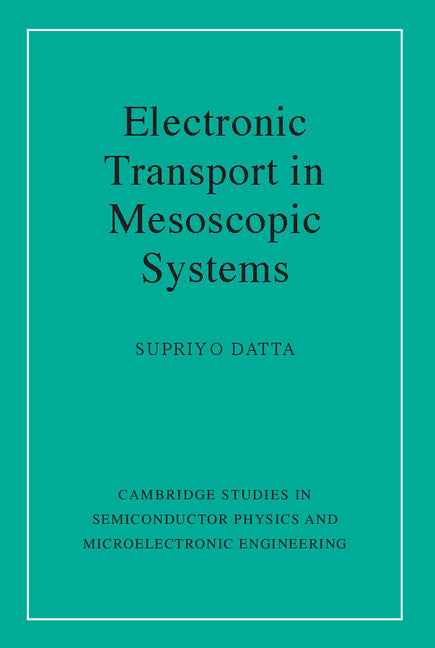
Electronic Transport in Mesoscopic Systems
A thorough account of the theory of electronic transport in semiconductor nanostructures.
Supriyo Datta (Author)
9780521599436, Cambridge University Press
Paperback / softback, published 15 May 1997
396 pages, 145 b/w illus. 2 tables
22.8 x 15.3 x 2.3 cm, 0.537 kg
'In this beautifully presented book, Supriyo Datta describes the new understanding which has been gained in this field during the last decade. The book is a thought-provoking study of electron transport in small structures which will stimulate anyone who wants to think about what conductivity really is … it starts right from the beginning of the story, assuming very little solid state physics, and thus will be appreciated by readers of differing backgrounds and experience.' S. J. Blundell, Contemporary Physics
Advances in semiconductor technology have made possible the fabrication of structures whose dimensions are much smaller than the mean free path of an electron. This book gives a thorough account of the theory of electronic transport in such mesoscopic systems. After an initial chapter covering fundamental concepts, the transmission function formalism is presented, and used to describe three key topics in mesoscopic physics: the quantum Hall effect; localisation; and double-barrier tunnelling. Other sections include a discussion of optical analogies to mesoscopic phenomena, and the book concludes with a description of the non-equilibrium Green's function formalism and its relation to the transmission formalism. Complete with problems and solutions, the book will be of great interest to graduate students of mesoscopic physics and nanoelectronic device engineering, as well as to established researchers in these fields.
1. Preliminary concepts
2. Conductance from transmission
3. Transmission function, S-matrix and Green's functions
4. Quantum Hall effect
5. Localisation and fluctuations
6. Double-barrier tunnelling
7. Optical analogies
8. Non-equilibrium Green's function formalism.
Subject Areas: Condensed matter physics [liquid state & solid state physics PHFC]