Special Order - allow 2+ weeks lead
Couldn't load pickup availability
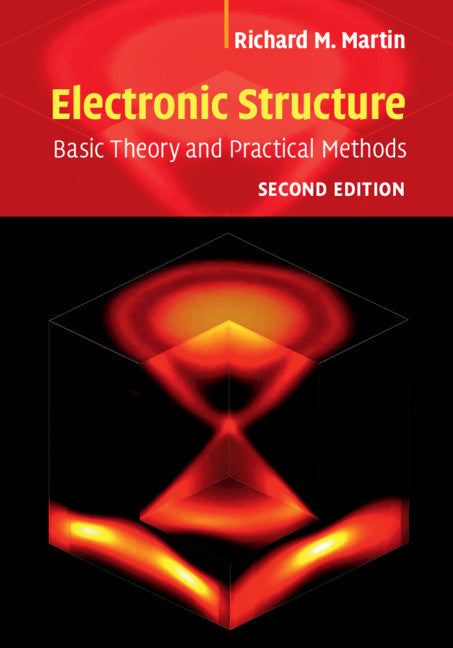
Electronic Structure
Basic Theory and Practical Methods
An authoritative text in condensed matter physics, unifying theory and methods to present electronic structure to students and researchers.
Richard M. Martin (Author)
9781108429900, Cambridge University Press
Hardback, published 27 August 2020
788 pages, 208 b/w illus. 7 tables
25 x 17.8 x 3.9 cm, 1.63 kg
'… this 2nd edition is … very welcome and timely, as it has been significantly expanded to cover the 'new' topics. The core of the book remains unchanged in scope, focusing on 'independent particle methods' such as DFT and Hartree-Fock theory, and their extensions. This is … a worthy … and is strongly recommended for anyone working in the field of electronic structure.' Matt Probert, Contemporary Physics
The study of electronic structure of materials is at a momentous stage, with new computational methods and advances in basic theory. Many properties of materials can be determined from the fundamental equations, and electronic structure theory is now an integral part of research in physics, chemistry, materials science and other fields. This book provides a unified exposition of the theory and methods, with emphasis on understanding each essential component. New in the second edition are recent advances in density functional theory, an introduction to Berry phases and topological insulators explained in terms of elementary band theory, and many new examples of applications. Graduate students and research scientists will find careful explanations with references to original papers, pertinent reviews, and accessible books. Each chapter includes a short list of the most relevant works and exercises that reveal salient points and challenge the reader.
Preface
Acknowledgments
Notation
Part I. Overview and background topics: 1. Introduction
2. Overview
3. Theoretical background
4. Periodic solids and electron bands
5. Uniform electron gas and sp-bonded metals
Part II. Density functional theory: 6. Density functional theory: foundations
7. The Kohn–Sham auxiliary system
8. Functionals for exchange and correlation I
9. Functionals for exchange and correlation II
Part III. Important preliminaries on atoms: 10. Electronic structure of atoms
11. Pseudopotentials
Part IV. Determination of electronic structure: the basic methods: 12. Plane waves and grids: basics
13. Plane waves and real space methods: full calculations
14. Localized orbitals: tight-binding
15. Localized orbitals: full calculations
16. Augmented functions: APW, KKR, MTO
17. Augmented functions: linear methods
18. Locality and linear scaling O(N) methods
Part V. From Electronic Structure to Properties of Matter: 19. Quantum molecular dynamics (QMD)
20. Response functions: phonons, magnons, . . .
21. Excitation spectra and optical properties
22. Surfaces, interfaces, and lower dimensional systems
23. Wannier functions
24. Polarization, localization, and Berry phases
Part VI. Electronic Structure and Topology: 25. Topology of the electronic structure of a crystal: introduction
26. Two band models: Berry phase, winding and topology
27. Topological insulators I: Two dimensions
28. Topological insulators II: Three dimensions
Part VII. APPENDICES: A. Functional equations
B. LSDA and GGA functionals
C. Adiabatic approximation
D. Perturbation Theory, response functions and Green's functions
E. Dielectric functions and optical properties
F. Coulomb interactions in extended systems
G. Stress from electronic structure
H. Energy and stress densities
I. Alternative force expressions
J. Scattering and phase shifts
K. Useful relations and formulas
L. Numerical methods
M. Iterative methods in electronic structure
N. Two-center matrix elements: expressions for arbitrary angular momentum l
O. Dirac equation and spin-orbit interaction
P. Berry phase, curvature and Chern numbers
Q. Quantum Hall effect and edge conductivity
R. Codes for electronic structure calculations for solids
References
Index.
Subject Areas: Materials science [TGM], Physical chemistry [PNR], Quantum physics [quantum mechanics & quantum field theory PHQ], Condensed matter physics [liquid state & solid state physics PHFC], Mathematical modelling [PBWH]