Freshly Printed - allow 10 days lead
Couldn't load pickup availability
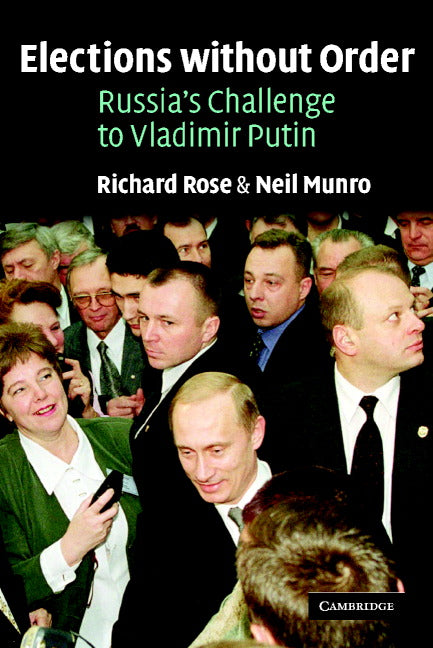
Elections without Order
Russia's Challenge to Vladimir Putin
Russians want free elections and order. This 2002 book presents unrivalled survey data on the challenge facing Putin.
Richard Rose (Author), Neil Munro (Author)
9780521016445, Cambridge University Press
Paperback / softback, published 15 August 2002
274 pages, 39 b/w illus. 24 tables
22.8 x 15.2 x 2 cm, 0.43 kg
'It would be hard to find any important topic in Russian politics that is not covered by the survey data presented in this book, which is outstanding for the evidence it presents, just as Richard Rose himself is untouchable in the production of public opinion and psephological data on post-communist Russia and Eastern Europe … There is no doubt at all about the book's quality and it will have no difficulty in making its way in the world.' Slavonica
Russians want both free elections and order, but order - a sense of predictability in everyday life and the rule of law - has been in short supply. This is the challenge that Russia presents to Vladimir Putin. This 2002 book is about Russia's attempt to achieve democratization backwards, holding elections without having created a modern state. It examines the multiplication of parties that do not hold the Kremlin accountable; the success of Vladimir Putin in offering a 'third way' alternative to the Communist Party and the Yeltsin family; the president's big but vague election mandate; the popular appeal and limits of Putin's coalition; and what the Russian people make of the combination of free elections and disorderly government. Russia is evaluated from the point of view of ordinary Russians, using clear figures and tables drawn from the rich resources of a decade of New Russia Barometer surveys of public opinion.
Introduction: the reality of Russia
1. A disorderly history
2. Democratization backwards
3. What Russians make of their new regime
4. Presidential succession: a 'family' problem
5. Parties without accountability
6. A floating choice of parties
7. Influences on the duma vote
8. From acting to elected president
9. Running a permanent campaign
10. An incomplete democracy.
Subject Areas: Political economy [KCP]