Freshly Printed - allow 10 days lead
Couldn't load pickup availability
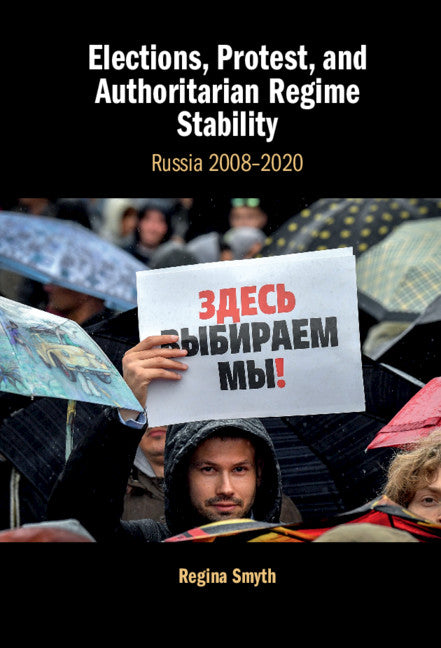
Elections, Protest, and Authoritarian Regime Stability
Russia 2008–2020
This comprehensive study of Russian electoral politics shows the vulnerability of Putin's regime as it navigates the risks of voter manipulation.
Regina Smyth (Author)
9781108841207, Cambridge University Press
Hardback, published 29 October 2020
278 pages
15 x 23 x 2 cm, 0.56 kg
'Theoretically rich, impressively researched, and full of fascinating detail, Smyth's new book shows how protests can alter the course of even the strongest authoritarian regimes. It is surely one of the best political science books on Russia in recent years.' Henry E. Hale, Professor of Political Science and International Affairs, Elliott School of International Affairs, The George Washington University
In a path-breaking study of Russian elections, Regina Smyth reveals how much electoral competition matters to the Putin regime and how competition leaves Russia more vulnerable to opposition challenges than is perceived in the West. Using original data and analysis, Smyth demonstrates how even weak political opposition can force autocratic incumbents to rethink strategy and find compromises in order to win elections. Smyth challenges conventional notions about Putin's regime, highlighting the vast resources the Kremlin expends to maintain a permanent campaign to construct regime-friendly majorities. These tactics include disinformation as well as symbolic politics, social benefits, repression, and falsification. This book reveals the stresses and challenges of maintaining an electoral authoritarian regime and provides a roadmap to understand how seemingly stable authoritarian systems can fall quickly to popular challenges even when the opposition is weak. A must-read for understanding Russia's future and the role of elections in contemporary autocratic regimes.
1. Elections, Protest, and Hybrid Regime Dynamics
2. Winning Hybrid Elections: Organized Opposition, Incumbent Regimes, and The Threat of Popular Engagement
3. The Long Game: Inter-Election Efforts to Shape Electoral Victories
4. The Unexpected Power of Weak Opposition: Organizations, Frames, and Political Opportunities
5. The Vote Protest: State, Opposition, and Voters in Russian Elections
6. The Polls Close And Two Movements Emerge
7. Protest and Rally Dynamics: A National Conversation Over Russia's Future
8. The Perpetual Campaign: Regime Response and Opposition Innovation
9. 2018-2020: Competition and Contestation.
Subject Areas: International relations [JPS], Comparative politics [JPB], Politics & government [JP]