Freshly Printed - allow 10 days lead
Couldn't load pickup availability
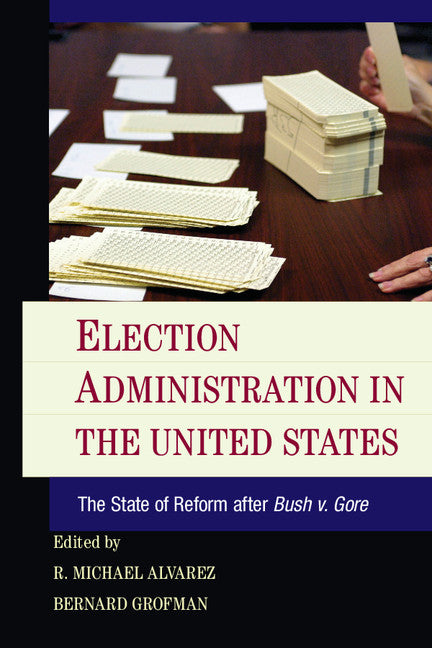
Election Administration in the United States
The State of Reform after Bush v. Gore
This book tells the story of how the way in which we conduct elections has changed after the Florida recount litigation of 2000.
R. Michael Alvarez (Edited by), Bernard Grofman (Edited by)
9781107625952, Cambridge University Press
Paperback / softback, published 29 September 2014
280 pages, 19 b/w illus. 23 tables
22.9 x 15.2 x 1.5 cm, 0.38 kg
'This volume is a nice compilation of our current understanding of election reform and administration. It will serve as a reference for scholars interested in election reform broadly, but it goes beyond description and synthesis to contribute new knowledge. The editors are extremely well qualified for the task and in no case could I name a scholar more qualified or more likely to produce quality work than the group assembled here.' J. Quin Monson, Brigham Young University
Some of the nation's leading experts look at various aspects of election administration, including issues of ballot format, changes in registration procedures, the growth in the availability of absentee ballot rules and other forms of 'convenience voting', and changes in the technology used to record our votes. They also look at how the Bush v. Gore decision has been used by courts that monitor the election process and at the consequences of changes in practice for levels of invalid ballots, magnitude of racial disparities in voting, voter turnout, and access to the ballot by those living outside the United States. The editors, in their introduction, also consider the normative question of exactly what we want a voting system to do. An epilogue by two leading election law specialists looks at how election administration and election contest issues played out in the 2012 presidential election.
Foreword Danny Boggs
Editors' introduction R. Michael Alvarez and Bernard Grofman
Part I. Bush v. Gore in Perspective: 1. Disputed elections post Bush v. Gore Mark Braden and Robert Tucker
2. The cites that counted: a decade of Bush v. Gore jurisprudence Charles Anthony Smith
3. Bush v. Gore in the American mind: reflections and survey results on the tenth anniversary of the decision ending the 2000 election controversy Amy Semet, Nathaniel Persily and Stephen Ansolabehere
Part II. What Has Changed since Bush v. Gore: 4. What hath HAVA wrought?: consequences, intended and not, of the post-Bush v. Gore reforms Charles Stewart, III
5. Voter confidence in 2010: local, state, and national factors Lonna Rae Atkeson
6. Early voting after Bush v. Gore Paul Gronke
7. Absentee ballot regimes: easing costs or adding a step? Jan E. Leighley and Jonathan Nagler
Part III. Remaining Challenges: 8. The evolution (or not) of ballot design ten years after Bush v. Gore Martha Kropf
9. Poll workers and polling places Thad E. Hall and Kathleen Moore
10. Resolving voter registration problems: making registration easier, less costly, and more accurate R. Michael Alvarez and Thad E. Hall
11. Felon disenfranchisement after Bush v. Gore: changes and trends Khalilah L. Brown-Dean
Epilogue: Bush v. Gore and the constitutional right to vote Samuel Issacharoff and Richard H. Pildes.
Subject Areas: Political science & theory [JPA]