Special Order - allow 2+ weeks lead
Couldn't load pickup availability
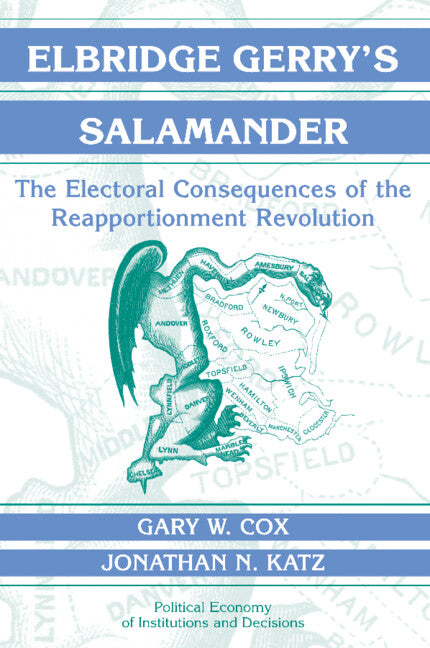
Elbridge Gerry's Salamander
The Electoral Consequences of the Reapportionment Revolution
This book shows how the Supreme Court's reapportionment decisions sparked a wave of extraordinary redistricting in the mid-1960s.
Gary W. Cox (Author), Jonathan N. Katz (Author)
9780521001540, Cambridge University Press
Paperback / softback, published 4 March 2002
248 pages, 7 b/w illus. 22 tables
22.8 x 15.2 x 1.5 cm, 0.35 kg
"...a study with important new findings relating to the impact of the reapportionment revolution." Perspectives on Politics
The Supreme Court's reapportionment decisions, beginning with Baker v. Carr in 1962, had far more than jurisprudential consequences. They sparked a massive wave of extraordinary redistricting in the mid-1960s. Both state legislative and congressional districts were redrawn more comprehensively - by far - than at any previous time in America's history. Moreover, they changed what would happen at law should a state government fail to enact a new districting plan when one was legally required. This book provides a detailed analysis of how judicial partisanship affected redistricting outcomes in the 1960s, arguing that the reapportionment revolution led indirectly to three fundamental changes in the nature of congressional elections: the abrupt eradication of a 6% pro-Republican bias in the translation of congressional votes into seats outside the south; the abrupt increase in the apparent advantage of incumbents; and the abrupt alteration of the two parties' success in congressional recruitment and elections.
Part I. Introduction: 1. Introduction
2. The reapportionment revolution
Part II. Democrats and Republicans: 3. A model of Congressional redistricting in the US
4. The case of the disappearing bias
5. The role of the courts in the 1960s redistricting process
6. Bias, responsiveness and the courts
7. Redistricting's differing impact on Democratic and Republican incumbents
Part III. Incumbents and Challengers: 8. The growth of the incumbency advantage
9. Redistricting and electoral coordination
10. Redistricting, the probability of securing a majority and entry
11. Reassessing the incumbency advantage
Part IV. Conclusion: 12. Conclusion.
Subject Areas: Politics & government [JP], Regional studies [GTB]