Special Order - allow 2+ weeks lead
Couldn't load pickup availability
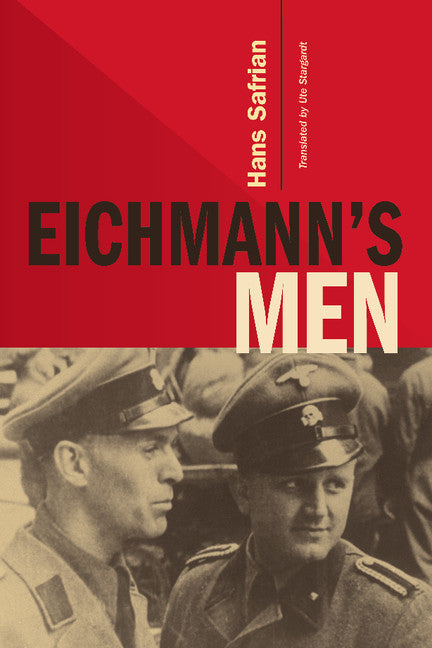
Eichmann's Men
This book examines National Socialist perpetrators who expelled Jews from their homelands to ghettos, concentration camps and killing centers in Eastern Europe.
Hans Safrian (Author), Ute Stargardt (Translated by)
9780521617260, Cambridge University Press
Paperback / softback, published 21 December 2009
328 pages
23.4 x 15.6 x 1.9 cm, 0.47 kg
'This edition contains a detailed and thorough listing of citations, with extra commentary threading from the test to generously annotated endnotes. In addition to the copious citations, to the pleasure and convenience of researchers and those who would like to pursue the subject in further readings, Safrian provides an impressive, accessible bibliography listing both primary and secondary sources.' The Journal of Central European History
More than sixty years after the advent of the National Socialist genocides, the question still remains: how could a state-sponsored terror that took the lives of millions of men, women, and children, persecuted as Jews or Gypsies, happen? Now available in English, Hans Safrian's path-breaking work on Adolf Eichmann and his Nazi helpers chronicles the escalation of Nazi anti-Semitic policies beginning in 1933 and during World War II to the 'final solution'. This book examines a central group of National Socialist perpetrators who expelled German, Austrian, and Czech Jews from their homelands and deported massive numbers of them to the ghettos, concentration camps, and killing centers of occupied Eastern Europe. Safrian reconstructs the 'careers' of Eichmann and his men in connection with the implementation of racial policies, particularly the gradual marginalization of their victims and the escalation from stigmatization, divestment, and segregation to deportation, forced labor, and, finally, mass murder.
Introduction
1. Eichmann and the development of the Vienna model
2. An unsuccessful start: the deportations to Nisko on the River San
3. The development and initial activities of Referat IV D 4
4. 1941: from expulsion to mass murder
5. 1941: controversies over the deportations to the occupied areas of the Soviet Union
6. 1942: the establishment of the genocide program
7. 1942: collaboration and deportations
8. The destruction of the Jewish community of Salonika: the cooperation of the SS and Wehrmacht
9. 1943–4: manhunts in France and Greece
10. 1944–5: manhunts in Hungary and Slovakia
11. The post-war era.
Subject Areas: Second World War [HBWQ], 20th century history: c 1900 to c 2000 [HBLW], European history [HBJD]