Freshly Printed - allow 10 days lead
Couldn't load pickup availability
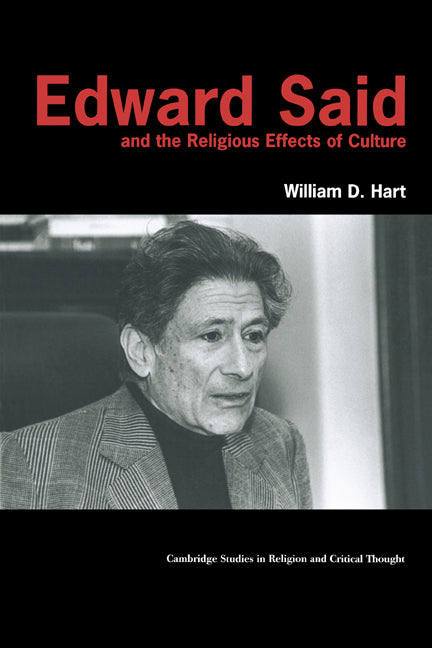
Edward Said and the Religious Effects of Culture
This book provides a distinctive account of Edward Said's critique of modern culture.
William D. Hart (Author)
9780521778107, Cambridge University Press
Paperback / softback, published 13 April 2000
252 pages
22.9 x 15.4 x 1.6 cm, 0.466 kg
"Hart meticulously analyses the constituent elements of Said's position and creates a much more nuanced and qualified assessment of its pros and cons. This book will excite and reward in graduate courses on the politics of contemporary religion and culture." Religious Studies Review Oct 2001
This book provides a distinctive account of Edward Said's critique of modern culture by highlighting the religion-secularism distinction on which it is predicated. This distinction is both literal and figurative. It refers, on the one hand, to religious traditions and to secular traditions and, on the other hand, to tropes that extend the meaning and reference of religion and secularism in indeterminate ways. The author takes these tropes as the best way of organizing Said's heterogeneous corpus - from Joseph Conrad and the Fiction of Autobiography, his first book, to Orientalism, his most influential book, to his recent writings on the Palestinian question. The religion-secularism distinction, as an act of imagination and narrative continuity, lies behind Said's cultural criticism, his notion of intellectual responsibility, and his public controversy with Michael Walzer about the meaning and the uses of the Exodus story and about the question of Palestine.
1. Cultural criticism as the transfiguration of religious thought
2. The religious effects of culture: nationalism
3. The religious effects of culture: orientalism
4. The religious effects of culture: imperialism
5. The responsibilities of the secular critic
6. Marx, Said and the Jewish question
Conclusion
Appendix A
Appendix B
Bibliography.
Subject Areas: Philosophy of religion [HRAB]