Freshly Printed - allow 10 days lead
Couldn't load pickup availability
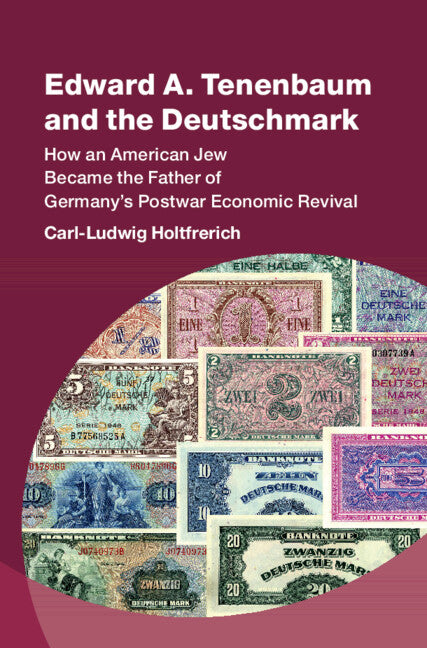
Edward A. Tenenbaum and the Deutschmark
How an American Jew Became the Father of Germany’s Postwar Economic Revival
Elevates Tenenbaum to his proper place in West Germany's economic history and demystifies Ludwig Erhard's claim to the Deutschmark 1948.
Carl-Ludwig Holtfrerich (Author)
9781009492812, Cambridge University Press
Hardback, published 31 October 2024
794 pages
23.5 x 16.1 x 5.3 cm, 1.33 kg
'The introduction of the German Mark was the beginning of the West German postwar economic miracle. Its intellectual father was not Ludwig Erhard, but an American of Jewish-Polish decent, Edward Tenenbaum. Carl Holtfrerich's masterful biography finally does justice to the role of a man who deserves a monument in German economic history.' Moritz Schularick, President of the Kiel Institute for the World Economy
German industry had survived Allied bombing largely unscathed. Currency reform was necessary to provide incentives for capital owners and labor to produce. The abundance of old Reichsmarks had to be curtailed to a scarce supply of Deutschmarks that users would expect to retain value. It was Edward A. Tenenbaum, currency expert of US military government in Berlin since 1946, who managed the exceptionally successful currency reform in West Germany 1948, which was implemented by the legislative powers of the three Western Allies against opposition from West German financial experts. It was the foundation of West Germany's 'economic miracle.' The West German currency conversion is part of the founding myth of the Federal Republic of Germany. Yet Tenenbaum's pivotal role is largely unknown among the German public. Besides providing a full-blown biography of the true father of the currency reform, this book elevates Tenenbaum to his proper place in German history.
1. Introduction
2. Ludwig Erhard, who took credit for Edward A. Tenenbaum's success
3. Edward A. Tenenbaum's family roots, adolescence, and military experience until 1946
4. In action for OMGUS and currency reform in Germany 1946–1948
5. From OMGUS to civil service in Washington DC and for Europe 1948–1953
6. Life and fate as a business and family man 1953–1975 and beyond
7. Conclusion.
Subject Areas: Macroeconomics [KCB]