Freshly Printed - allow 8 days lead
Couldn't load pickup availability
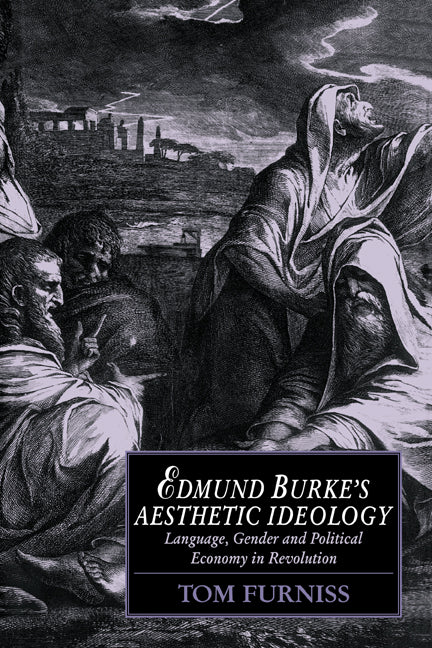
Edmund Burke's Aesthetic Ideology
Language, Gender and Political Economy in Revolution
A detailed and theoretically informed reading of the aesthetics and politics of Burke's major writings.
Tom Furniss (Author)
9780521055482, Cambridge University Press
Paperback / softback, published 21 January 2008
324 pages
22.8 x 15.1 x 1.8 cm, 0.494 kg
This study develops a detailed reading of the interrelations between aesthetics, ideology, language, gender and political economy in two highly influential works by Edmund Burke: his Philosophical Enquiry into the Origin of our Ideas of the Sublime and the Beautiful (1757), and the Reflections on the Revolution in France (1790). Tom Furniss's close attention to the rhetorical labyrinths of these texts is combined with an attempt to locate them within the larger discursive networks of the period, including texts by Locke, Hume and Smith. This process reveals that Burke's contradictions and inconsistencies are symptomatic of a strenuous engagement with the ideological problems endemic to the period. Burke's dilemma in this respect makes the Reflections an audacious compromise which simultaneously defends the ancien régime, contributes towards the articulation of radical thought, and makes possible the revolution which we call English Romanticism.
Acknowledgements
Note on texts
Introduction
Part I. Aesthetics for a Bourgeois Revolution: 1. A theory not to be revoked: A Philosophical Enquiry
2. Labour and luxury: aesthetics and the division of labour
3. The political economy of taste: limiting the sublime
4. The labour and profit of language
Part II. Reflections on a Radical Revolution: 5. The genesis of the Reflections: resisting the irresistible voice of the multitude
6. Stripping the queen: Edmund Burke's magic lantern show
7. A revolution in manners: chivalry and political economy
8. Reform and revolution
9. Imaginary constitutions and economies
10. Speculation and the republic of letters
Notes
Index.
Subject Areas: Literary studies: general [DSB]