
Freshly Printed - allow 7 days lead
Couldn't load pickup availability
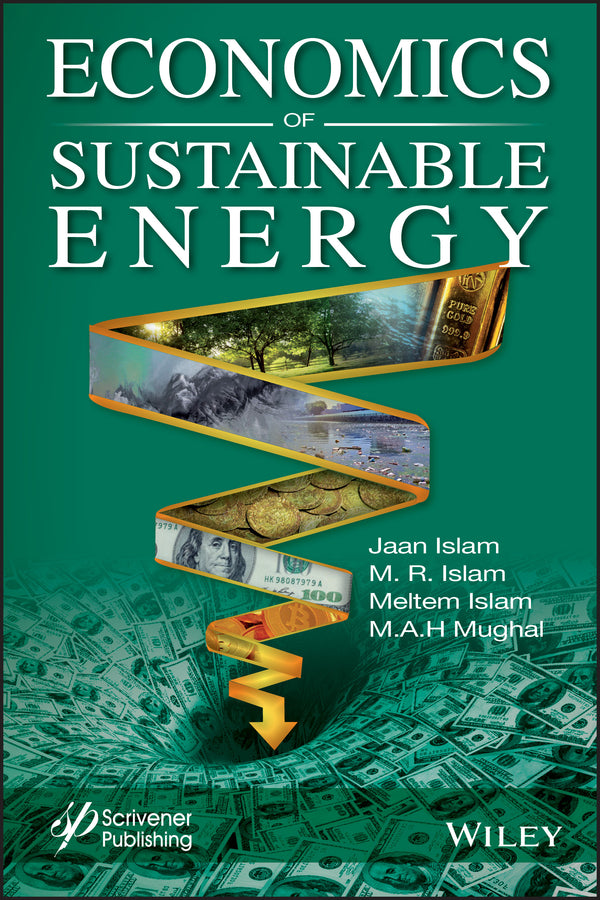
Economics of Sustainable Energy
Jaan S. Islam (Author), M. R. Islam (Author), Meltem Islam (Author), M. A. H. Mughal (Author)
9781119525929, Wiley
Hardback, published 2 October 2018
644 pages
1 x 1 x 1 cm, 0.454 kg
Co-written by a pioneer of the sustainability movement, this groundbreaking volume offers a new way of thinking about the economics of sustainable energy, a goal that has eluded scientists and economists for decades. Every year, as soon as reports on global economic inequality remind us about the direction our civilization is heading, there is a hysterical reaction, but hysteria dies down within weeks and we go back to the lifestyle that brought us here today. Often the blame is laid on the Millennial generation for their "apathy," "lust for comfort," and "bratty" attitude. Yet, business insider surveys indicate it's the same Millennial generation that overwhelmingly cares for the state of the world and the direction in which our civilization is heading. Nearly 50% of them ranked climate change and destruction of nature as their primary concern. This is followed by concern for war and global conflict, and then global economic inequality. The vast majority of those surveyed are willing and eager to make lifestyle changes. This book breaks open the hypocrisy of our civilization and stops the blame game in its tracks and identifies the root causes of today's world economy, ecology, and global politics. The book demonstrates that changes in lifestyle are necessary but not sufficient. No economic policy or technology development mode has a chance to survive, let alone thrive unless supported by the political establishment. In this process, the government plays a pivotal role. The challenge is to change the attitude of the government from a 'self-serving' controlling mode to a representative philanthropic mode. This new system of economic development and political governance is inspired by a long-forgotten understanding of political economics: medieval Islamic economics. In reviewing the history of economics from trade, currencies, and interest, the strengths and weaknesses of various economic developments over our centuries are evaluated. Based on the historical analysis, a step by step procedure is outlined for this fundamental change in our society today. As a whole, this book is the first in the modern era to offer such a comprehensive analysis, complete with solutions to the entire crisis of today's civilization.
Preface 1 Introduction 1 1.1 Opening Remarks 1 1.2 Research Questions Asked 4 2 Delinearized History of Economics and Energy 13 2.1 Introduction 13 2.2 The European Tract of Economics History 14 2.3 Transition of Money 39 2.4 The Nature Science Tract of Economics History 49 2.5 Connection to Energy 63 3 The Incompatibility of Conventional Economic Analysis Tools with Sustainability Models 69 3.1 Introduction 69 3.2 Current Economic State of the World 74 3.3 The Status of the Money God 94 3.4 The Current Economic Models 97 3.5 The Illogicality of Current Theories 110 3.6 The Delinearized History of Modern Economics 111 3.7 The Transition of Robotization 153 3.8 Yellow Gold vs. Black Gold 171 3.9 How Science and Economics Mimic the Same Aphenomenality 175 3.9.1 Sources of Unsustainability 176 Notes 177 4 State-of-the Art of Current Technology Development 179 4.1 Introduction 179 4.2 Denaturing for a Profit 182 4.3 Aphenomenal Theories of the Modern Era 186 4.4 The Sugar Culture and Beyond 198 4.5 The Culture of the Artificial Sweetener 203 4.6 Delinearized History of Saccharin® and the Money Trail 211 4.7 The Culture of Aspartame 219 4.8 The Honey-Sugar-Saccharin-Aspartame Degradation in Everything 243 4.9 Assessing the Overall Performance of a Process 248 5 Comprehensive Analysis of Energy Sustainability 263 5.1 Introduction 263 5.2 Sustainability in the Information Age and Environmental Insult 265 5.3 Climate Change Hysteria 279 5.4 The Energy Crisis 283 5.5 Petroleum in the Big Picture 315 5.6 Science of Healthy Energy and Mass 329 6 The Islamic Track of Economical Analysis 357 6.1 Introduction 357 6.2 Function of Gold Dinars and a New Paradigm for Economic Analyses 359 6.3 Labor Theory of Value 363 6.4 Zero Waste Economy 382 6.5 Role of Government in State’s Economy 386 6.6 Macroeconomy and Theory on Money 393 6.7 The Optimum Lifestyle 403 6.8 The Gold Standard for Sustainable Economy 411 7 Framework of Economics of Sustainable Energy 415 7.1 Introduction 415 7.2 Delinearized History of Modern Age 416 7.3 Petroleum Refining and Conventional Catalysts 434 7.4 The New Synthesis 439 7.5 The New Investment Model, Conforming to the Information Age 445 8 Economics of Sustainable Energy Operations 471 8.1 Introduction 471 8.2 Issues in Petroleum Operations 472 8.3 Critical Evaluation of Current Petroleum Practices 482 8.4 Greening of Petroleum Operations 490 8.5 Zero-Waste Operations 501 8.6 Characteristic Time 504 8.7 Quality of Energy 509 9 Role of Government in Assuring Energy Sustainability 555 9.1 Introduction 555 9.2 The U.S. Government 556 9.3 The Wealth Paradigm 561 9.4 Zero Interest 575 9.5 Zero-Waste Economics 581 10 Summary and Conclusions 589 10.1 Summary 589 10.2 Answers to the Research Questions 591 11 References and Bibliography 601 Index 621
Subject Areas: History [HB]