Freshly Printed - allow 10 days lead
Couldn't load pickup availability
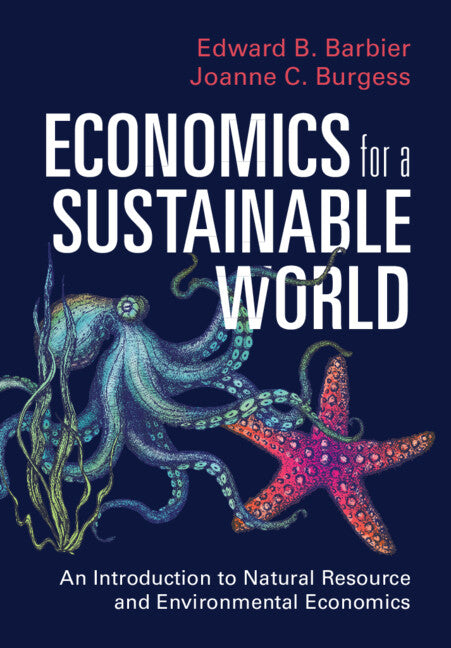
Economics for a Sustainable World
An Introduction to Natural Resource and Environmental Economics
An undergraduate textbook exploring how the economy intrinsically depends on nature and how it can guide policy to ensure sustainability.
Edward B. Barbier (Author), Joanne C. Burgess (Author)
9781108833110, Cambridge University Press
Hardback, published 12 June 2025
553 pages
25.4 x 17.8 x 3 cm, 1.288 kg
'This valuable new textbook will help a range of readers to better understand the meaning and causes of the various environmental challenges which plague our planet. The book includes an engaging and often sobering array of case studies and discussion questions to introduce students to the scale of the challenges of sustainable development ahead. Barbier and Burgess, leaders in the field, write in an impressively clear and concise manner, offering a powerful case for a new economic discourse on environmental issues.' Cameron Hepburn, University of Oxford
Written for undergraduate students with little or no exposure to economics, this introductory textbook offers a new perspective on environmental economics for the 21st century. It explains how economics for a sustainable world requires a new approach: accepting that the economy is intrinsically dependent on nature. Drawing on up-to-date case studies from around the globe, the book examines how economic concepts and techniques can apply to a wide range of environmental challenges while ensuring that poor and vulnerable members of society are included in progress toward sustainable development. The book also addresses current environmental policy options and innovations at the local, regional, and international levels. Chapters cover key topics such as climate change, pollution, energy, minerals, forests, land use, oceans, biodiversity, and water scarcity. Included in the book are the following pedagogical features: learning objectives, boxed examples, discussion questions, lists of further resources, and a glossary.
Preface
Part I. Introduction and Key Concepts: 1. Economics and the environment
2. Sustainable economic development
Part II. Economic Tools and Techniques: 3. Demand, supply, and efficient allocation
4. Market and policy failures
5. Economic values and valuation methods
6. Cost benefit analysis
7. Policy options
Part III. Application to Environmental Sustainability: 8. Land use and agriculture
9. Water scarcity
10. Minerals and energy
11. Oceans and marine resources
12. Forests and biodiversity
13. Local and regional pollution
14. Global pollution
Part IV. Global Sustainability: 15. Towards global sustainability
References
Glossary.
Subject Areas: Environmental economics [KCN]