Freshly Printed - allow 10 days lead
Couldn't load pickup availability
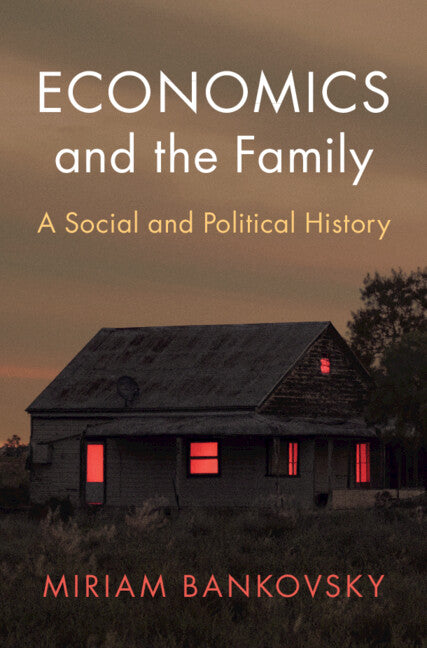
Economics and the Family
A Social and Political History
A social and political history of how economists have studied families, from the nineteenth century to the present.
Miriam Bankovsky (Author)
9781009187008, Cambridge University Press
Hardback, published 5 June 2025
351 pages
23.5 x 16 x 2.4 cm, 0.65 kg
Most economists think family economics began in the 1960s when price theory was applied to family behaviour. Instead, this book focuses on enduring concerns with family poverty across the last two centuries. In nineteenth-century Britain and Europe, economists debated the effects of poverty relief and sought to improve family productivity. In the US, interwar household consumer economists studied how to rationalise family consumption, because factories were producing goods for low-income families. From the 1960s onwards, 'New' household economists attributed family poverty to inadequate human capital investment in predominantly non-white families. Even when feminist, development, and queer economists problematised gendered injustices, they recentred family poverty, targeting the 'pauperisation' of motherhood and the marginalisation of 'families we choose.' Economics and the Family does not simply reconstruct this alternate history, it also shows how economists in all these periods overlooked injustices which must be shouldered today.
Preliminary matter
Detailed contents
Acknowledgements
Tables
1. The family and its problems in the history of economics: poverty, gendered injustice, and beyond
2. Improving family labour in industry: Alfred Marshall on the Victorian factory families and their pinching sorrow
3. Are families immoral because they are poor, or poor because immoral? The early Lausanne economists
4. Low-income interwar family consumption in the United States: the old family economists and living standards across cities and farms
5. Post-war 'underclass' in affluent North America: Black family instability, human capital theory, and Gary Becker's new household economics
6. Selected contemporary approaches: the feminist family, recentring poverty, and gender diversity
7. Fictions for a future: poverty and 'the families we choose' in a context of ecosystem collapse
References
Index.
Subject Areas: Economic theory & philosophy [KCA]