Freshly Printed - allow 10 days lead
Couldn't load pickup availability
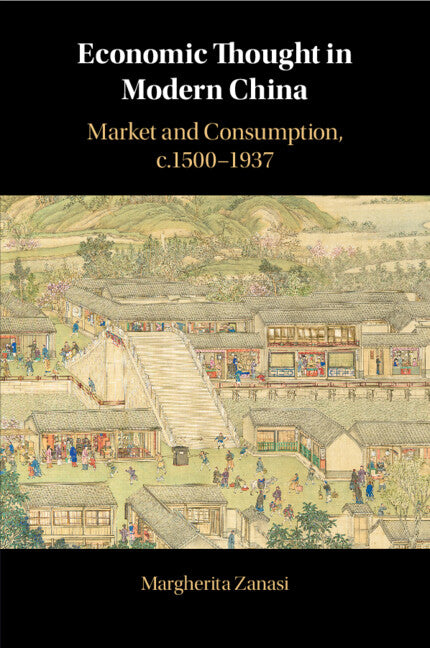
Economic Thought in Modern China
Market and Consumption, c.1500–1937
Zanasi argues that notions of market and consumption linked to economic liberalism emerged earlier in China than in Europe.
Margherita Zanasi (Author)
9781108718714, Cambridge University Press
Paperback / softback, published 30 June 2022
254 pages
22.9 x 15.2 x 1.3 cm, 0.346 kg
'This fascinating title is suitable for students interested in political economy and economic thought … Highly recommended.' D. Li, Choice
In this major new study, Margherita Zanasi argues that basic notions of a free market economy emerged in China a century and half earlier than in Europe. In response to the commercial revolutions of the late 1500s, Chinese intellectuals and officials called for the end of state intervention in the market, recognizing its power to self-regulate. They also noted the elasticity of domestic demand and production, arguing in favour of ending long-standing rules against luxury consumption, an idea that emerged in Europe in the late seventeenth and early nineteenth centuries. Zanasi challenges Eurocentric theories of economic modernization as well as the assumption that European Enlightenment thought was unique in its ability to produce innovative economic ideas. She instead establishes a direct connection between observations of local economic conditions and the formulation of new theories, revealing the unexpected flexibility of the Confucian tradition and its accommodation of seemingly unorthodox ideas.
Introduction
1. The political and intellectual framework: the Minsheng mandate and China's economy of scarcity
2. Efficient markets and productive consumption (1500–1800)
3. Scarcity revisited: population growth, frugality, and self-strengthening (1800–1911)
4. Nation-building, strategic markets, and frugal modernity: the early decades of the Republic of China (1912–1930s)
Conclusion.
Subject Areas: Economic history [KCZ], Social & cultural history [HBTB], Asian history [HBJF]