Special Order - allow 2+ weeks lead
Couldn't load pickup availability
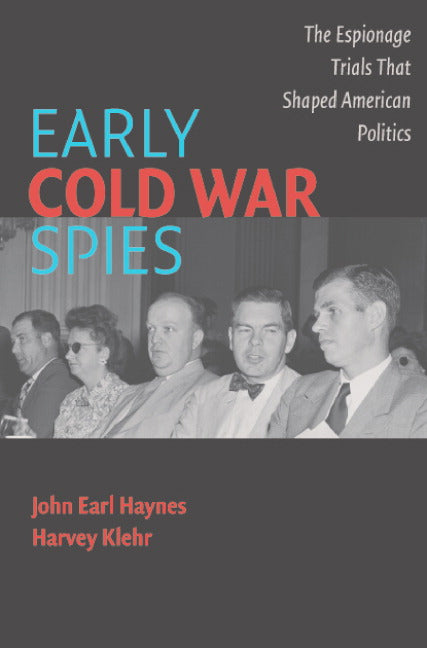
Early Cold War Spies
The Espionage Trials that Shaped American Politics
This book, first published in 2006, is a review of the major spy cases of the early Cold War.
John Earl Haynes (Author), Harvey Klehr (Author)
9780521674072, Cambridge University Press
Paperback / softback, published 28 August 2006
264 pages
22.8 x 15.2 x 1.5 cm, 0.371 kg
'… very good, both as an introductory text and as an example of the promise that comparative study holds for expanding our understanding of espionage, intelligence, and the political environment in which they are carried out. … Haynes and Klehr are among the best qualified historians to look at Cold War spy cases.' Studies in Intelligence
Communism was never a popular ideology in America, but the vehemence of American anticommunism varied from passive disdain in the 1920s to fervent hostility in the early years of the Cold War. Nothing so stimulated the white hot anticommunism of the late 1940s and 1950s more than a series of spy trials that revealed that American Communists had co-operated with Soviet espionage against the United States and had assisted in stealing the technical secrets of the atomic bomb as well as penetrating the US State Department, the Treasury Department, and the White House itself. This book, first published in 2006, reviews the major spy cases of the early Cold War (Hiss-Chambers, Rosenberg, Bentley, Gouzenko, Coplon, Amerasia and others) and the often-frustrating clashes between the exacting rules of the American criminal justice system and the requirements of effective counter-espionage.
1. Introduction: early Cold War spy cases
2. The precursors
3. Elizabeth Bentley: the case of the blond spy queen
4. The Alger Hiss - Whittaker Chambers case
5. The atomic espionage cases
6. Judith Coplon: the spy who got away with it
7. The Soble-Soblen case: last of the early Cold War spy trials
8. Conclusion: the decline of the ideological spy.
Subject Areas: Postwar 20th century history, from c 1945 to c 2000 [HBLW3], History of the Americas [HBJK]