Freshly Printed - allow 10 days lead
Couldn't load pickup availability
Dwelling on the Green Line
Privatize and Rule in Israel/Palestine
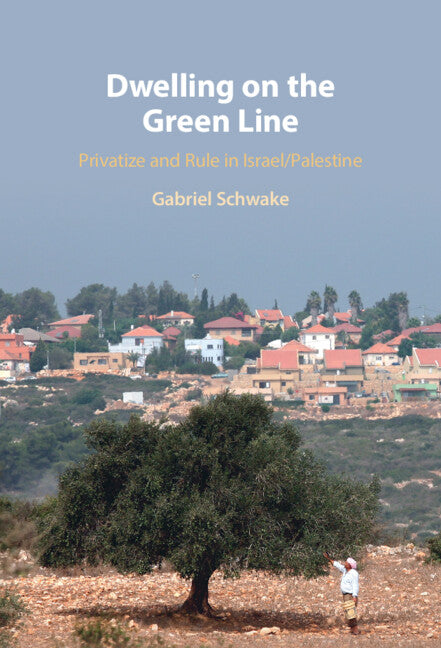
Analyses settlements between Israel and the West-Bank, the Green-Line, exploring the influence of geopolitics and geoeconomics on the production of space.
Gabriel Schwake (Author)
9781316512890, Cambridge University Press
Hardback, published 17 March 2022
296 pages
23.5 x 15.7 x 2.2 cm, 0.568 kg
'Offering a valuable critical perspective on the relationships between privatisation processes and the production of settler-colonial space in Israel, this book, which is based on a rich and original empirical study, argues that privatisation of settlement development, the production of the built environment and the erection of infrastructure such as the Trans‐ Israel Highway large projects goes beyond Israel's economic growth, rather is a complementary tool of geopolitical expansion. Importantly, the book focusses on an overlooked territorial unit, namely the frontier with the occupied West‐Bank. This book is a must-read as in offers a productive lens to understand the territorial reality, spatial politics and social fragmentation of Israel while engaging with critical theory.' Haim Yacobi, University College London
Concealed within the walls of settlements along the Green-Line, the border between Israel and the occupied West-Bank, is a complex history of territoriality, privatisation and multifaceted class dynamics. Since the late 1970s, the state aimed to expand the heavily populated coastal area eastwards into the occupied Palestinian territories, granting favoured groups of individuals, developers and entrepreneurs the ability to influence the formation of built space as a means to continuously develop and settle national frontiers. As these settlements developed, they became a physical manifestation of the relationship between the political interest to control space and the ability to form it. Telling a socio-political and economic story from an architectural and urban history perspective, Gabriel Schwake demonstrates how this production of space can be seen not only as a cultural phenomenon, but also as one that is deeply entangled with geopolitical agendas.
PREFACE
1. INTRODUCTION
2. BACKGROUND
3. [Neo]RURALISATION & THE COMMUNITY SETTLEMENT
4. GENTRIFICATION & THE SUBURBAN SETTLEMENT
5. MASS-SUBURBANISATION & THE STARS SETTLEMENT
6. FINANCIALISATION & HARISH CITY
7. CONCLUSIONS.
Subject Areas: International relations [JPS], Politics & government [JP], Middle Eastern history [HBJF1]