Freshly Printed - allow 10 days lead
Couldn't load pickup availability
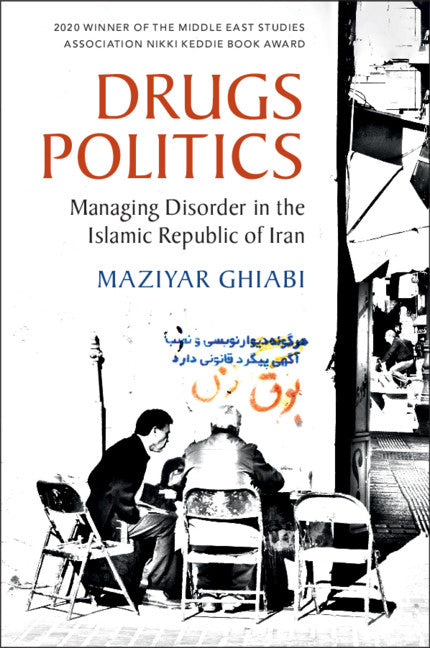
Drugs Politics
Managing Disorder in the Islamic Republic of Iran
Offers new and cutting-edge research on the role of drugs in Iranian society and government. This title is also available as Open Access on Cambridge Core.
Maziyar Ghiabi (Author)
9781108466936, Cambridge University Press
Paperback / softback, published 13 May 2021
364 pages
15 x 23 x 2 cm, 0.53 kg
'[Ghiabi] has done some remarkable field work, interviewing addicts and officials at the highest and lowest levels of society to produce a vivid dissection of the Iranian body politic in all its humanity, its saints and sinners.' Antony Wynn, Asian Affairs
Iran has one of the world's highest rates of drug addiction: estimated to be between 2 and 7 percent of the entire population. This makes the questions that this book asks all the more salient: what is the place of illegal substances in the politics of modern Iran? How have drugs affected the formation of the Iranian state and its power dynamics? And how have governmental attempts at controlling and regulating illicit drugs affected drug consumption and addiction? By answering these questions, Maziyar Ghiabi suggests that the Islamic Republic of Iran's image as an inherently conservative state is not only misplaced and inaccurate, but in part a myth. In order to dispel this myth, he skilfully combines ethnographic narratives from drug users, vivid field observations from 'under the bridge', with archival material from the pre- and post-revolutionary era, statistics on drug arrests and interviews with public officials. This title is also available as Open Access on Cambridge Core.
1. The drugs assemblage, Part I: 2. A genealogy of drugs politics: opiates under the Pahlavi
3. Drugs, revolution, war
4. Reformism and drugs: formal and informal politics of harm reduction
5. Crisis as an institution: the Expediency Council
Part II: 6. The anthropological mutation of methamphetamines
7. The maintenance of disorder
8. Drugs and populism: Ahmadinejad and grassroots authoritarianism.
Subject Areas: Politics & government [JP], Social welfare & social services [JKS], Illness & addiction: social aspects [JFFH], Middle Eastern history [HBJF1]