Freshly Printed - allow 7 days lead
Couldn't load pickup availability
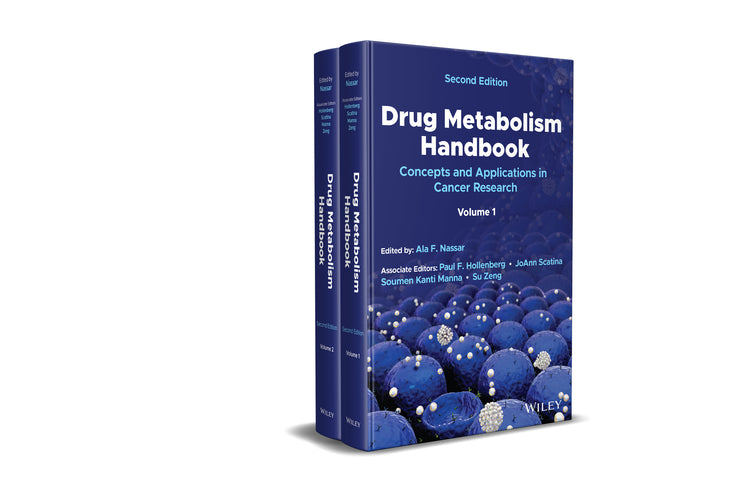
Drug Metabolism Handbook
Concepts and Applications in Cancer Research
Ala F. Nassar (Edited by), Paul F. Hollenberg (Associate editor), JoAnn Scatina (Associate editor), Soumen Kanti Manna (Associate editor), Su Zeng (Associate editor)
9781119851011, Wiley
Hardback, published 9 March 2023
1056 pages
23.8 x 16.7 x 6 cm, 2.079 kg
Mit der neu überarbeiteten zweiten Auflage von Drug Metabolism Handbook: Concepts and Applications in Cancer Research legt ein anerkanntes Team von Wissenschaftlern eine prägnante, solide Betrachtung des Arzneimittelmetabolismus vor und präsentiert mit zahlreichen Illustrationen und detaillierten Erklärungen die neuesten Werkzeuge und Techniken, die in der Forschung, Pharmakologie und Medizin verwendet werden. In diesem Buch werden die Schaffung neuer molekularer Einheiten, die Entwicklung von Arzneimitteln, die Fehlerbehebung und andere äußerst relevante Konzepte besprochen, um der Leserschaft neue Anwendungen in der Forschung, Entwicklung und Bewertung von Arzneimitteln nahezubringen.
Die neueste Ausgabe enthält aktualisierte Inhalte zu den Grundlagen des Metabolismus und zur Anwendung verschiedener neuer Techniken wie Massenspektrometrie, bildgebender Verfahren, Metabolomik und Immuntherapie in der Krebsbehandlung. Darüber hinaus wird in ausführlichen Fallstudien die Rolle des Metabolismus in der Arzneimittelentwicklung betrachtet.
Außerdem bietet das Werk:
* Eine gründliche Einführung in den Arzneimittelmetabolismus, auch aus historischer Sicht, sowie Erläuterungen zu Faktoren, die den Metabolismus beeinflussen, und zu Biotransformationen im Arzneimittelmetabolismus
* Umfassende Erörterungen der Technologien für In-vitro- und In-vivo-Studien, insbesondere der Massenspektrometrie und der beschleunigten Identifizierung von Metaboliten durch Massenspektrometrie
* Eine eingehende Untersuchung der Arzneimittelinteraktionen, insbesondere der Enzymhemmung und der Inhibition mithilfe des Cytochrom-P450-Systems
* Ausführliche Erläuterungen zur Toxizität von Arzneimitteln sowie zur Rolle des Arzneimittelmetabolismus bei der Toxizität und zu allergischen Reaktionen auf Arzneimittel
Volume 1 Preface xiii List of contributors xv Part I. Introduction 1 1. Historical Perspective 3 1.1 Controversies Spanning Past, Present, and Future 3 1.2 1800s: Discovery of Major Drug Metabolism Pathways (Conti and Bickel, 1977) 5 1.3 1900–1950s: Confirmation of Major Pathways and Mechanistic Studies 8 1.4 1950s–1980: Modern Drug Metabolism Emerges, with Enzymatic Basis 9 1.5 1980–2005: Field Driven by Improved Technologies 10 1.6 2005+: High Technology 10 References 10 2. Factors Affecting Metabolism 13 References 16 3. Biotransformations in Drug Metabolism 17 3.1 Drug Metabolism in Drug Development and Drug Therapy 17 3.2 Prediction of Metabolite and Enzyme Responsible 20 3.3 Functional Group Biotransformations: Phase I, Phase II, and Catalysis 21 3.4 Oxidations and Cytochrome P450 23 3.5 Enzymology and Modifiers of Cytochrome P450s 34 References 39 4. A Comprehensive Picture of Biotransformation in Drug Discovery 41 4.1 Introduction 41 4.2 Rate of Metabolism 43 4.3 Metabolism of Small Molecules 46 4.4 Analytical Technologies in Drug Metabolism 65 4.5 Biotransformation for Novel Modalities – Peptides and Protein Degraders 79 4.6 Conclusion 93 References 93 5. In Vivo Drug Metabolite Kinetics 103 5.1 Introduction 103 5.2 In Vivo Drug Metabolite Kinetic Concepts and Principles 105 5.3 Effect of Inhibition and Induction on Metabolite Kinetics 122 5.4 Determination of Formation and Elimination Clearance of Metabolite 127 5.5 Incorporation of Pharmacologically Active Metabolite(s) in Pharmacokinetic/Pharmacodynamic Modeling 130 5.6 Summary 135 Abbreviations 135 References 137 6. LC-MS/MS-Based Proteomics Methods for Quantifying Drug-Metabolizing Enzymes and Transporters 143 6.1 Introduction 143 6.2 Mass Spectrometry Versus Alternative Protein Quantification Methods 144 6.3 Mass Spectrometry Data Acquisition Methods for Proteomics Analysis 145 6.4 Targeted Approaches 146 6.5 Untargeted Proteomics Approaches 147 6.6 Relative Quantification Versus Absolute Quantification 150 6.7 Label-Based Proteomics 152 6.8 Label-Free Proteomics 155 6.9 DMET Protein Quantification Using LC-MS/MS-Based Proteomics 158 6.10 Potential Application of DMET Expression Studies 160 6.11 Considerations of DMET Protein Quantification Utilizing LC-MS/MS Methods 163 6.12 Conclusion 164 References 164 Part II. Technologies for in vitro and in vivo studies 177 7. Mass Spectrometry 179 7.1 Introduction 179 7.2 A Brief History 180 7.3 The Mass Spectrometry Literature 182 7.4 Mass Spectrometry Instrumentation 183 7.5 Interpretation:What Does it Mean 211 7.6 Conclusions 254 References 255 8. Accelerating Metabolite Identification Mass Spectrometry Technology Drives Metabolite Identification Studies Forward 267 8.1 Introduction 267 8.2 Criteria for LC-MS Methods 269 8.3 Matrices Effect 269 8.4 Tool of Choice for Metabolite Characterization 270 8.5 Strategies for Identifying Unknown Metabolites 274 8.6 Online HD-LC-MS 275 8.7 “All-in-One” Radioactivity Detector, Stop Flow, and Dynamic Flow for Metabolite Identification 282 8.8 Metabolic Activation Studies by Mass Spectrometry 287 8.9 Strategies to Screen for Reactive Metabolites 288 8.10 Summary 289 Abbreviations and Glossary 290 References 299 9. Role of Structural Modifications of Drug Candidates to Enhance Metabolic Stability 303 9.1 Background 303 9.2 Introduction 304 9.3 Significance of Metabolite Characterization and Structure Modification 305 9.4 Enhance Metabolic Stability 305 9.5 Metabolic Stability and Intrinsic Metabolic Clearance 306 9.6 Advantages of Enhancing Metabolic Stability 307 9.7 Strategies to Enhance Metabolic Stability 307 9.8 Analytical Tools 317 9.9 Case Studies 318 9.10 Conclusions 320 References 320 10. Drug Design Strategies: Role of Structural Modifications of Drug Candidates to Improve PK Parameters of New Drugs 323 10.1 Active Metabolites 323 10.2 Oral Absorption and Intravenous Dose 333 10.3 PK Analysis 333 10.4 Case Studies 334 10.5 Prodrugs to IncreaseWater Solubility 338 10.6 Conclusion 339 References 340 11. Chemical Structural Alert and Reactive Metabolite Concept as Applied in Medicinal Chemistry to Minimize the Toxicity of Drug Candidates 345 11.1 Importance of Reactive Intermediates in Drug Discovery and Development 345 11.2 Idiosyncratic Drug Toxicity and Molecular Mechanisms 349 11.3 Key Tools and Strategies to Improve Drug Safety 352 11.4 Peroxidases 357 11.5 Acyl Glucuronidation and S-Acyl-CoA Thioesters 358 11.6 Covalent Binding 359 11.7 Mechanistic Studies 360 11.8 Preclinical Development 363 11.9 Clinical Development: Strategy 364 11.10 Case Studies 364 11.11 Conclusion and Future Possibilities 366 References 367 12. Studies of Reactive Metabolites using Genotoxicity Arrays and Enzyme/DNA Biocolloids – 2021 373 12.1 Introduction 373 12.2 On Demand Metabolic Reactions 374 12.3 Arrays with Electrochemical Detection 376 12.4 Electrochemiluminescent Arrays 379 12.5 ECL Arrays can Measure Both DNA Oxidation and Nucleobase Adduction 388 12.6 Detecting Site-Specific Damage to TUMOR SUPPRESSORGenes 392 12.7 Emerging Technologies and Methods 394 12.8 Conclusions and Future Outlook 398 Acknowledgments 399 Biographies 399 References 399 Part III. Drug interactions 407 13. Enzyme Inhibition 409 13.1 Introduction 409 13.2 Mechanisms of Enzyme Inhibition 411 13.3 Competitive Inhibition 412 13.4 Noncompetitive Inhibition 413 13.5 Uncompetitive Inhibition 414 13.6 Product Inhibition 414 13.7 Transition-State Analogs 415 13.8 Slow, Tight-Binding Inhibitors 415 13.9 Mechanism-Based Inactivators 415 13.10 Inhibitors that are Metabolized to Reactive Products that Covalently Attach to the Enzyme 418 13.11 Substrate Inhibition 419 13.12 Partial Inhibition 419 13.13 Inhibition of Cytochrome P450 Enzymes 420 13.14 Reversible Inhibitors 421 13.15 Quasi-Irreversible Inhibitors 421 13.16 Mechanism-Based Inactivators 422 References 424 14. Xenobiotic Receptor-Mediated Gene Regulation in Drug Metabolism and Disposition 427 14.1 Introduction 427 14.2 Pregnane X Receptor 429 14.3 Constitutive Androstane/Activated Receptor (CAR) 441 14.4 Closing Remarks and Perspectives 452 Acknowledgments 453 References 453 15. Characterization of Cytochrome P450 Mechanism Based Inhibition 465 15.1 Introduction 465 15.2 Inhibitors that Upon Activation Bind Covalently to the P450 Apoprotein 475 15.3 Inhibitors that Interact in a Pseudoirreversible Manner with Heme Iron 478 15.4 Inactivation that Cause Destruction of the Prosthetic Heme Group, Often Times Leading to Heme-Derived Products that Covalently Modify the Apoprotein 480 References 515 16. An Introduction to Metabolic Reaction-Phenotyping 527 16.1 Introduction 527 16.2 Significant Drug-Metabolizing Enzymes 528 16.3 Common In VitroMethods to Assess Drug Metabolism 534 16.4 In Vitroto In VivoExtrapolation of Metabolic Clearance 539 16.5 Summary 546 References 546 17. Epigenetic Regulation of Drug-Metabolizing Enzymes in Cancer 553 17.1 Introduction 553 17.2 DNA Methylation of DMEs 554 17.3 Histone Modification 558 17.4 Noncoding RNA 559 17.5 RNA Methylation 561 17.6 Closing Remarks and Perspectives 563 Acknowledgments 564 References 564 18. Epigenetic Regulation of Drug Transporters in Cancer 573 18.1 Introduction 573 18.2 DNA Methylation 575 18.3 Histone Modifications 579 18.4 Noncoding RNAs 581 18.5 Closing Remarks and Perspectives 591 Acknowledgments 592 References 592 Volume 2 Preface xi List of contributors xiii Part IV. Toxicity 605 19. The Role of Drug Metabolism in Toxicity 607 20. Allergic Reactions to Drugs 677 21. Chemical Mechanisms in Toxicology 703 22. Role of Bioactivation Reactions in Chemically Induced Nephrotoxicity 745 Part V. Applications 773 23. Mapping the Heterogeneous Distribution of Cancer Drugs by Imaging Mass Spectrometry 775 24. Systemic Metabolomic Changes Associated with Chemotherapy: Role in Personalized Therapy 811 25. Metabolic Reprogramming in Cancer 841 26. Case Study: Metabolism and Reactions of Alkylating Agents in Cancer Therapy 893 27. Rewiring of Drug Metabolism and Its Cross-talk with Metabolic Reprogramming in Cancer 923 28. Principles of Drug Metabolism and Interactions in Cardio-Oncology 967 Index 993
Roberta S. King
Roberta S. King
Roberta S. King
Joe R. Cannon, Prakash Vachaspati, and Yang Yuan
Zheng Yang
Logan S. Smith, Sun Min Jung, Jiapeng Li, and Hao-Jie Zhu
Thomas R. Sharp
Ala F. Nassar
Ala F. Nassar
Ala F. Nassar
Ala F. Nassar
James F. Rusling and Eli G. Hvastkovs
Paul F. Hollenberg
Hongbing Wang and Wen Xie
Dan A. Rock and Larry C. Wienkers
Carl Davis
Jiaqi Wang, Xiaoli Zheng, and Su Zeng
Yingying Wang, Ying Zhou, Yu Wang, Lushan Yu, and Su Zeng
Umesh M. Hanumegowda and Carl Davis
Mark P. Grillo
Mark P. Grillo
Lawrence H. Lash
Purva S. Damale and Shibdas Banerjee
Bhargab Kalita, Ganesh K. Barik, Tanisha Sharma, Khushman Taunk, Praneeta P. Bhavsar, Manas K. Santra, and Srikanth Rapole
Debasish Prusty and Soumen Kanti Manna
Ala F. Nassar, Adam V. Wisnewski, and Ivan King
Subhabrata Majumder and Soumen Kanti Manna
Sherry-Ann Brown, Craig Beavers, Sailaja Kamaraju, Meera Mohan, Olubadewa Fatunde, Gift Echefu, Svetlana Zaharova, Brianna Wallace, and Carolyn Oxencis
Subject Areas: Chemistry [PN]