Freshly Printed - allow 7 days lead
Couldn't load pickup availability
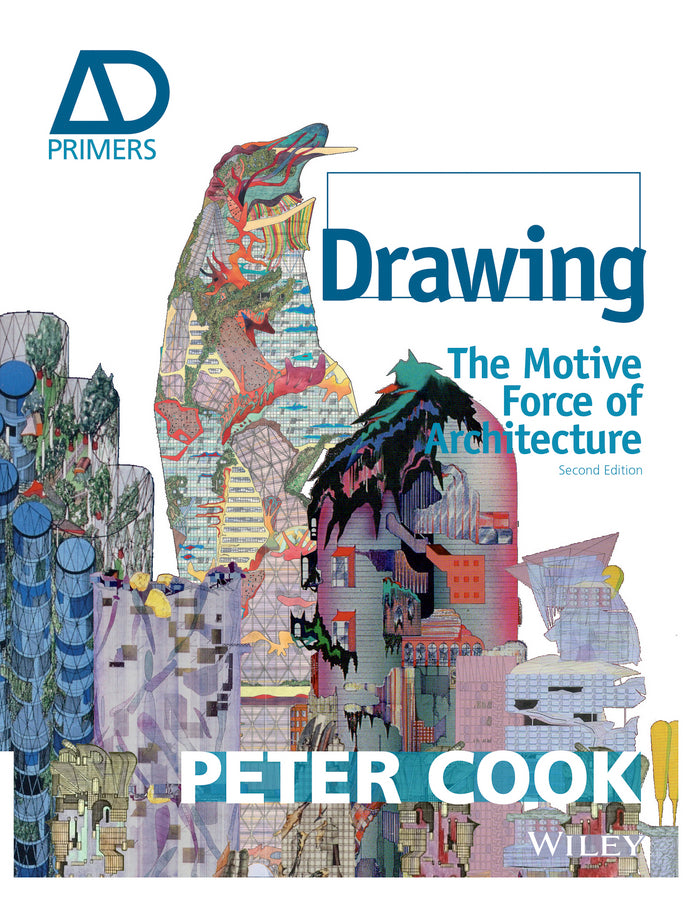
Drawing
The Motive Force of Architecture
Sir Peter Cook (Author)
9781118700648, Wiley
Paperback / softback, published 13 December 2013
256 pages
21.8 x 17 x 2 cm, 0.68 kg
"Peter Cook's enthusiasm for imagined realities and unbuilt schemes is irresistible." (bdonline.co.uk, March 2014)
Drawing Focusing on the creative and inventive significance of drawing for architecture, this book by one of its greatest proponents, Peter Cook, is an established classic. It exudes Cook’s delight and his wide-ranging, catholic tastes for the architectural. Readers are provided with perceptive insights at every turn. The book features some of the greatest and most intriguing drawings by architects, ranging from Frank Lloyd Wright, William Heath Robinson, Le Corbusier and Otto Wagner to Frank Gehry, Zaha Hadid, Coop Himmelb(l)au, Arata Isozaki, Eric Owen Moss, Bernard Tschumi and Lebbeus Woods; as well as key works by Cook and other members of the original Archigram group. For this new edition, Cook provides a substantial new chapter that charts the speed at which the trajectory of drawing is moving. It reflects the increasing sophistication of available software and also the ways in which ‘hand drawing’ and the ‘digital’ are being eclipsed by new hybrids – injecting drawing with a fresh momentum. These ‘crossovers’ provide a whole new territory as attempts are made to release drawing from the boundaries of a solitary moment, a single-viewing position or a single referential language. Featuring the likes of Toyo Ito, Perry Kulper, Izaskun Chinchilla, Kenny Kinugasa-Tsui, Ali Rahim, John Berglund and Lorène Faure, it leads to fascinating insights into the effect that medium has upon intention and definition of an idea or a place. Is a pencil drawing more attuned to a certain architecture than an ink drawing, or is a particular colour evocative of a certain atmosphere? In a world where a Maya® drawing is creatively contributing something different from a Rhinoceros® drawing, there is much to demand of future techniques.
The Motive Force of Architecture
Introduction 008 Chapter 1: Drawing and Motive 010 Chapter 2: Drawing and Strategy 029 Chapter 3: Drawing and Vision 055 Chapter 4: Drawing and Image 074 Chapter 5: Drawing and Composition 092 Chapter 6: Drawing with Expression and Atmosphere 111 Chapter 7: Drawing and Technics 135 Chapter 8: Drawing and Surface 154 Chapter 9: Beyond Drawing – Beyond Reality 177 Chapter 10: Digital–Manual Drawing and the Power of the Eye 203 Index 241 Picture Credits 247
Subject Areas: Architecture [AM]