Special Order - allow 2+ weeks lead
Couldn't load pickup availability
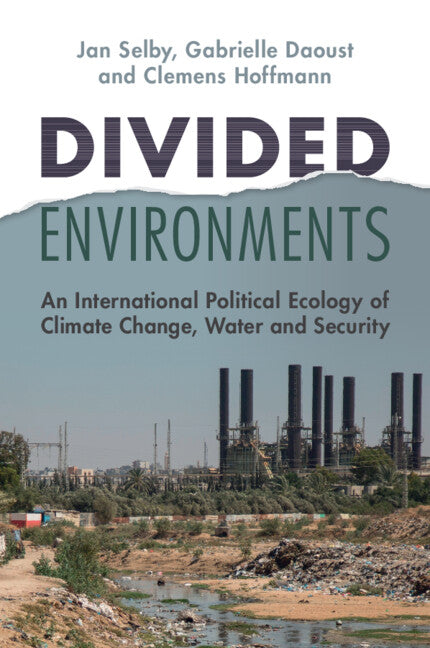
Divided Environments
An International Political Ecology of Climate Change, Water and Security
An original 'international political ecology' analysis of the implications of climate change and water scarcity for twenty-first-century conflict and security.
Jan Selby (Author), Gabrielle Daoust (Author), Clemens Hoffmann (Author)
9781009107600, Cambridge University Press
Paperback / softback, published 22 September 2022
362 pages
22.8 x 15.2 x 1.9 cm, 0.53 kg
'For International Relations to productively contribute to the climate challenge, scholars in the field must interrogate the assumptions and oversimplified analyses which are frequently attached to climate security and climate change politics. This important book highlights and corrects key climate-related claims and is a must-read text for not only climate change activists and policy-makers but for all IR researchers!' Milja Kurki, Aberystwyth University
What are the implications of climate change for twenty-first-century conflict and security? Rising temperatures, it is often said, will bring increased drought, more famine, heightened social vulnerability, and large-scale political and violent conflict; indeed, many claim that this future is already with us. Divided Environments, however, shows that this is mistaken. Focusing especially on the links between climate change, water and security, and drawing on detailed evidence from Israel-Palestine, Syria, Sudan and elsewhere, it shows both that mainstream environmental security narratives are misleading, and that the actual security implications of climate change are very different from how they are often imagined. Addressing themes as wide-ranging as the politics of droughts, the contradictions of capitalist development and the role of racism in environmental change, while simultaneously articulating an original 'international political ecology' approach to the study of socio-environmental conflicts, Divided Environments offers a new and important interpretation of our planetary future.
Preface: 1. Introduction
2. Geography versus demography
3. Drought
4. Others
5. Hydraulics
6. Frontiers
7. War
8. Peace
9. Transformations and circulations
10. Conclusions.
Subject Areas: Social impact of environmental issues [RNT], International relations [JPS], Comparative politics [JPB]