Freshly Printed - allow 7 days lead
Couldn't load pickup availability
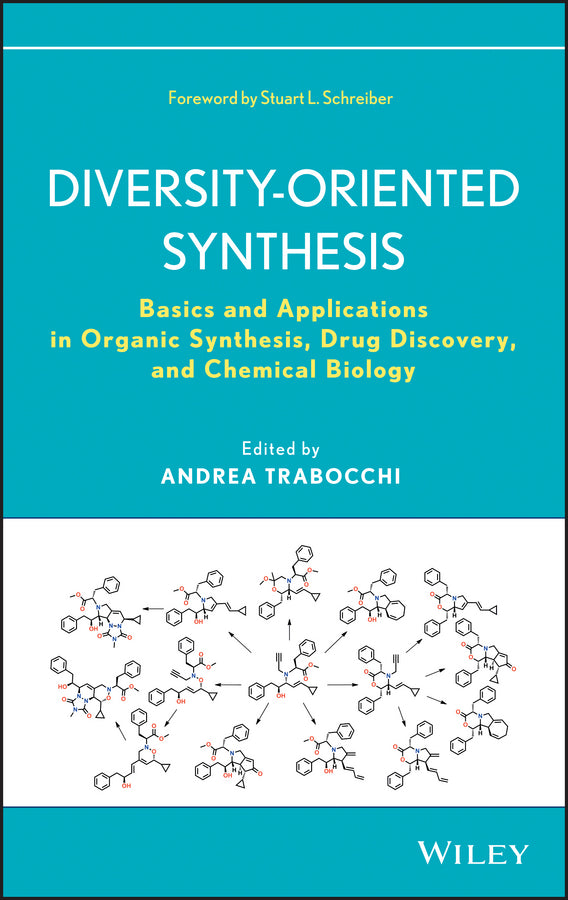
Diversity-Oriented Synthesis
Basics and Applications in Organic Synthesis, Drug Discovery, and Chemical Biology
Andrea Trabocchi (Author), Stuart L. Schreiber (Foreword by)
9781118145654, Wiley
Hardback, published 23 August 2013
680 pages
24.1 x 16.3 x 3.6 cm, 1.052 kg
Discover an enhanced synthetic approach to developing and screening chemical compound libraries Diversity-oriented synthesis is a new paradigm for developing large collections of structurally diverse small molecules as probes to investigate biological pathways. This book presents the most effective methods in diversity-oriented synthesis for creating small molecule collections. It offers tested and proven strategies for developing diversity-oriented synthetic libraries and screening methods for identifying ligands. Lastly, it explores some promising new applications based on diversity-oriented synthesis that have the potential to dramatically advance studies in drug discovery and chemical biology. Diversity-Oriented Synthesis begins with an introductory chapter that explores the basics, including a discussion of the relationship between diversity-oriented synthesis and classic combinatorial chemistry. Divided into four parts, the book: This book has been written and edited by leading international experts in organic synthesis and its applications. Their contributions are based on a thorough review of the current literature as well as their own firsthand experience developing synthetic methods and applications. Clearly written and extensively referenced, Diversity-Oriented Synthesis introduces novices to this highly promising field of research and serves as a springboard for experts to advance their own research studies and develop new applications.
CONTRIBUTORS xv FOREWORD xix PREFACE xxi ABBREVIATIONS xxv 1 The Basics of Diversity-Oriented Synthesis 1 1.1 Introduction, 1 1.2 What Is Diversity-Oriented Synthesis?, 1 1.3 Small Molecules and Biology, 2 1.4 Comparing DOS, TOS, and Combinatorial Chemistry: Focused Library Synthesis, 4 1.5 Molecular Diversity, 5 1.6 Molecular Diversity and Chemical Space, 8 1.7 Synthetic Strategies for Creating Molecular Diversity, 8 1.8 Reagent-Based Approaches to Diversity Generation, 11 1.9 Substrate-Based Approach to Skeletal Diversity Generation, 19 1.10 Other Build/Couple/Pair Examples, 19 1.11 Concluding Remarks, 24 PART I CHEMICAL METHODOLOGY IN DIVERSITY-ORIENTED SYNTHESIS 2 Strategic Applications of Multicomponent Reactions in Diversity-Oriented Synthesis 29 2.1 Introduction, 29 2.2 MCR Products for HTS, 31 2.3 MCRs as Starting Points for DOS, 39 2.4 Conclusions, 55 3 Cycloaddition Reactions in Diversity-Oriented Synthesis 59 3.1 Introduction, 59 3.2 [4+2] Cycloaddition Reactions, 60 3.3 1,3-Dipolar Cycloaddition Reactions, 70 3.4 Miscellaneous Cycloadditions, 83 3.5 Conclusions, 91 4 Phosphine Organocatalysis as a Platform for Diversity-Oriented Synthesis 97 4.1 Introduction, 97 4.2 DOS Using Phosphine Organocatalysis, 100 4.3 Skeletal Diversity Based on a Phosphine Catalysis/Combinatorial Scaffolding Strategy, 116 4.4 A DOS Library Based on Phosphine Organocatalysis: Biological Screening, Analog Synthesis, and Structure–Activity Relationship Analysis, 121 4.5 Conclusions, 129 5 Domino Reactions in Library Synthesis 135 5.1 Introduction, 135 5.2 Pericyclic Domino Reactions, 136 5.3 Anionic Domino Reactions, 150 5.4 Transition-Metal-Mediated Domino Reactions, 159 5.5 Radical Domino Reactions, 165 5.6 Conclusions, 174 6 Diversity-Oriented Synthesis of Amino Acid–Derived Scaffolds and Peptidomimetics: A Perspective 177 6.1 Introduction, 177 6.2 Definition and Classification of Peptidomimetics, 179 6.3 Early Combinatorial Approaches to Peptidomimetic Scaffolds, 180 6.4 Amino Acid–Derived Scaffolds, 183 6.5 Macrocyclic Peptidomimetic Scaffolds, 194 6.6 Conclusions, 197 7 Solid-Phase Synthesis Enabling Chemical Diversity 201 7.1 Introduction, 201 7.2 Skeletal Diversity, 203 7.3 Stereochemical Diversity, 234 7.4 Appendage Diversity, 238 7.5 Build/Couple/Pair Strategy, 239 7.6 Scaffold Hopping, 243 7.7 Conclusions, 249 8 Macrocycles as Templates for Diversity Generation in Drug Discovery 253 8.1 Introduction, 253 8.2 Challenges Associated with Macrocycles, 254 8.3 Macrocyclic Peptides, 259 8.4 Peptidomimetic Macrocycles, 265 8.5 Diversity-Oriented Strategies Based on Nonpeptidic Natural Product Scaffolds, 273 8.6 Conclusions, 281 PART II CHEMICAL LIBRARIES AND DIVERSITY-ORIENTED SYNTHESIS 9 Diversity-Oriented Synthesis of Natural Product–Like Libraries 291 9.1 Introduction, 291 9.2 Libraries Inspired by Natural Product Scaffolds, 292 9.3 Folding Pathways in the Synthesis of Natural Product–Like Libraries, 297 9.4 Branching Pathways in the Synthesis of Natural Product–Like Libraries, 305 9.5 Oligomer-Based Approaches to Natural Product–Like Libraries, 312 9.6 Summary, 320 10 Chemoinformatic Characterization of the Chemical Space and Molecular Diversity of Compound Libraries 325 10.1 Introduction, 325 10.2 Concept of Chemical Space, 326 10.3 General Aspects of Chemoinformatic Methods to Analyze the Chemical Space, 327 10.4 Chemoinformatic-Based Analysis of Libraries using Different Representations, 328 10.5 Recent Trends in Computational Approaches to Characterize Compound Libraries, 344 10.6 Concluding Remarks, 345 11 DNA-Encoded Chemical Libraries 353 11.1 Introduction, 353 11.2 DNA-Encoded Chemical Libraries, 357 11.3 Selection and Decoding, 386 11.4 Drug Discovery by DNA-Encoded Chemical Libraries, 388 11.5 DNA-Encoded Chemical Libraries: Prospects and Outlook, 391 11.6 Conclusions, 393 PART III SCREENING METHODS AND LEAD IDENTIFICATION 12 Experimental Approaches to Rapid Identification, Profiling, and Characterization of Specific Biological Effects of DOS Compounds 403 12.1 Introduction, 403 12.2 Basic Principles of HTS, 405 12.3 Common Assay Methods and Techniques, 415 12.4 Future Perspectives, 428 13 Small-Molecule Microarrays 431 13.1 Introduction, 431 13.2 Chemical Library Design and Synthesis, 432 13.3 Fabrication of SMMs, 438 13.4 Applications of SMM, 446 13.5 Summary and Outlook, 451 14 Yeast as a Model in High-Throughput Screening of Small-Molecule Libraries 455 14.1 Introduction, 455 14.2 Chemical Genetics and S. cerevisiae, 461 14.3 Chemical Genomics and S. cerevisiae, 471 14.4 Conclusions: The Route of Drug Discovery with the Budding Yeast, 477 15 Virtual Screening Methods 483 15.1 Introduction, 483 15.2 Basic Virtual Screening Concepts, 484 15.3 Molecular Similarity in Virtual Screening, 487 15.4 Spectrum of Virtual Screening Approaches, 489 15.5 Docking, 490 15.6 Similarity Searching, 491 15.7 Compound Classification, 496 15.8 Machine Learning, 498 15.9 Conclusions, 501 16 Structure–Activity Relationship Data Analysis: Activity Landscapes and Activity Cliffs 507 16.1 Introduction, 507 16.2 Numerical SAR Analysis Functions, 508 16.3 Principles and Intrinsic Limitations of Activity Landscape Design, 511 16.4 Activity Landscape Representations, 513 16.5 Defining and Identifying Activity Cliffs, 520 16.6 Activity Cliff Survey, 525 16.7 Activity Cliffs and SAR Information, 526 16.8 Concluding Remarks, 528 PART IV APPLICATIONS IN CHEMICAL BIOLOGY AND DRUG DISCOVERY 17 Diversity-Oriented Synthesis and Drug Development: Facilitating the Discovery of Novel Probes and Therapeutics 535 17.1 Introduction, 535 17.2 Case Study 1: Inhibition of Cytokine-Induced -cell Apoptosis, 540 17.3 Case Study 2: Identification of Antimalarials, 548 17.4 Case Study 3: Targeting Protein–Protein and Protein–DNA Interactions, 558 17.5 Conclusions, 570 18 DOS-Derived Small-Molecule Probes in Chemical Biology 575 18.1 Introduction, 575 18.2 DOS-Derived Small-Molecule Probes, 576 18.3 Developing Small-Molecule Probes of Complex Biological Pathways, 576 18.4 Expanding the Collection of Important Biological Probes, 595 18.5 Developing Probes for Therapeutically Desirable Phenotypes, 603 18.6 Natural Product–Inspired Small-Molecule Probes Developed from DOS and Biology-Oriented Synthesis, 606 18.7 Summary and Outlook, 611 References, 611 INDEX 619
Kieron M. G. O'Connell, Warren R. J. D. Galloway, and David R. Spring
John M. Knapp, Mark J. Kurth, Jared T. Shaw, and Ashkaan Younai
Giovanni Muncipinto
Zhiming Wang and Ohyun Kwon
Matthew G. LaPorte, John R. Goodell, Sammi Tsegay, and Peter Wipf
Andrea Trabocchi
Nadezda Canka¡rova and Viktor Krch¡nak
Eric Marsault
Mark Dow, Francesco Marchetti, and Adam Nelson
Jose Luis Medina-Franco
Luca Mannocci
Eduard A. Sergienko and Susanne Heynen-Genel
Hongyan Sun
Irene Stefanini, Carlotta De Filippo, and Duccio Cavalieri
Jurgen Bajorath
Jurgen Bajorath
Jeremy R. Duvall, Eamon Comer, and Sivaraman Dandapani
Nicholas Hill, Lingyan Du, and Qiu Wang
Subject Areas: Chemistry [PN]