Freshly Printed - allow 6 days lead
Couldn't load pickup availability
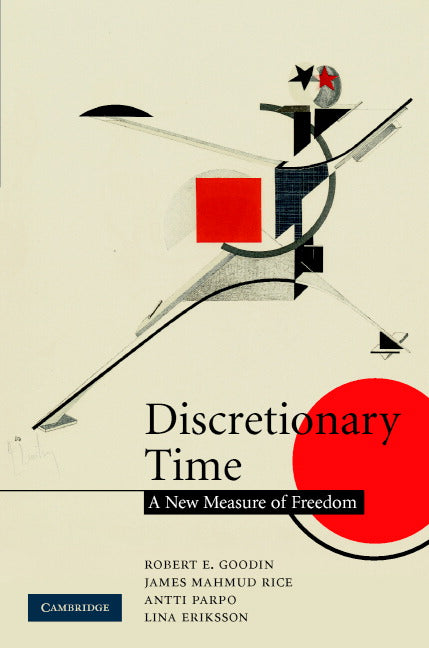
Discretionary Time
A New Measure of Freedom
A novel study of how much control people have over their time and work-life balance.
Robert E. Goodin (Author), James Mahmud Rice (Author), Antti Parpo (Author), Lina Eriksson (Author)
9780521882989, Cambridge University Press
Hardback, published 21 February 2008
482 pages, 41 b/w illus. 41 tables
23.5 x 16 x 3.2 cm, 0.898 kg
'This book makes fascinating reading and invites further questions.' Managing Leisure
A healthy work-life balance has become increasingly important to people trying to cope with the pressures of contemporary society. This trend highlights the fallacy of assessing well-being in terms of finance alone; how much time we have matters just as much as how much money. The authors of this book have developed a novel way to measure 'discretionary time': time which is free to spend as one pleases. Exploring data from the US, Australia, Germany, France, Sweden and Finland, they show that temporal autonomy varies substantially across different countries and under different living conditions. By calibrating how much control people have over their time, and how much they could have under alternative welfare, gender or household arrangements, this book offers a new perspective for comparative cross-national enquiries into the temporal aspects of human welfare.
Part I. Introduction: 1. Time and money
2. Discretionary time
3. The distribution of discretionary time
Part II. Time Pressure: 4. Time pressure: a new problem?
5. Time pressure: a new measure
6. Is it really an illusion?
Part III. Welfare Regimes Matter: 7. How welfare regimes differ
8. A temporal perspective on welfare regimes
9. Welfare regimes and temporal autonomy
Part IV. Gender Regimes Matter: 10. How gender regimes differ
11. A temporal perspective on gender regimes
12. Gender regimes and temporal autonomy
Part V. Household Regimes Matter: 13. How household regimes differ
14. The difference that household rules make
15. The difference that states make
16. Alternative household rules and temporal autonomy
Part VI. Conclusions: 17. Conclusions
Appendix 1. Methodology
Appendix 2. Data.
Subject Areas: Political economy [KCP], Economics [KC], Comparative politics [JPB], Social & political philosophy [HPS]