Freshly Printed - allow 7 days lead
Couldn't load pickup availability
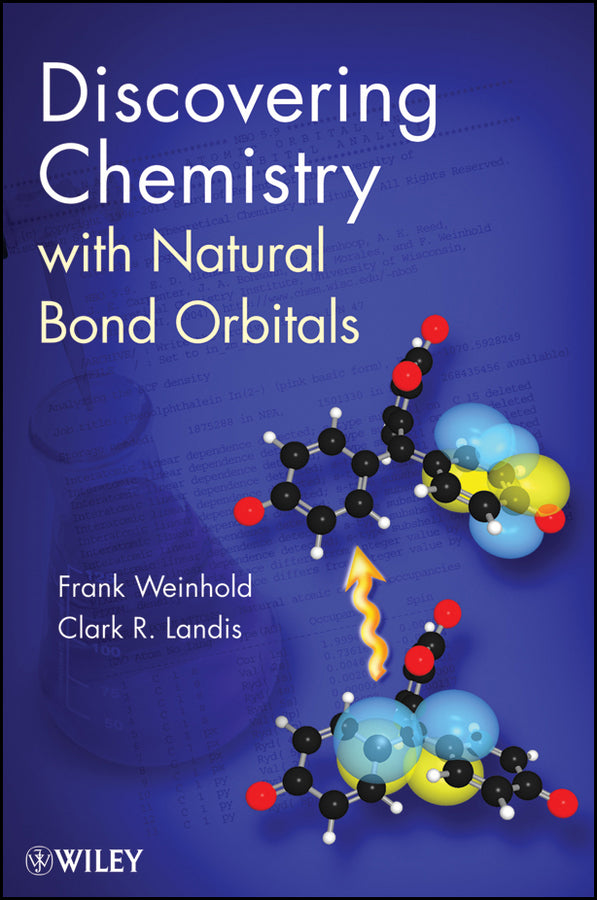
Discovering Chemistry With Natural Bond Orbitals
Frank Weinhold (Author), Clark R. Landis (Author)
9781118119969, Wiley
Paperback / softback, published 27 July 2012
352 pages
23.6 x 15.8 x 1.8 cm, 0.517 kg
“Following this text’s clear explanations, even readers with limited backgrounds in quantum mechanics will learn how to perform sophisticated explorations of modern bonding and valency concepts.” (Chimie Nouvelle, 1 March 2013)
This book explores chemical bonds, their intrinsic energies, and the corresponding dissociation energies which are relevant in reactivity problems. It offers the first book on conceptual quantum chemistry, a key area for understanding chemical principles and predicting chemical properties. It presents NBO mathematical algorithms embedded in a well-tested and widely used computer program (currently, NBO 5.9). While encouraging a "look under the hood" (Appendix A), this book mainly enables students to gain proficiency in using the NBO program to re-express complex wavefunctions in terms of intuitive chemical concepts and orbital imagery.
Preface xi 1 Getting Started 1 1.1 Talking to your electronic structure system 1 1.2 Helpful tools 3 1.3 General $NBO keylist usage 4 1.4 Producing orbital imagery 6 Problems and exercises 8 2 Electrons in Atoms 10 2.1 Finding the electrons in atomic wavefunctions 10 2.2 Atomic orbitals and their graphical representation 13 2.3 Atomic electron configurations 18 2.4 How to find electronic orbitals and configurations in NBO output 23 2.5 Natural atomic orbitals and the natural minimal basis 29 Problems and exercises 31 3 Atoms in Molecules 34 3.1 Atomic orbitals in molecules 35 3.2 Atomic configurations and atomic charges in molecules 39 3.3 Atoms in open-shell molecules 44 Problems and exercises 49 4 Hybrids and Bonds in Molecules 51 4.1 Bonds and lone pairs in molecules 52 4.2 Atomic hybrids and bonding geometry 60 4.3 Bond polarity, electronegativity, and Bent’s rule 71 4.4 Hypovalent three-center bonds 78 4.5 Open-shell Lewis structures and spin hybrids 82 4.6 Lewis-like structures in transition metal bonding 86 Problems and exercises 89 5 Resonance Delocalization Corrections 92 5.1 The natural Lewis structure perturbative model 93 5.2 Second-order perturbative analysis of donor–acceptor interactions 96 5.3 $Del energetic analysis [integrated ESS/NBO only] 105 5.4 Delocalization tails of natural localized molecular orbitals 113 5.5 How to $CHOOSE alternative Lewis structures 117 5.6 Natural resonance theory 123 Problems and exercises 133 6 Steric and Electrostatic Effects 135 6.1 Nature and evaluation of steric interactions 136 6.2 Electrostatic and dipolar analysis 145 Problems and exercises 153 7 Nuclear and Electronic Spin Effects 155 7.1 NMR chemical shielding analysis 156 7.2 NMR J-coupling analysis 162 7.3 ESR spin density distribution 168 Problems and exercises 173 8 Coordination and Hyperbonding 176 8.1 Lewis acid–base complexes 178 8.2 Transition metal coordinate bonding 193 8.3 Three-center, four-electron hyperbonding 204 Problems and exercises 206 9 Intermolecular Interactions 209 9.1 Hydrogen-bonded complexes 210 9.2 Other donor–acceptor complexes 217 9.3 Natural energy decomposition analysis 223 Problems and exercises 227 10 Transition State Species and Chemical Reactions 231 10.1 Ambivalent Lewis structures: the transition-state limit 232 10.2 Example: bimolecular formation of formaldehyde 236 10.3 Example: unimolecular isomerization of formaldehyde 243 10.4 Example: SN2 halide exchange reaction 246 Problems and exercises 249 11 Excited State Chemistry 252 11.1 Getting to the “root” of the problem 252 11.2 Illustrative applications to NO excitations 256 11.3 Finding common ground: NBO versus MO state-to-state transferability 269 11.4 NBO/NRT description of excited-state structure and reactivity 277 11.5 Conical intersections and intersystem crossings 282 Problems and exercises 289 Appendix A: What’s Under the Hood? 297 Appendix B: Orbital Graphics: The NBOView Orbital Plotter 300 Appendix C: Digging at the Details 302 Appendix D: What If Something Goes Wrong? 304 Appendix E: Atomic Units (a.u.) and Conversion Factors 307 Index 309
Subject Areas: Chemistry [PN]