Freshly Printed - allow 7 days lead
Couldn't load pickup availability
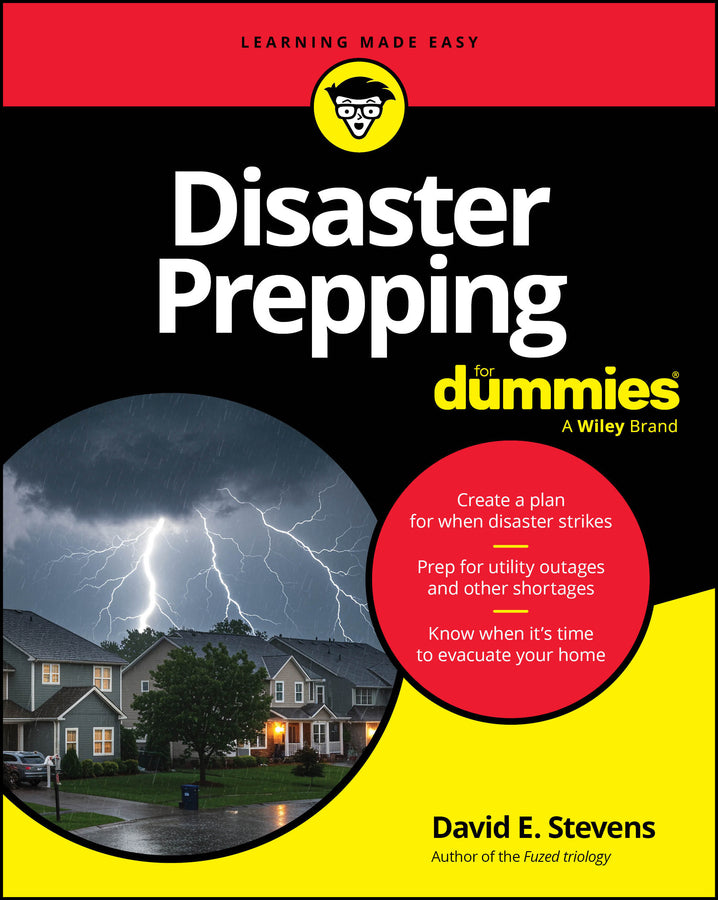
Disaster Prepping For Dummies
David E. Stevens (Author)
9781394388745, Wiley
Paperback / softback, published 20 April 2026
368 pages
22.9 x 18.3 x 2.5 cm, 0.499 kg
A grounded, effective guide to preparing for serious natural and man-made disasters In Disaster Prepping For Dummies, experienced Navy pilot, writer, speaker, and disaster preparedness expert David E. Stevens delivers an eye-opening and practical guide to preparing yourself and your family for natural and man-made disasters. You'll learn to develop a survival mindset that equips you to handle the real-world issues that arise when things go sideways. You'll discover how to prioritize the resources you would need to survive, including shelter, water, food, and communication. Stevens brings a down-to-earth realism to a subject that's often clouded by outlandish paranoia and head-in-the-sand denialism. He explains how you can prepare for specific disasters—like earthquakes, hurricanes, wars, and blackouts—while keeping the risks in perspective. He shows you how to make measured, proportional preparations to support yourself and your loved ones in the event of large-scale disruptions to society. Inside the book: Perfect for everyone concerned about the possibility of natural and human-caused disaster events, Disaster Prepping For Dummies is a realistic and hands-on roadmap to identifying your risk exposure and taking simple, practical steps to improving your ability to survive and thrive in the face of unexpected events.
Introduction 1 About This Book 2 Foolish Assumptions 3 Icons Used in This Book 3 Beyond the Book 4 Where to Go from Here 4 Part 1: Preparing for Prepping 5 Chapter 1: Preparing for the Worst or Something Less 7 Prepping 8 Understanding the threat 8 Surviving with the basics: Air, water, food, septic, and medical 8 Sheltering in place: Staying connected, powered, and protected 9 Evacuating: When, how, and with what 10 Achieving independence from municipal infrastructure 10 Having some fun while prepping 11 Developing a Survival Mindset 12 Surviving an apocalyptic disaster 12 Mind: Learning to “MacGyver” 13 Attitude 14 MacGyvering 14 Humor 14 Body: Evaluating Your Physical Condition 15 Medication 15 Fitness 15 Spirit: Understanding the Impact of Spiritual Outlook 16 Chapter 2: Identifying the Top Potential Global Disasters 19 Ranking by Probability and Consequence 20 1: Asteroids/comets: Increasing odds of a catastrophic impact 20 2: Artificial general intelligence: Arriving sooner than you think 26 3: Global war: Growing international tension and rogue states 30 4: Biological threat: Expanding biotechnology and pandemics 31 5: Solar superstorm: Taking out the global power grid 33 6: Super volcano: Exploding cubic miles of ash 35 7: Climate change: Growing superstorms and a slow-motion train wreck 38 Estimating the Odds of Global Disasters 39 Table of Contents iii Chapter 3: Identifying Local Disasters and Their Impacts 41 Evaluating Vulnerability 42 Hurricanes/Typhoons: Surging Water Carries Away Houses, Cars, and People 43 Classifying hurricanes 43 Considering storm surge 44 Assessing risk 45 Taking immediate action 46 Preparing 46 Heat Waves: Overheating Is the #1 Cause of Weather-Related Fatalities 46 Assessing risk 47 Taking immediate action 47 Preparing 47 Floods: Drowning Is the #1 Cause of Storm-Related Fatalities 48 Assessing risk 48 Taking immediate action 49 Preparing 49 Tornadoes: Blowing Away Structures and Creating Deadly Projectiles 49 Assessing risk 50 Taking immediate action 51 Preparing 51 Wildfires: Driving Winds Push Fires and Kill by Smoke Inhalation 51 Assessing risk 51 Taking immediate action 52 Preparing 52 Earthquakes: Collapsing Roofs and Walls Cause Most Fatalities 52 Assessing risk 52 Taking immediate action 53 Preparing 53 Industrial/Nuclear Accidents: Poisoning the Air You Breathe 53 Assessing risk 53 Taking immediate action 54 Preparing 54 Blizzards/Ice Storms: Freezing without the Power Grid 54 Assessing risk 54 Taking immediate action 55 Preparing 55 Active Shooter: Running, Hiding, Attacking 55 Assessing risk 55 Taking immediate action 55 Preparing 56 Cyberattack: Shutting Down the Digital Economy and Your Bank 57 Assessing risk 57 Taking immediate action 57 Preparing 57 Chapter 4: Avoiding Personal Disasters 59 Evaluating Your Vulnerability 59 Avoiding Fraud, Identity Theft, and Cyberattacks 60 Losing Your Job 62 Spiraling Debt 63 Suffering a serious injury or illness 65 Losing your significant other 66 Part 2: Surviving — Basic Life Support 67 Chapter 5: Breathing When the Air Is Toxic 69 Level 1: Protecting Yourself from Toxic Gases, Bacteria, and Viruses 70 Stocking N95 masks and knowing their limitations 70 Upgrading to a paint respirator for better filtering and dual use 71 Escaping with small cans of pressurized oxygen 72 Improving air filtration with central air HVAC systems 74 Improving air filtration if you don’t have central air 75 Level 2: Securing the Air in Your Home for Longer-Term Disasters 75 Upgrading to a gas mask 75 Sealing doors and windows to reduce air infiltration 76 Installing an ultraviolet air purifier 77 Buying a standalone air purifier 78 Expanding your portable oxygen supply 79 Considering your vehicle’s need for air 80 Chapter 6: Drinking When the Faucets Run Dry 81 Determining How Much Water You Need 82 Calculating water for drinking 82 Calculating water for flushing 82 Calculating water for cleaning 83 Calculating water example and worksheet 84 Acquiring Immediate Water When Water Pressure Is Lost (Level 1) 85 Accessing water that you may already have 85 Stockpiling water 87 Treating contaminated water 90 Securing Water for Longer Duration Disasters (Level 2) 94 Creating a larger water reserve 94 Collecting and treating water 94 Finding new sources of water 95 Using an atmospheric water generator 96 Chapter 7: Eating When the Grocery Stores Shut Down 99 Determining How Much and What Kind of Food You Need 100 Forget the old food pyramid; for survival, fat is your friend 100 Testing the best types of survival foods 102 Acquiring Basic Survival Foods for a Week or Two (Level 1) 102 Identifying the right types of food 103 Choosing optimum foods to fill your pantry 104 Trying a multi-day fast to learn your body’s response 109 Securing Enough Food for a Month (Level 2) 109 Stocking basic staples 109 Using powdered and freeze-dried foods 110 Expanding your nutritional supplements 111 Choosing to maintain a vegetarian or vegan diet 112 Evaluating ready-made survival foods 113 Fishing and hunting 114 Chapter 8: Pooping When the Sewer Stops Working 117 Creating a Backup Plan for When Things Back Up (Level 1) 118 Gloves 118 Trash 118 Municipal or city sewer system failure 119 Toilets to go 120 Finishing up the paperwork 121 Using Technology to Improve the “Backup” Plan (Level 2) 121 Chapter 9: Treating Injuries and Illness without Emergency Medical Services 123 Understanding Your Personal Health 124 Evaluating your medical condition and medication requirements 124 Consulting with your doctor to consolidate or eliminate medications 125 Acquiring First Aid Kits and Supplies (Level 1) 125 Getting first aid training and having a medical guide 125 Stocking over-the-counter medications 126 Stocking your prescription medications 127 Choosing or Building First Aid Kits 128 Nitrile gloves 129 Epinephrine Autoinjector 131 Venomous snake or insect bite medication 131 Radiation exposure measures 132 Expanding Your Medications and Supplies for Longer-Term Disasters (Level 2) 133 Requesting important emergency medications 133 Creating a shelter agreement with medical personnel 134 Part 3: Sheltering 135 Chapter 10: Sheltering in Place 137 Preparing to Stay (Level 1) 137 Finding immediate shelter for time-critical disasters 137 Improving Your Home’s Security (Level 2) 144 Fortifying your home from storms and intruders 145 Creating an earthquake sanctuary inside your home 149 Improving your home’s resistance to wildfires 150 Using an RV for a Backup Shelter 151 Chapter 11: Connecting without the Networks 153 Using Apps That Provide Advanced Warning 153 Wireless Emergency Alerts 154 Weather apps 154 Space weather apps 155 Wildfire apps 155 General warning apps 155 Staying Connected When the Cell Phone Network Fails (Level 1) 155 Understanding cell phone network and Internet vulnerability 156 Using radios 158 Using your cell phone without cell phone towers 160 Texting via satellite 161 Protecting electronic devices from EMPs 162 Setting up non-local emergency points of contact 164 Staying Connected Long-Term from Anywhere (Level 2) 165 Iridium satellite network phones 165 Switching your Internet to a satellite network 166 Protecting your entire home from an EMP 169 Storing and accessing digital information 169 Chapter 12: Powering without the Power Grid 171 Understanding and Prioritizing Power 172 Defining power grid limitations 172 Prioritizing power 172 Understanding how much power you need 173 Powering Communication, Lights, and Medical Equipment (Level 1) 177 Powering critical medical equipment 177 Powering communication and lighting 178 Jump-starting your car and phones with one device 181 Dealing with the loss of refrigeration, heating, or air conditioning 183 Exploring Power Options (Level 2) 184 Powering with gas generators 185 Portable power stations 189 Portable solar panels and wind turbines 190 Powering Basic Heating and Cooling (Level 2) 191 Combining a gas-powered generator with a portable power station 191 Powering Central Air and More (Level 2+) 198 Powering your home’s central air and heat 198 Bidirectional charging with an electric vehicle (EV) 200 Chapter 13: Protecting Yourself during Civil Unrest 203 Evaluating Your Self-Defense Mindset 204 Keeping a low profile 204 Listening to your gut feeling 204 Trying to be a lone wolf is dangerous 205 Observing Orienting Deciding Acting (OODA) 205 Defending with Non-Lethal Devices (Level 1) 207 Observing 207 Defending with pepper spray 208 Defending with a stun gun 209 Taking self-defense classes 210 Defending with Non-Lethal Devices (Level 2) 211 Surveilling with security cameras 211 Protecting with a bulletproof vest 212 Surveilling with night vision goggles (NVGs) 213 Defending with a gas-propelled stun gun 214 Defending with gas-propelled pepper 215 Nonlethal versus lethal defensive devices 216 Defending with what’s at hand 217 Chapter 14: Defending with Firearms 219 Using Lethal Weapons 220 Understanding Rules of Engagement (ROE) 220 Determining Your Rules of Engagement 221 Dealing with retribution 221 Considering legal consequences 221 Determining strategy based on mindset 221 Evaluating Types of Firearms 222 Rifles and shotguns for home defense 222 Handguns for home defense 222 Choosing a Home Defense and Bug-Out Bag Firearm 223 Home defense handgun 223 Bug-out bag handgun 224 Using Other Resources and Firearm Safety 225 Chapter 15: Fixing Stuff 227 Doing It Yourself (DIY) Repair Mindset 227 Preparing for Failure 228 Avoiding single-point failures 228 Stocking basic tools and supplies 229 Stocking basic maintenance items 231 Troubleshooting Problems 231 Troubleshooting advice from The Greatest Generation 231 Troubleshooting with the Internet 233 Part 4: Evacuating 235 Chapter 16: Evacuating When You Can’t Stay Home 237 Planning an Immediate Escape 237 Determining an escape path 238 Identifying escape aids 238 Determining When to Evacuate 238 Evaluating the resources required to stay 239 Considering physical and medical factors 239 Evacuating with uncertain disaster impact or duration 239 Timing your evacuation 240 Deciding Where to Evacuate 240 Staying with friends or family 240 Considering camping 241 Choosing What to Take with You 242 Bugging out with a bug-out bag 242 Identifying additional important items 244 Considering a Recreational Vehicle for Evacuation 246 Chapter 17: Traveling during a Disaster 247 Evaluating Transportation Options (Level 1) 247 Owning a multispeed bike 247 Using your current vehicle 248 Evaluating Transportation Options (Level 2) 250 Considering pre-1980 vehicles 252 Chapter 18: Funding during a Disaster 253 Maintaining Cash for Emergencies (Level 1) 254 Stashing cash 254 Hiding cash from yourself 254 Having Enough Liquid Assets for an Extended Disaster (Level 2) 255 Stashing more cash 255 Spreading assets across multiple financial institutions 255 Diversifying liquid assets 256 Considering Non-Liquid Assets 259 Expanding Sources of Income 259 Preparing for events that might happen to you 260 Preparing for events that might happen to everyone 260 Developing secondary incomes 261 Choosing a business model or asset 262 Part 5: Next Level Disaster Preparation 263 Chapter 19: Developing Independence from Municipal Water 265 Drilling a Well 266 Catching the Rain — Rainwater Catchment Systems 267 Determining your consumption 268 Determining your home’s rain collection potential 268 Sizing storage tanks 269 Evaluating rainwater catchment for your location 270 Filtering Surface Water: Lakes, Rivers, or the Ocean 271 Filtering freshwater 271 Desalinating ocean water 271 Generating Water from the Air — Atmospheric Water Generators 272 Combining water production options 273 Replacing the municipal sewer system 273 Chapter 20: Developing Independence from the Power Grid 275 Powering with the Wind 276 Powering with Water 277 Powering with the Sun 278 Determining your location’s suitability 279 Choosing a solar array that can power your house 279 Whole-House Generators 282 Chapter 21: Creating a Survival Retreat Destination 285 Choosing a Survival/Vacation Location 285 Choosing an RV, cabin, or house 287 Using an RV at your survival or vacation location 288 Considering a small off-grid camper van 290 Chapter 22: Creating Your Own Shelter 297 Installing a Bomb Shelter 298 Survival/Vacation/Short-Term Rental Cabin 299 Choosing the size 300 Choosing the construction method 301 Optimizing the layout 303 Selecting your utilities 305 Choosing the right HVAC and appliances 307 Designing the “Cabin” 311 Powering with Solar 312 Backing Up with Batteries 312 Optimizing Space 313 Buying a Readymade Off-Grid Cabin for Anywhere 315 Chapter 23: Finding the Right Vehicle 317 Evaluating Disaster Preparation/Daily Driver Vehicle Characteristics 318 Identifying the most important characteristics 318 Identifying security and evacuation characteristics 318 Comparing Electric versus Gas Vehicles 319 Evaluating internal combustion engine (ICE) vehicles 320 Evaluating electric vehicles (EV) 320 Disaster-specific situations for ICE versus EV 321 Determining the Best Vehicles in Their Category 322 Chapter 24: Preventing Global Disasters 323 Preventing Asteroid/Comet Impacts 323 Finding comets 323 Moving a near-earth object (NEO) 324 Penetrating impactor deflection 324 Lasing deflection 325 Educating governments 326 Preparing for Artificial Intelligence 326 Predicting how AI will unfold in the next five years 326 Predicting the global impact of AGI 327 Evaluating immediate AI concerns 329 Preventing an AGI catastrophe 329 Regulating AGI 330 Preventing Nuclear/Biological Disasters 331 Preventing nuclear war 331 Preventing biotechnology disasters 331 Mitigating the Effects of a Solar Superstorm 332 Improving Super Volcano Warning 333 Preparing for Climate Change 333 Trying to reduce the global warming peak 333 Preparing for the effects of climate change 334 Part 6: the Part of Tens 335 Chapter 25: Ten Fun Things to Do While Claiming to Prep 337 Soaking in Your “Emergency Water Supply” 337 Testing “Survival” Desserts 338 Scaring Neighbors by Wearing Night Vision Goggles on Your Deck 338 Playing with Your Walkie Talkies 338 Taking a Tactical Driving Course 339 Designing Your Survival Retreat 339 Finding Vacation/Retreat Destinations with Airbnb 339 Testing Evacuation by Renting an RV 340 Honing Your Fishing Skills 340 Pursuing Related Subjects That Interest You 340 Index 343
Subject Areas: Business & management [KJ]