Freshly Printed - allow 8 days lead
Couldn't load pickup availability
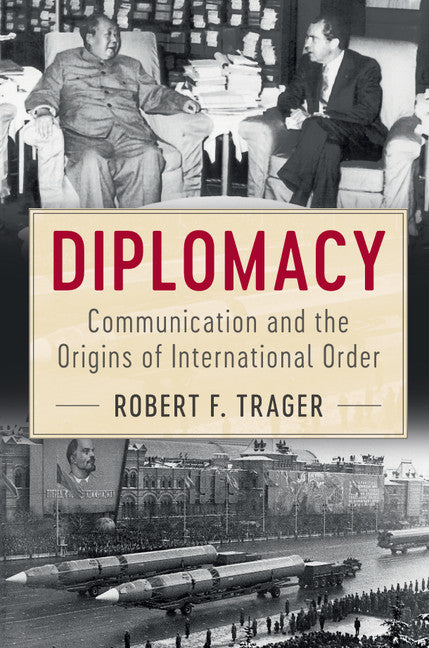
Diplomacy
Communication and the Origins of International Order
This book explores questions such as: How do adversaries communicate? How do diplomatic encounters shape international orders and determine whether states go to war?
Robert F. Trager (Author)
9781107049161, Cambridge University Press
Hardback, published 26 October 2017
300 pages, 33 b/w illus. 8 tables
23.5 x 15.8 x 2.2 cm, 0.55 kg
'All in all, this book is much more than just a welcome addition to the literature on the study of diplomacy, since it successfully breaks new methodological ground and manages to gracefully combine history with political science research and methods, while also contributing to historical debates on seminal diplomatic incidents.' Alexandros Nafpliotis, Diplomatica
How do adversaries communicate? How do diplomatic encounters shape international orders and determine whether states go to war? Diplomacy, from alliance politics to nuclear brinkmanship, almost always operates through a few forms of signaling: choosing the scope of demands on another state, risking a breach in relations, encouraging a protégé, staking one's reputation, or making a diplomatic approach all convey specific sorts of information. Through rich history and analyses of diplomatic network data from the Confidential Print of the British Empire, Trager demonstrates the lasting effects that diplomatic encounters have on international affairs. The Concert of Europe, the perceptions of existential threat that formed before the World Wars, the reduction in Cold War tensions known as détente, and the institutional structure of the current world order were all products of inferences about intentions drawn from the statements of individuals represented as the will of states. Diplomacy explains how closed-door conversations create stable orders and violent wars.
1. Can adversaries communicate?
2. How perceptions of intentions form
Part I. Theory: 3. The scope of demands
4. Risking a breach
5. Balancing allies and adversaries
6. Diplomatic approaches
Part II. Empirical Analysis: 7. The fruit of 1912 diplomacy
8. How Germany weighed British resolve in 1938–9
9. Statistical analysis of diplomatic communication
10. Creating international orders
Appendices: A. Proofs for chapters 3-6
B. Inference data set
C. Threats, offers, and assurance dataset
D. German inferences prior to World War II.
Subject Areas: International relations [JPS], Comparative politics [JPB]