Freshly Printed - allow 7 days lead
Couldn't load pickup availability
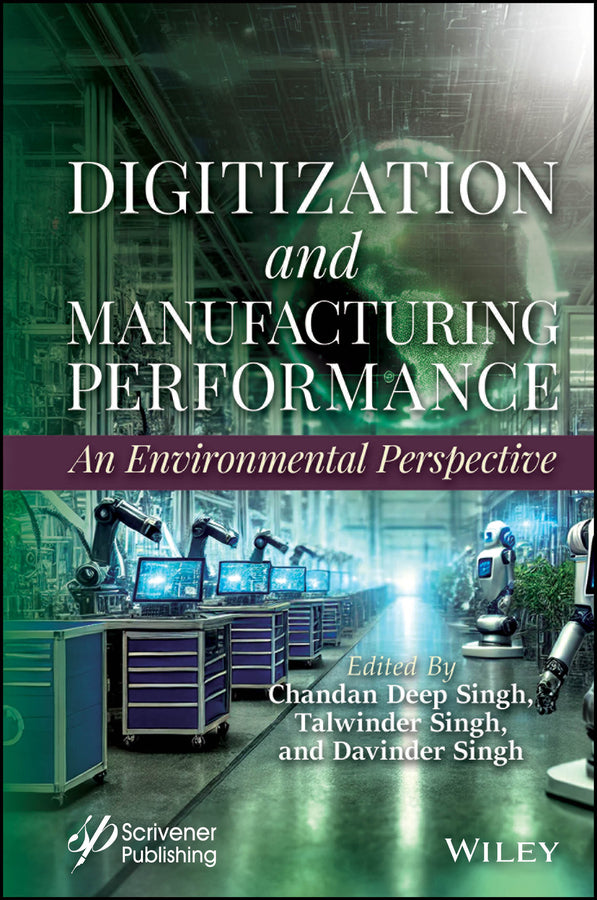
Digitization and Manufacturing Performance
An Environmental Perspective
Chandan Deep Singh (Edited by), Singh (Author), Talwinder Singh (Edited by), Davinder Singh (Edited by)
9781394197767, Wiley
Hardback, published 10 June 2025
320 pages
28 x 19 x 2.6 cm, 0.666 kg
The book provides valuable insights into how modern production strategies can enhance quality, efficiency, and environmental sustainability, ultimately driving profit and competitive advantage in today’s high-tech industry. Today, production strategies are influenced by quality, cost, delivery, innovation, and responsiveness. Firms have traditionally pursued these goals through the adoption of production practices, such as simultaneous engineering, increasing efficiency through the elimination of defects, setup reduction, and worker empowerment. However, recent developments in industry suggest that industry regulators and professional bodies must encourage innovation in a broad range of high-tech production facilities with the environment in mind. The success of the industry depends on production facilities and the competitive advantage that the industry gains due to better quality and reliability. This advantage leads to an increase in sales and the creation of a sound customer base for greater market share, which eventually leads to more profit, growth, and expansion. A firm’s processes must possess operating advantages in the form of competitive priorities to outperform its competitors, keeping in mind its influence on the environment. Digitization and Manufacturing Performance: An Environmental Perspective presents the expectations of industrialists, policymakers, and academics by evaluating the impact of production facilities. Readers will find the book: Audience Researchers, scholars, faculty, professionals in research and development, and industrialists in the industrial, production, mechanical, and electronics sectors.
Preface xv 1 Green Energy Technologies 1 1.1 Introduction 1 1.2 Industrial Processes 4 1.3 Overview of Renewable Energy Technologies 8 1.4 Dedicated Energy Crops 24 1.5 Agricultural Crop Residue 25 1.6 Forestry Residues 25 1.7 Algae 25 1.8 Wood Processing Residues 26 1.9 Sorted Municipal Waste 26 1.10 Wet Waste 26 1.11 What is Solar PV? 31 1.12 Solar Photovoltaic Energy Conversion 32 1.13 What is Waste to Energy? 33 1.14 Where are Nanomaterials Found? 45 2 Recent Advances in Green Energy Materials: A Review 51 2.1 Introduction 52 2.2 Solar Energy Materials 54 2.3 Wind Energy Materials 56 2.4 Hydroelectric Energy Materials 56 2.5 Geothermal Energy Materials 62 2.6 Biomass Energy Materials 64 2.7 Conclusion 70 3 Green Computing Technologies: Toward Sustainable Computing 73 3.1 Introduction 74 3.2 Virtualization and Cloud Computing 79 3.3 Sustainable Computing Practices 84 3.4 Green Computing in Industry and Society 87 3.5 Challenges and Opportunities 90 3.6 Conclusion 93 4 Application of Machine Learning Techniques for Environmental Monitoring and Conservation: A Review 97 4.1 Introduction 98 4.2 Machine Learning Techniques 106 4.3 Applications of Machine Learning in Environmental Aspect 109 4.4 Natural Resource Management and Conservation 113 4.5 Biodiversity Conservation 114 4.6 Waste Management and Recycling 115 4.7 Challenges and Opportunities 116 4.8 Opportunities for the Advancement of Machine Learning in Environmental Aspect 117 4.9 Ethics, Transparency, and Fairness in Machine Learning for Environmental Aspect 118 4.10 Real-World Applications of Machine Learning in Environmental Aspect 120 4.11 Case Studies 121 4.12 Success Stories and Best Practices 122 4.13 Conclusion and Recommendations 124 5 Green Engineering in IoT 129 5.1 Introduction 130 5.2 IoT Data Types 130 5.3 What is Green IoT? 132 5.4 Benefits of Adopting Green IoT 134 5.5 Green IoT Components 135 5.6 Recommendations for Raising Awareness and Future Research Directions 145 6 Green Engineering in Product Development 149 6.1 Introduction and Meaning 149 6.2 Principles of Green Engineering 151 6.3 Benefits of Green Engineering 157 6.4 Promoting Green Engineering Through Green Chemistry 158 6.5 Sustainability and Green Engineering Innovations That Might Just Change the World 159 6.6 Conclusion 163 7 Green Policies in Education: Fostering Environmental Stewardship and Sustainable Practices 167 7.1 Introduction 168 7.2 Theoretical Framework 175 7.3 Policy Development and Implementation 178 7.4 Curriculum Integration and Pedagogy 182 7.5 Infrastructure and Facilities 184 7.6 Student Engagement and Participation 189 7.7 Collaboration and Partnerships 190 7.8 Monitoring, Evaluation, and Reporting 191 7.9 Challenges and Future Directions 196 7.10 Conclusion 207 8 Green Engineering in Automobile Sector 211 8.1 Introduction 211 8.2 Green Engineering in Automobile Design 215 8.3 Conclusion 228 9 Towards Sustainable Manufacturing: Integrating Digital Technologies on the Green Path 235 9.1 Introduction 235 9.2 Digital Technologies for Sustainable Manufacturing with Internet of Things (IoT) 241 9.3 Digital Technologies for Sustainable Manufacturing with Artificial Intelligence 241 9.4 Digital Technologies for Sustainable Manufacturing with Digital Twins 242 9.5 Digital Technologies for Sustainable Manufacturing with Additive Manufacturing (3D Printing) 243 9.6 Digital Technologies for Sustainable Manufacturing with Augmented Reality (AR) 244 9.7 Green Path for Sustainable Manufacturing 245 9.8 Introduction to Green Manufacturing 246 9.9 Future Trends in Sustainable Manufacturing 253 9.10 Emerging Digital Technologies for Sustainable Manufacturing 254 9.11 New Trends in Green Manufacturing Practices 254 9.12 Future Directions for Sustainable Manufacturing 255 9.13 Conclusion 256 9.14 Future Scope 257 10 Smart Manufacturing for a Sustainable Future: A Review 265 10.1 Introduction 266 10.2 Smart Manufacturing for Green Future 267 10.3 Green Supply Chain Management 269 10.4 Waste Reduction 270 10.5 Renewable Energy Integration 271 10.6 Green Product Design 272 10.7 Circular Economy 273 10.8 Water Conservation 274 10.9 Green Data Centers 275 10.10 Conclusion 276 11 Smart Manufacturing for a Greener Future 281 11.1 Introduction and Meaning 281 11.2 Historical Background of Manufacturing 284 11.3 Characteristics and Challenges of Smart Manufacturing Systems 288 11.4 Enabling Mechanisms Toward Smart Manufacturing for Greener Future 291 11.5 Supporting Tool/Methods Toward Smart Manufacturing for Greener Future 294 11.6 Conclusions 296 References 297 Index 299
Chandan Deep Singh
Mukhtiar Singh, Maninder Singh, Jasvinder Singh, Mandeep Singh and Harjit Singh
Maninder Singh, Mukhtiar Singh, Jasvinder Singh, Harjit Singh and Mandeep Singh
Mukhtiar Singh, Maninder Singh, Jasvinder Singh, Harjit Singh and Mandeep Singh
Talwinder Singh and Davinder Singh
Harpreet Sharma, Chandan Deep Singh and Kanwaljeet Singh
Mukhtiar Singh, Maninder Singh, Jasvinder Singh, Harjit Singh and Mandeep Singh
Harjit Singh, Mukhtiar Singh, Jasvinder Singh and Maninder Singh
Harjit Singh, Mukhtiar Singh, Jasvinder Singh and Maninder Singh
Maninder Singh, Mukhtiar Singh, Jasvinder Singh and Harjit Singh
Harpreet Sharma, Chandan Deep Singh and Kanwaljeet Singh
Subject Areas: Mechanical engineering & materials [TG]