Freshly Printed - allow 7 days lead
Couldn't load pickup availability
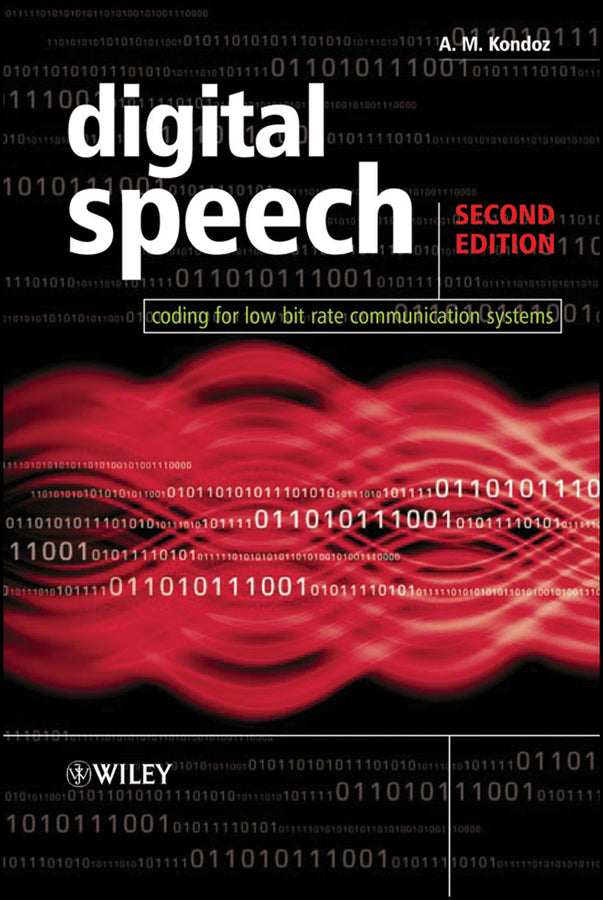
Digital Speech
Coding for Low Bit Rate Communication Systems
A. M. Kondoz (Author)
9780470870082, Wiley
Paperback / softback, published 24 September 2004
464 pages
24.4 x 16.8 x 2.7 cm, 0.68 kg
Building on the success of the first edition Digital Speech offers extensive new, updated and revised material based upon the latest research. This Second Edition continues to provide the fundamental technical background required for low bit rate speech coding and the hottest developments in digital speech coding techniques that are applicable to evolving communication systems. Written by a well-known, highly respected academic, this authoritative volume will be invaluable to practising engineers, network designers, computer scientists and advanced students in communications, electrical and electronic engineering.
Preface xiii 1 Introduction 1 2 Coding Strategies and Standards 5 3 Sampling and Quantization 23 4 Speech Signal Analysis and Modelling 57 5 Efficient LPC Quantization Methods 87 6 Pitch Estimation and Voiced–Unvoiced Classification of Speech 149 7 Analysis by Synthesis LPC Coding 199 8 Harmonic Speech Coding 261 9 Multimode Speech Coding 277 10 Voice Activity Detection 357 11 Speech Enhancement 379 Bibliography 426
Acknowledgements xv
2.1 Introduction 5
2.2 Speech Coding Techniques 6
2.3 Algorithm Objectives and Requirements 9
2.4 Standard Speech Coders 12
2.5 Summary 18
3.1 Introduction 23
3.2 Sampling 23
3.3 Scalar Quantization 26
3.4 Vector Quantization 39
3.5 Summary 54
4.1 Introduction 57
4.2 Short-Time Spectral Analysis 57
4.3 Linear Predictive Modelling of Speech Signals 65
4.4 Pitch Prediction 77
4.5 Summary 84
5.1 Introduction 87
5.2 Alternative Representation of LPC 87
5.3 LPC to LSF Transformation 90
5.4 LSF to LPC Transformation 101
5.5 Properties of LSFs 103
5.6 LSF Quantization 105
5.7 Codebook Structures 110
5.8 MSVQ Performance Analysis 117
5.9 Inter-frame Correlation 121
5.10 Improved LSF Estimation Through Anti-Aliasing Filtering 130
5.11 Summary 146
6.1 Introduction 149
6.2 Pitch Estimation Methods 150
6.3 Voiced–Unvoiced Classification 178
6.4 Summary 196
7.1 Introduction 199
7.2 Generalized AbS Coding 200
7.3 Code-Excited Linear Predictive Coding 219
7.4 Summary 258
8.1 Introduction 261
8.2 Sinusoidal Analysis and Synthesis 262
8.3 Parameter Estimation 263
8.4 Common Harmonic Coders 268
8.5 Summary 275
9.1 Introduction 277
9.2 Design Challenges of a Hybrid Coder 280
9.3 Summary of Hybrid Coders 281
9.4 Synchronized Waveform-Matched Phase Model 285
9.5 Hybrid Encoder 298
9.6 Speech Classification 311
9.7 Hybrid Decoder 319
9.8 Performance Evaluation 320
9.9 Quantization Issues of Hybrid Coder Parameters 322
9.10 Variable Bit Rate Coding 331
9.11 Acoustic Noise and Channel Error Performance 336
9.12 Summary 350
10.1 Introduction 357
10.2 Standard VAD Methods 360
10.3 Likelihood-Ratio-Based VAD 368
10.4 Summary 375
11.1 Introduction 379
11.2 Review of STSA-based Speech Enhancement 381
11.3 Noise Adaptation 402
11.4 Echo Cancellation 406
11.5 Summary 423
Index 429
Subject Areas: Electronics & communications engineering [TJ]