Freshly Printed - allow 7 days lead
Couldn't load pickup availability
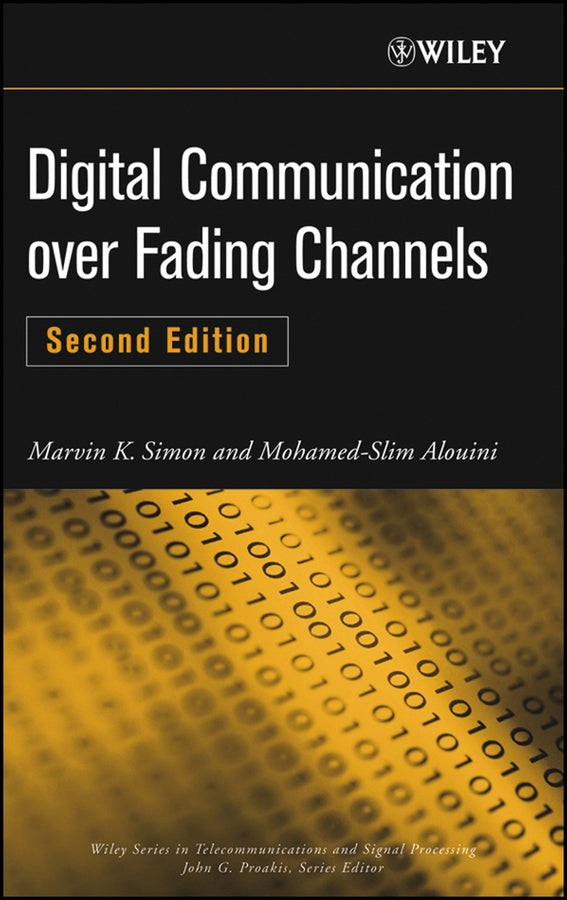
Digital Communication over Fading Channels
Marvin K. Simon (Author), Mohamed-Slim Alouini (Author)
9780471649533, Wiley
Hardback, published 7 January 2005
944 pages
24.5 x 15.8 x 4.9 cm, 1.418 kg
The four short years since Digital Communication over Fading Channels became an instant classic have seen a virtual explosion of significant new work on the subject, both by the authors and by numerous researchers around the world. Foremost among these is a great deal of progress in the area of transmit diversity and space-time coding and the associated multiple input–multiple output (MIMO) channel. This new edition gathers these and other results, previously scattered throughout numerous publications, into a single convenient and informative volume. Like its predecessor, this Second Edition discusses in detail coherent and noncoherent communication systems as well as a large variety of fading channel models typical of communication links found in the real world. Coverage includes single- and multichannel reception and, in the case of the latter, a large variety of diversity types. The moment generating function (MGF)–based approach for performance analysis, introduced by the authors in the first edition and referred to in literally hundreds of publications, still represents the backbone of the book's presentation. Important features of this new edition include: Digital Communication over Fading Channels, Second Edition is an indispensable resource for graduate students, researchers investigating these systems, and practicing engineers responsible for evaluating their performance.
Preface xxv Part 1 Fundamentals Chapter 1 Introduction 3 Chapter 2 Fading Channel Characterization and Modeling 17 Chapter 3 Types of Communication 45 Part 2 Mathematical Tools Chapter 4 Alternative Representations of Classical Functions 83 Chapter 5 Useful Expressions for Evaluating Average Error Probability Performance 123 Chapter 6 New Representations of Some Probability Density and Cumulative Distribution Functions for Correlative Fading Applications 169 Part 3 Optimum Reception and Performance Evaluation Chapter 7 Optimum Receivers for Fading Channels 189 Chapter 8 Performance of Single-Channel Receivers 223 Chapter 9 Performance of Multichannel Receivers 311 Part 4 Multiuser Communication Systems Chapter 10 Outage Performance of Multiuser Communication Systems 639 Chapter 11 Optimum Combining—a Diversity Technique for Communication over Fading Channels in the Presence of Interference 681 Chapter 12 Direct-Sequence Code-Division Multiple Access (ds-cdma) 735 Part 5 Coded Communication Systems Chapter 13 Coded Communication over Fading Channels 759 Chapter 14 Multichannel Transmission—Transmit Diversity and Space-Time Coding 797 Chapter 15 Capacity of Fading Channels 863 References 877
Nomenclature xxxi
1.1 System Performance Measures 4
1.2 Conclusions 14
2.1 Main Characteristics of Fading Channels 17
2.2 Modeling of Flat-Fading Channels 19
2.3 Modeling of Frequency-Selective Fading Channels 37
3.1 Ideal Coherent Detection 45
3.2 Nonideal Coherent Detection 62
3.3 Noncoherent Detection 66
3.4 Partially Coherent Detection 68
4.1 Gaussian Q-Function 84
4.2 Marcum Q-Function 93
4.3 The Nuttall Q-Function 113
4.4 Other Functions 117
5.1 Integrals Involving the Gaussian Q-Function 123
5.2 Integrals Involving the Marcum Q-Function 131
5.3 Integrals Involving the Incomplete Gamma Function 137
5.4 Integrals Involving Other Functions 141
6.1 Bivariate Rayleigh PDF and CDF 170
6.2 PDF and CDF for Maximum of Two Rayleigh Random Variables 175
6.3 PDF and CDF for Maximum of Two Nakagami-m Random Variables 177
6.4 PDF and CDF for Maximum and Minimum of Two Log-Normal Random Variables 180
7.1 The Case of Known Amplitudes, Phases, and Delays—Coherent Detection 191
7.2 The Case of Known Phases and Delays but Unknown Amplitudes 195
7.3 The Case of Known Amplitudes and Delays but Unknown Phases 198
7.4 The Case of Known Delays but Unknown Amplitudes and Phases 199
7.5 The Case of Unknown Amplitudes, Phases, and Delays 219
8.1 Performance Over the AWGN Channel 223
8.2 Performance Over Fading Channels 252
9.1 Diversity Combining 312
9.2 Maximal-Ratio Combining (MRC) 316
9.3 Coherent Equal Gain Combining 331
9.4 Noncoherent and Differentially Coherent Equal Gain Combining 342
9.5 Optimum Diversity Combining of Noncoherent Fsk 375
9.6 Outage Probability Performance 379
9.7 Impact of Fading Correlation 389
9.8 Selection Combining 404
9.9 Switched Diversity 417
9.10 Performance in the Presence of Outdated or Imperfect Channel Estimates 456
9.11 Combining in Diversity-Rich Environments 466
9.12 Post-detection Combining 537
9.13 Performance of Dual-Branch Diversity Combining Schemes over Log-Normal Channels 566
9.14 Average Outage Duration 584
9.15 Multiple-Input/Multiple-Output (MIMO) Antenna Diversity Systems 594
10.1 Outage Probability in Interference-Limited Systems 640
10.2 Outage Probability with a Minimum Desired Signal Power Constraint 648
10.3 Outage Probability with Dual-Branch SC and SSC Diversity 659
10.4 Outage Rate and Average Outage Duration of Multiuser Communication Systems 667
11.1 Performance of Diversity Combining Receivers 682
11.2 Optimum Combining with Multiple Transmit and Receive Antennas 721
12.1 Single-Carrier DS-CDMA Systems 736
12.2 Multicarrier DS-CDMA Systems 741
13.1 Coherent Detection 761
13.2 Differentially Coherent Detection 781
13.3 Numerical Results—Comparison between the True Upper Bounds and Union–Chernoff Bounds 787
14.1 A Historical Perspective 799
14.2 Transmit versus Receive Diversity—Basic Concepts 800
14.3 Alamouti's Diversity Technique—a Simple Transmit Diversity Scheme Using Two Transmit Antennas 803
14.4 Generalization of Alamouti's Diversity Technique to Orthogonal Space-Time Block Code Designs 809
14.5 Alamouti's Diversity Technique Combined with Multidimensional Trellis-Coded Modulation 812
14.6 Space-Time Trellis-Coded Modulation 818
14.7 Other Combinations of Space-Time Block Codes and Space-Time Trellis Codes 833
14.8 Disclaimer 858
15.1 Channel and System Model 863
15.2 Optimum Simultaneous Power and Rate Adaptation 865
15.3 Optimum Rate Adaptation with Constant Transmit Power 867
15.4 Channel Inversion with Fixed Rate 869
15.5 Numerical Examples 871
15.6 Capacity of MIMO Fading Channels 876
Index 883
Subject Areas: Electronics & communications engineering [TJ]