Freshly Printed - allow 7 days lead
Couldn't load pickup availability
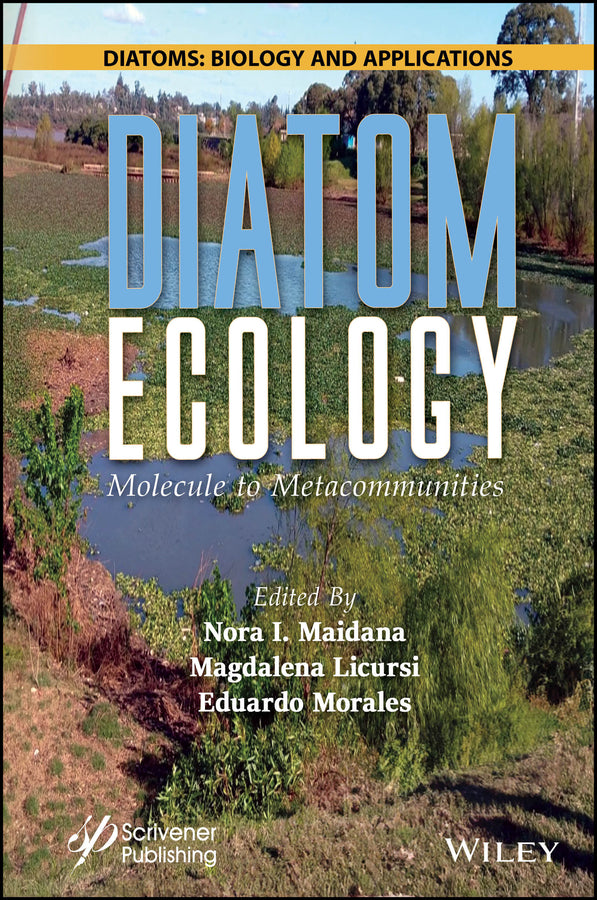
Diatom Ecology
Molecule to Metacommunities
Nora I. Maidana (Edited by), Magdalena Licursi (Edited by), Eduardo Morales (Edited by)
9781394174454, Wiley
Hardback, published 19 September 2024
464 pages
22.9 x 15.2 x 2.5 cm, 1.043 kg
This book offers a comprehensive, unique and up-to-date exploration of diatom ecology spanning from fundamental molecular aspects to the intricate dynamics of metacommunities. In recent years there has been a considerable increase in the amount of research devoted to diatom ecology, with a wide spectrum of approaches. This large amount of information, published in many different journals and books, makes it very difficult to keep up to date, both for the trained researcher and for students. Eduardo A. Morales (d. May 2023) had the original idea to assemble chapters on various subjects within diatom ecology. The questions he posed to potential contributors framed the current book consisting of 12 chapters. Audience
The book is intended primarily for professionals in the fields of diatom research, algal research (phycology), organismal, population and community ecology, limnology, microbiology, organismal biology, paleoecology and paleolimnology. The book will also serve as a reference for graduate students seeking guidance on terminology, techniques, and current methods in diatom research.
Preface xxvii 1 Using Diatoms to Guide Successful Ecological Restoration 1 1.1 Introduction 2 1.2 Components of Successful Ecosystem Restoration 3 1.3 Incorporating Diatoms in Ecological Restoration 8 1.4 Communicating Diatom-Based Indicators of Restoration Progress 24 1.5 Summary and Opportunities 27 2 Abundance-Occupancy Relationships in Freshwaters: The Case of Pond Diatoms 41 2.1 Introduction 42 2.2 Materials and Methods 43 2.3 Results 47 2.4 Discussion 49 3 The Ecology of Diatom Reproduction 59 3.1 Introduction 60 3.2 Reports of Auxosporulation in Natural Populations 63 3.3 Ecological Significance of Auxosporulation 71 3.4 Future Prospects for Phenological Studies 74 4 Deterministic and Stochastic Effects on Freshwater Diatom Biodiversity and Community Composition 85 4.1 Introduction 86 4.2 Deterministic Effects on Diatom Metacommunities 94 4.3 Stochastic Effects on Diatom Metacommunities 98 4.4 Relative Importance of Deterministic and Stochastic Effects on Diatom Metacommunities 100 4.5 Assembly Processes Over Time 102 4.6 Assembly Processes Over Space 104 4.7 Concluding Remarks and Future Directions 105 5 Recent Insights into Diatom Distributions and the Contributions of Molecular Approaches 123 5.1 Introduction 124 5.2 A Metacommunity Framework 142 5.3 Metabarcoding 146 5.4 The Problem of Undersampling 149 5.5 Conclusions 150 6 Diatom Taxonomy: Disentangled from Ecology? 163 6.1 Introduction 164 6.2 Diatom Taxonomy 165 6.3 Diatom Ecology 174 6.4 Where Are the Challenges? 181 6.5 Integrating Information 182 6.6 Conclusions 183 7 Diatom Biodiversity in Urban Freshwater Ecosystems: Opportunities and Challenges for Conservation 203 7.1 Contextualizing Urban and Novel Ecosystems 204 7.2 Diatom Diversity in Novel Freshwater Ecosystems: Insights and Future Directions from a Systematic Literature Review 208 7.3 Mapping Gaps and Opportunities 213 7.4 Ecological Importance of Diatoms in Monitoring and Managing Urban Freshwater Ecosystems 216 7.5 Climate Change and Conservation of Diatom Biodiversity in Urban Systems 217 7.6 New Approaches and Perspectives for the Future 219 8 Guilds for Diatoms: History and Future Prospects 233 8.1 The Origin and History of the Guild Concept 234 8.2 Passy's Idea: Use of the Guild Concept in Diatom Research 236 8.3 Relationship Between Guilds and Environmental Variables 242 8.4 Effect of Global Threatening Processes on Guilds 249 8.5 Diatom Guilds in Plankton and Their Ecological Role 252 8.6 Guild Dispersal, Guild-Based Metacommunity Analysis and Β-Diversity 253 8.7 Guilds in Conservation Biology Studies 258 8.8 Guilds in the Past, Present and Future 260 8.9 Conclusion and Future Directions of the Guild Concept in Diatom Community Ecology 263 9 Soil Diatoms and Their Use in Bioindication 281 9.1 Introduction 282 9.2 Taxonomy 284 9.3 Ecology 291 9.4 Diatoms as Environmental Markers 297 9.5 Soil Diatoms in Forensic Sciences 301 9.6 Future Perspectives 302 10 Lacustrine Diatoms as Paleoclimate Proxies and Their Use in Climate Change Research 329 10.1 Introduction 330 10.2 Lacustrine Diatoms as Archives of Climatic Signals 332 10.3 Diatoms, Limnology and Climate 335 10.4 Conclusions 351 11 Diatoms in Temporary Rivers: Importance in a Global Climate Change Context 361 11.1 Introduction 361 11.2 Diatoms Adaptation Mechanisms in Temporary Rivers 366 11.3 Flow Reduction/Lentification 370 11.4 Desiccation Stress 372 11.5 Thermal Stress 374 11.6 UV Radiation Exposure 376 11.7 Community Dynamics in Temporary Rivers 380 11.8 Diatoms as Bioindicators in Temporary Rivers 382 11.9 Final Remarks 382 12 The Ecology of Diatoms in Peatlands: Communities from Tierra del Fuego Peat Bogs as a Study Case 393 12.1 Introduction 394 12.2 Singularity of Peatland Diatoms 396 12.3 Diatoms in Tierra del Fuego Peat Bogs 400 12.4 Closing Remarks and Future Perspectives 409 References 410 Index 421
Evelyn E. Gaiser
Saúl Blanco, María Borrego-Ramos and Óscar Fernández-Ramos
David G. Mann and Mark B. Edlund
Xavier Benito, Sophia I. Passy, Annika Vilmi, Aurélien Jamoneau, Juliette Tison-Rosebery, Maria Kahlert, Chad A. Larson, Joseph L. Mruzek, Janne Soininen and Andrew Bramburger
Jana Kulichová and Rosa Trobajo
Eileen J. Cox
Majoi de Novaes Nascimento and Luciane Fontana
Csilla Stenger-Kovács and Viktória B-Béres
Jasper Foets and Eveline Pinseel
Gabriela S. Hassan
Maria Helena Novais and Manuela Morais
Valeria Casa, María V. Quiroga, Bart Van de Vijver and Gabriela Mataloni
Subject Areas: Science: general issues [PD]