Freshly Printed - allow 10 days lead
Couldn't load pickup availability
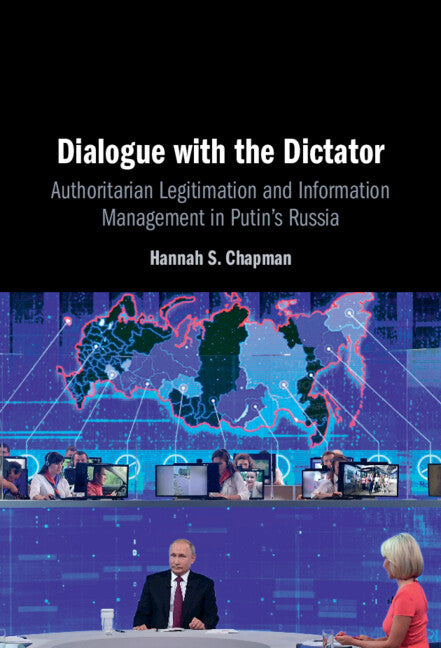
Dialogue with the Dictator
Authoritarian Legitimation and Information Management in Putin's Russia
Illuminates how autocrats structure interaction between citizens and leaders to manage information dilemmas and build regime legitimacy.
Hannah S. Chapman (Author)
9781009427524, Cambridge University Press
Hardback, published 22 February 2024
270 pages
23.5 x 15.8 x 2.2 cm, 0.55 kg
'[A]n ambitious and comprehensive book that makes a significant contribution to our understanding of contemporary autocracies. By illuminating how and why non-democratic regimes use seemingly democratic practices to entrench their control over society, it helps explain the autocrats' resilience. … the theoretical framework and empirical findings offer valuable lessons for making sense of authoritarian governance around the world. Chapman's insights are particularly pertinent for our digital age, as autocrats adapt new technologies to the enduring problem of maintaining their hold on power.' Dima Kortukov, Europe-Asia Studies
Dialogue with the Dictator illuminates the ways in which authoritarian regimes structure interaction between citizens and leaders to simultaneously manage information dilemmas and build regime legitimacy. In doing so, it demonstrates the conditions under which managed participation can reinforce or jeopardize authoritarian control. Chapters uncover how these tools are viewed from the perspective of the public and the mechanisms through which they influence attitudes toward authorities. By cultivating limited opportunities for participation in otherwise closed political systems, autocrats bolster regime legitimacy while still maintaining control of the means and content of communication. These tools ultimately reinforce and entrench autocratic leaders rather than contributing to increased prospects for democracy – but not without consequences. Combining interviews, original surveys, and text analysis, the book provides a novel theoretical framework for understanding managed participation under authoritarianism and explains both its benefits and potential consequences for authoritarian regimes.
1. Introduction
2. A Theory of Participatory Technologies
3 Varieties of Participatory Technologies in Non-Democracies
4. The Direct Line with Vladimir Putin
5. Information Management, Performative Governance, and Image Making in The Direct Line
6. Manufacturing Consent: The Impact of Participatory Technologies on Political Attitudes
7. Who Buys In? The Conditional and Polarizing Effects of Participatory Technologies
8. Conclusion.
Subject Areas: Constitution: government & the state [JPHC]